
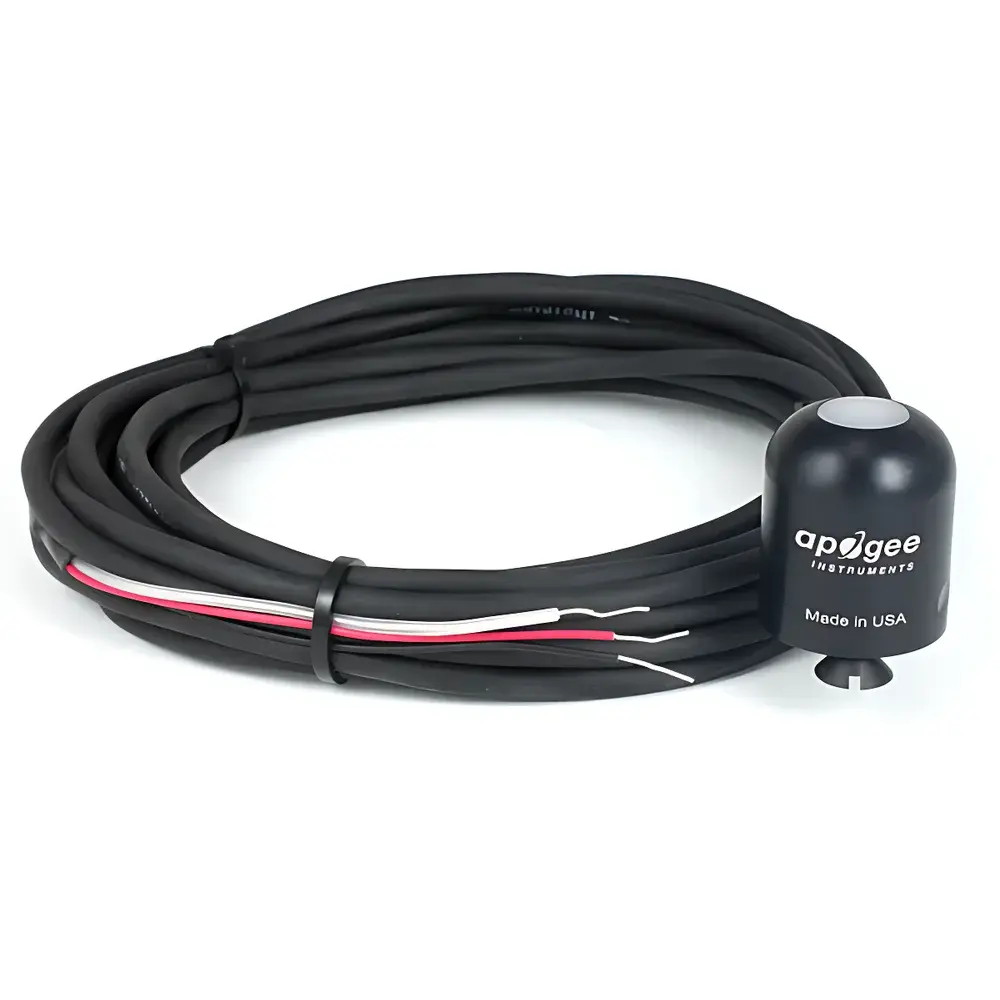
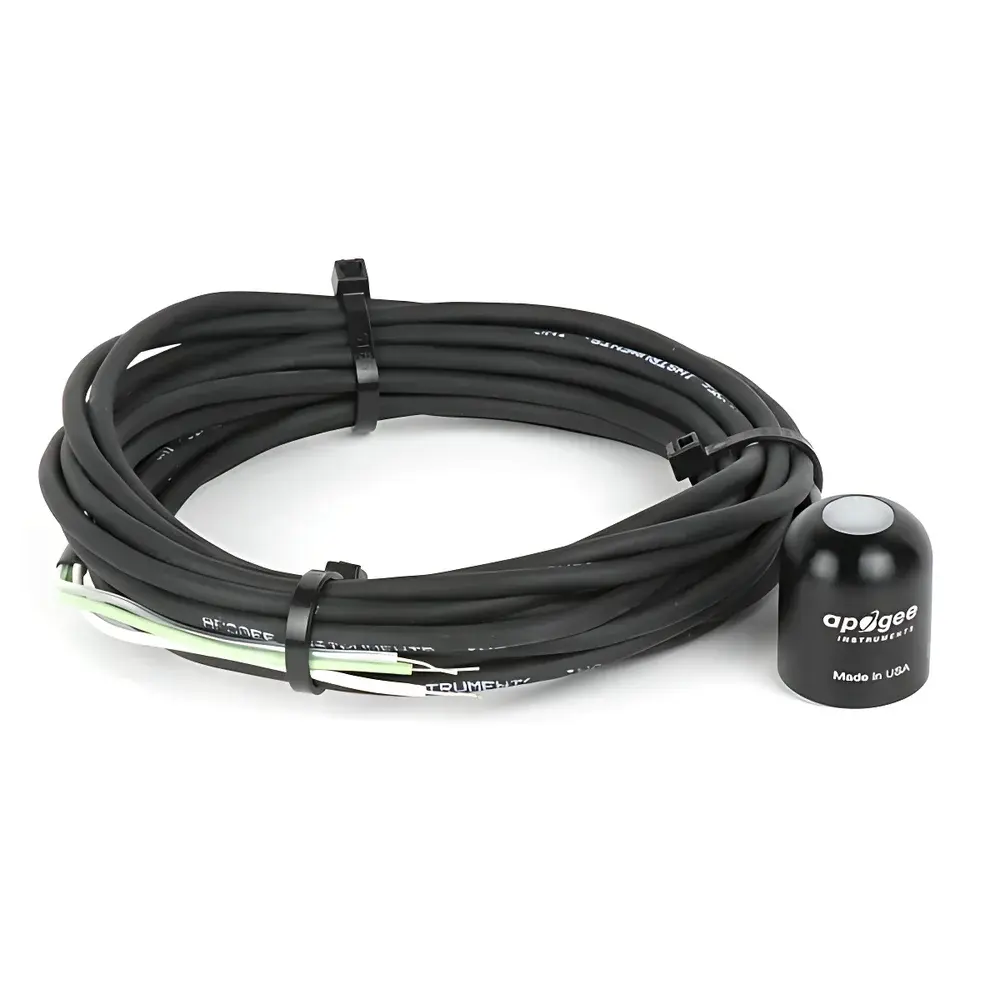
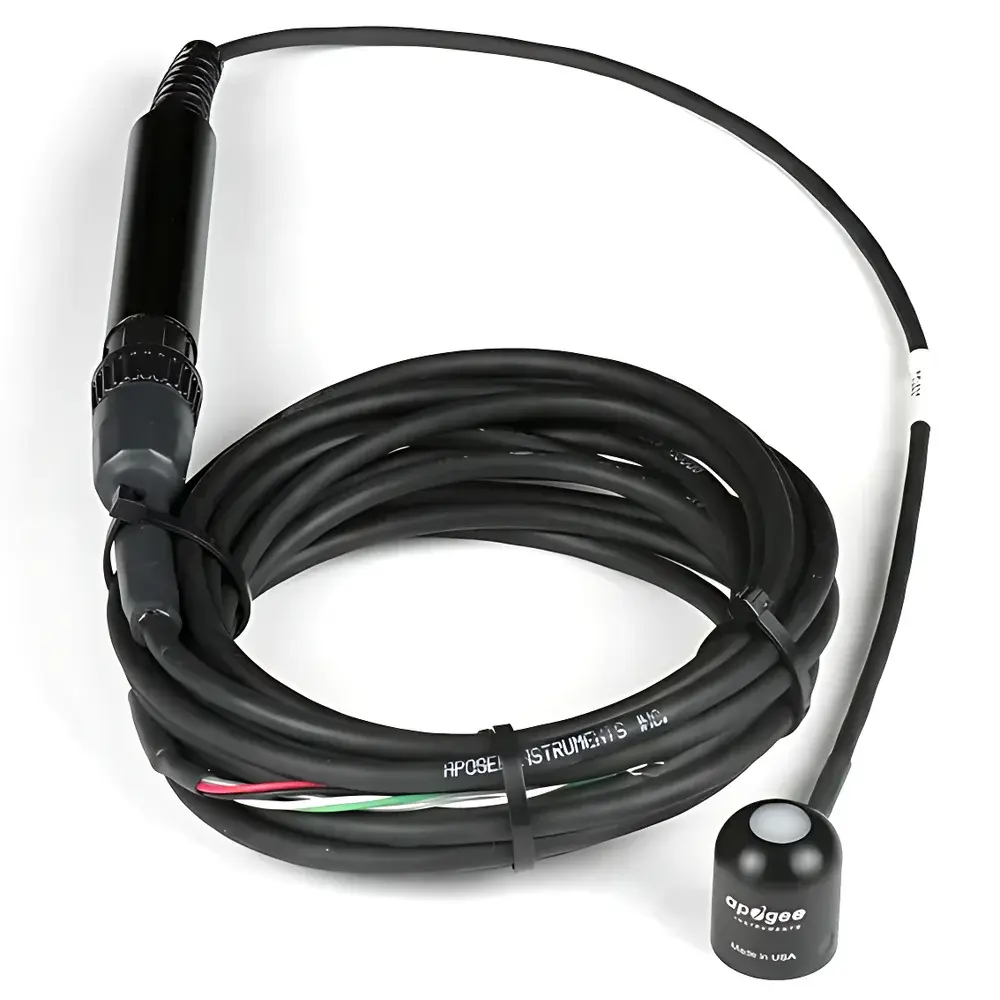
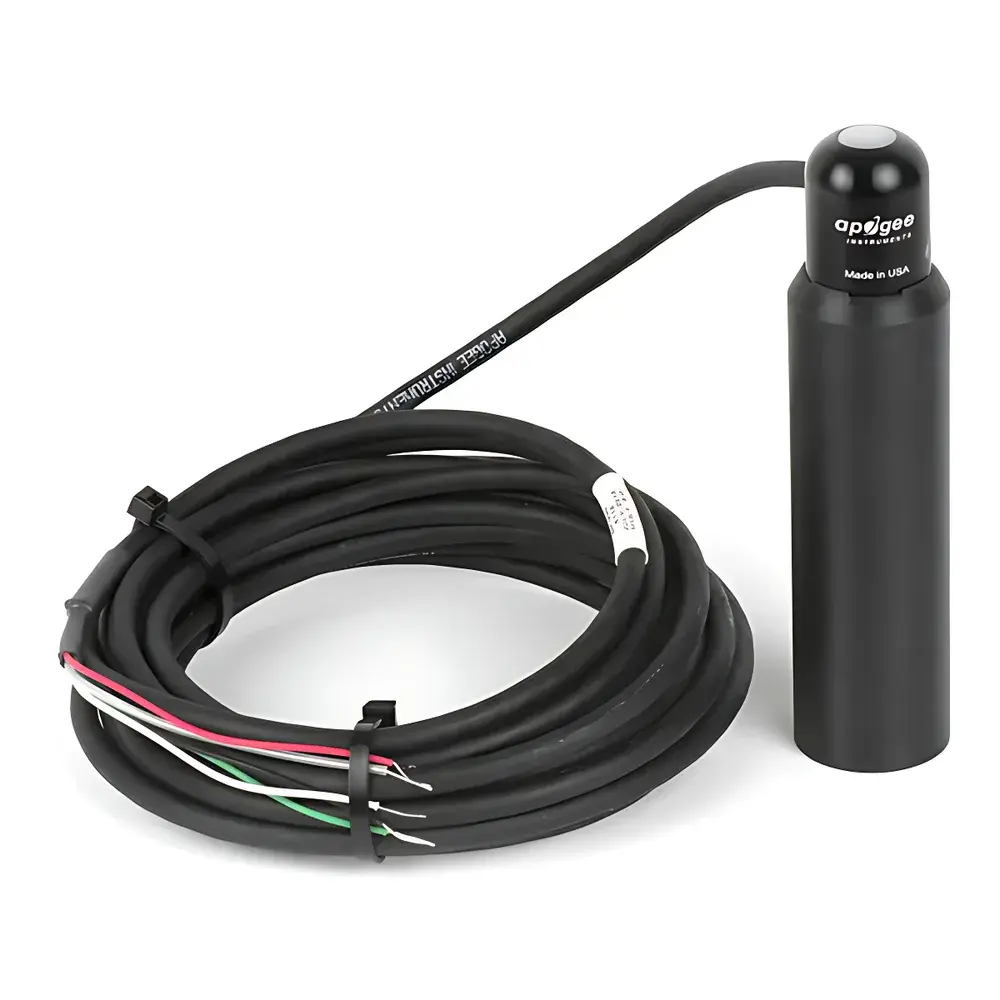
Apogee SP Series Shortwave Pyranometers
| Brand | Apogee |
|---|---|
| Origin | USA |
| Model | SP-110 / SP-212 / SP-214 / SP-215 / SP-230 |
| Output Types | mV (SP-110, SP-230), 0–2.5 V (SP-212), 4–20 mA (SP-214), 0–5 V (SP-215) |
| Spectral Range | 360–1120 nm |
| Field of View | 180° |
| Sensitivity | 0.2 mV/(W·m⁻²) (SP-110, SP-230), 2.0 mV/(W·m⁻²) (SP-212), 0.013 mA/(W·m⁻²) (SP-214), 4.0 mV/(W·m⁻²) (SP-215) |
| Calibration Uncertainty | ±5% |
| Nonlinearity | <1% (0–1250 or 0–1750 W·m⁻², model-dependent) |
| Response Time | <1 ms |
| Directional Error @75° | ±5% |
| Temperature Response | −0.04 ± 0.04 %/°C |
| Operating Environment | −40 to +70 °C, 0–100 % RH |
| Long-Term Drift | <2 %/year |
| Repeatability | <1% |
| Housing Dimensions | Ø24 mm × 28 mm |
| Weight (with 5 m cable) | 90 g (SP-110, SP-212, SP-215, SP-230), 140 g (SP-214) |
| Warranty | 4 years |
Overview
The Apogee SP Series Shortwave Pyranometers are precision-calibrated, thermopile-based sensors engineered for accurate measurement of global shortwave solar irradiance (360–1120 nm) under natural outdoor conditions. Utilizing a blackened thermopile detector with a fused silica diffuser and cosine-corrected optical design, each sensor conforms to ISO 9060:2018 classification as a “Secondary Standard” pyranometer—ensuring traceable performance for meteorological monitoring, agronomic research, photovoltaic system performance validation, and climate science applications. The series comprises five models differentiated by output signal type and internal electronics: the self-powered SP-110 (mV), the voltage-output SP-212 (0–2.5 V) and SP-215 (0–5 V), the current-loop SP-214 (4–20 mA), and the heated SP-230 (mV) optimized for frost- and dew-prone environments. All models feature rapid thermal equilibrium (<1 ms response), minimal temperature dependence (−0.04 ± 0.04 %/°C), and robust aluminum housings rated for continuous operation from −40 to +70 °C and 0–100 % relative humidity.
Key Features
- Thermopile detector with spectrally flat response across 360–1120 nm, aligned with the ASTM G173-03 solar reference spectrum
- Cosine-corrected fused silica diffuser enabling directional error ≤ ±5% at 75° zenith angle—critical for low-sun-angle accuracy
- Secondary Standard classification per ISO 9060:2018, supporting traceability to WRR (World Radiometric Reference)
- Five output configurations: millivolt (SP-110, SP-230), analog voltage (SP-212, SP-215), and loop-powered 4–20 mA (SP-214)
- Integrated heater in SP-230 model prevents dew/frost accumulation without compromising thermal stability or calibration integrity
- Nonlinearity <1% over full operational range (0–1250 W·m⁻² for SP-212/214/215; 0–1750 W·m⁻² for SP-110/230)
- Long-term stability <2 % deviation per year—validated via accelerated aging and field intercomparison protocols
- Compact form factor (Ø24 mm × 28 mm) with IP68-rated sealing and UV-stabilized housing for permanent outdoor deployment
Sample Compatibility & Compliance
The SP Series is designed for direct exposure to unobstructed hemispherical sky radiation and is compatible with all standard mounting hardware (e.g., leveling bases, solar trackers, and weather station booms). It requires no external power for SP-110 and SP-230 models; SP-212, SP-214, and SP-215 operate within wide input voltage ranges (2.5–24 V DC, 5–36 V DC, and 5–24 V DC respectively) to accommodate diverse data logger architectures—including Campbell Scientific, Onset HOBO, Delta-T Devices, and custom SCADA systems. All units comply with IEC 61724-1:2021 for PV system monitoring, meet environmental stress requirements per MIL-STD-810G Method 509.6 (humidity) and Method 502.6 (temperature), and support GLP-aligned calibration documentation including NIST-traceable certificates with individual serial-numbered calibration coefficients.
Software & Data Management
While the SP Series operates as a passive analog sensor requiring no embedded firmware or configuration software, its output signals integrate seamlessly into industry-standard data acquisition platforms. Voltage and current outputs are compatible with 16-bit or higher resolution ADCs, and raw mV readings can be converted to irradiance (W·m⁻²) using the factory-provided calibration coefficient (e.g., 5.0 W·m⁻² = 1 mV for SP-110). Apogee provides comprehensive technical documentation—including datasheets, calibration reports, mounting guides, and uncertainty budget templates—to support audit-ready data processing workflows. For users implementing automated QA/QC, the consistent repeatability (<1%) and low drift (<2%/year) enable long-term trend analysis without frequent recalibration, reducing operational overhead in multi-year environmental studies.
Applications
- Solar resource assessment for utility-scale photovoltaic site selection and yield modeling
- Real-time performance ratio (PR) monitoring in operational PV plants per IEC 61724-1
- Surface energy balance studies in eddy covariance flux towers and micrometeorological networks
- Controlled-environment agriculture (CEA) and greenhouse light management systems
- Albedo and surface reflectance characterization in cryospheric and land-surface modeling
- Educational laboratories requiring ISO-compliant irradiance measurement with minimal setup complexity
FAQ
What is the difference between SP-212 and SP-215?
The SP-212 outputs a 0–2.5 V signal, while the SP-215 outputs a 0–5 V signal—both scaled linearly to irradiance. Select SP-212 for compatibility with loggers accepting lower-voltage inputs; choose SP-215 when higher signal-to-noise ratio or longer cable runs are required.
Does the SP-230 require continuous power to maintain heater operation?
Yes—the SP-230 heater draws 15 mA at 12 V DC and must be powered continuously during periods of potential condensation or sub-zero ambient temperatures to prevent optical obscuration.
Can SP-series pyranometers be used underwater or in high-humidity enclosures?
No—these sensors are rated for outdoor atmospheric exposure only. While IP68-rated against rain and dust, they are not submersible and lack pressure compensation for immersion.
Is recalibration required annually?
Not strictly required. With <2 %/year long-term drift and documented stability, recalibration every 2 years is recommended for critical applications; annual verification against a reference standard is sufficient for most research-grade deployments.
How is cosine response verified during calibration?
Each unit undergoes angular responsivity testing at discrete zenith angles (0° to 80°) using a collimated source in a darkroom facility, with deviations reported in the certificate of calibration per ISO 9060 Annex E.
Related Products







