
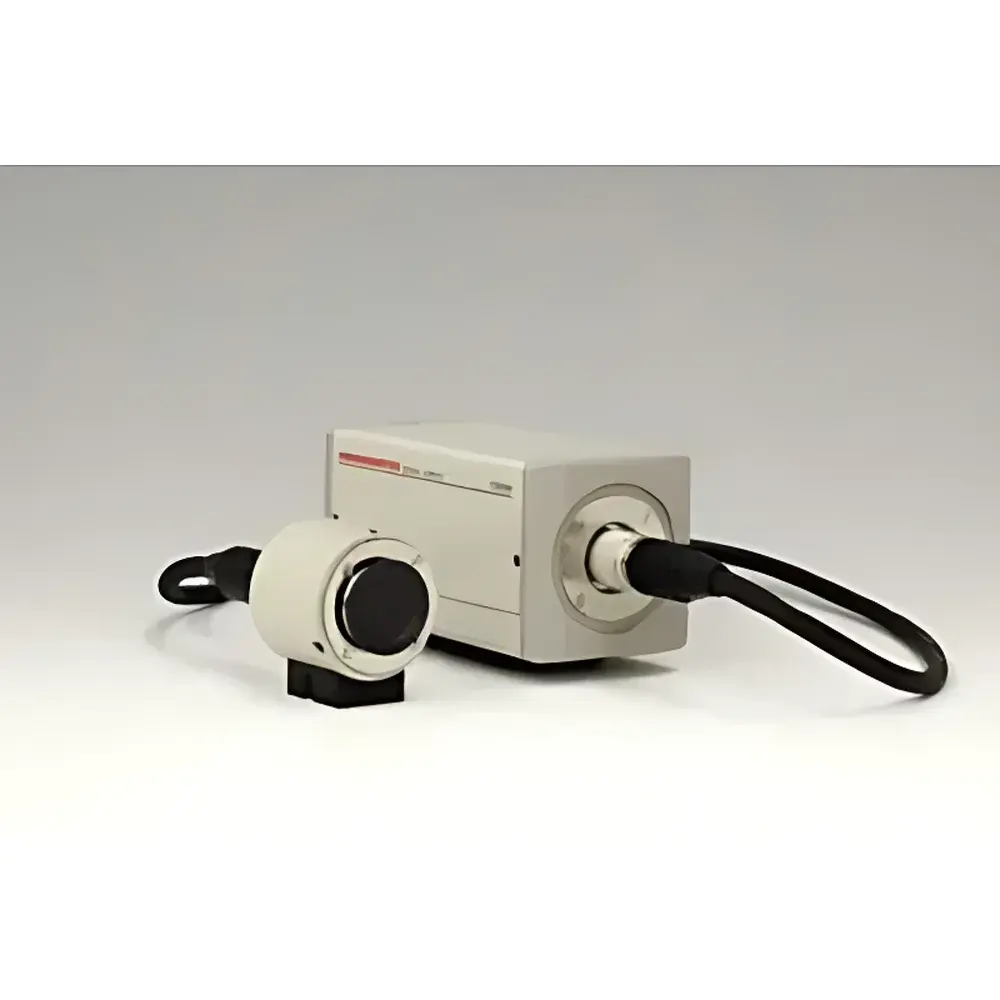
Hamamatsu C8484-16C UV-Sensitive Interline CCD Camera
| Brand | Hamamatsu |
|---|---|
| Origin | Japan |
| Manufacturer Type | Original Equipment Manufacturer (OEM) |
| Import Status | Imported |
| Model | C8484-16C |
| Spectral Range | 200–1000 nm |
| Quantum Efficiency | 40% @ 200 nm, 30% @ 250 nm |
| Sensor Format | 1/2-inch interline CCD with microlens array |
| Resolution | 1344 (H) × 1024 (V) pixels |
| Pixel Size | 4.65 µm × 4.65 µm |
| Active Area | 6.25 mm (H) × 4.76 mm (V) |
| Readout Speed | 11.9 fps |
| Read Noise | 14 e⁻ rms (typ.) |
| Exposure Time | 12.4 µs – 1 s |
| Dynamic Range | 778:1 |
| Analog Gain | 1×, 5× |
| Subarray Mode | 1344 (H) × 8–1024 (V), step 8 rows |
| Binning | 2×2, 4×4 |
| Trigger Input | External TTL-compatible |
| Interface | Camera Link |
| A/D Resolution | 12-bit |
| Mount | C-mount |
| Power Supply | DC +12 V |
| Power Consumption | 10 W |
| Operating Temperature | +10 °C to +40 °C |
| Storage Temperature | −10 °C to +50 °C |
| Relative Humidity | ≤70% RH (non-condensing) |
Overview
The Hamamatsu C8484-16C is a high-performance, UV-optimized interline transfer CCD camera engineered for quantitative low-light imaging across the deep ultraviolet to near-infrared spectrum (200–1000 nm). Unlike standard silicon-based CCDs—whose quantum efficiency (QE) drops sharply below 350 nm—the C8484-16C incorporates a specialized UV-enhanced coating and microlens array to achieve 40% QE at 200 nm and 30% at 250 nm, enabling reliable detection of weak UV emissions from plasmas, fluorescence, ozone absorption bands, and photochemical reaction intermediates. Its 1344 × 1024 pixel resolution, combined with a compact 4.65 µm pixel pitch and 1/2-inch optical format, delivers high spatial fidelity without compromising field-of-view compatibility with standard C-mount optics. The absence of a mechanical shutter and support for continuous interline scanning ensure stable, jitter-free acquisition in time-resolved applications such as pulsed laser-induced fluorescence or UV spectroscopy synchronization.
Key Features
- UV-optimized quantum efficiency: 40% at 200 nm, validated per Hamamatsu’s spectral response calibration data sheet (PN: S12807-01)
- Interline CCD architecture with vertical overflow drain (VOD) structure—suppresses blooming during overexposure of bright UV sources (e.g., mercury lamp lines or arc plasma emission)
- Low-noise readout electronics: 14 e⁻ rms typical read noise at full-frame 11.9 fps, optimized for photon-starved UV imaging where signal-to-noise ratio is critical
- 12-bit digitization with dual analog gain settings (1×, 5×) enabling flexible dynamic range adaptation without hardware modification
- Subarray and binning modes: configurable ROI readout (1344 × 8–1024, step 8 rows) and on-chip 2×2 / 4×4 binning for increased sensitivity or frame-rate acceleration
- Camera Link interface (Base configuration) ensures deterministic latency, precise trigger synchronization, and robust data throughput up to 255 MB/s—essential for integration into automated inspection or synchrotron beamline systems
Sample Compatibility & Compliance
The C8484-16C is designed for use in controlled laboratory and industrial environments compliant with IEC 61000-6-3 (EMC emission limits) and IEC 61000-6-2 (immunity requirements). Its sealed aluminum housing and thermal design support operation within ISO Class 5 cleanroom-adjacent conditions (per ISO 14644-1), provided ambient humidity remains below 70% RH non-condensing. While not intrinsically rated for hazardous locations, the camera meets CE marking requirements for measurement equipment under the Low Voltage Directive (2014/35/EU) and RoHS 3 (2015/863/EU). It is routinely deployed in applications requiring traceable calibration—including UV radiometry setups aligned to NIST-traceable standards—and supports GLP-compliant documentation when integrated with timestamped metadata via Camera Link GenICam-compliant drivers.
Software & Data Management
Hamamatsu provides native SDKs for Windows (C/C++, .NET, LabVIEW) and Linux (C/C++), supporting GenICam v2.2 protocol compliance for seamless integration with third-party image acquisition platforms (e.g., MATLAB Image Acquisition Toolbox, HALCON, or custom Python-based pipelines using PyCapture2 or harvesters). All acquired frames embed EXIF-like metadata—including exposure time, gain setting, temperature sensor reading, and trigger source status—enabling audit-ready data provenance. Raw 12-bit data is preserved without compression; optional on-the-fly conversion to TIFF or HDF5 formats supports long-term archival in accordance with FAIR (Findable, Accessible, Interoperable, Reusable) data principles. For regulated environments, the camera’s deterministic trigger response (< 1 µs jitter) and hardware timestamping capability facilitate alignment with FDA 21 CFR Part 11-compliant electronic record systems when paired with validated acquisition software.
Applications
- UV fluorescence microscopy of semiconductor defects, biological fluorophores (e.g., tryptophan, NADH), and thin-film coatings
- In-line UV inspection of PCB solder mask integrity, UV-curable adhesive curing uniformity, and pharmaceutical tablet coating homogeneity
- Spectral imaging in UV-VIS spectrometers (200–400 nm region), particularly for ozone monitoring (253.7 nm), NO₂ detection (350–450 nm), and plasma diagnostics
- Time-resolved UV luminescence studies in materials science—e.g., persistent phosphors, scintillators, and wide-bandgap semiconductors (GaN, AlN)
- Synchrotron beamline end-stations requiring radiation-hardened, low-dark-current imaging in vacuum-adjacent enclosures
FAQ
Is the C8484-16C suitable for vacuum environments?
No—it is rated for ambient atmospheric operation only; for ultra-high-vacuum applications, Hamamatsu recommends the C11440 series back-illuminated sCMOS cameras with vacuum-compatible variants.
Can the camera be synchronized with external laser pulses?
Yes—via TTL-compatible external trigger input with sub-microsecond timing precision; programmable exposure delay and width enable precise gating relative to Q-switched or mode-locked lasers.
Does the camera support cooling for dark current reduction?
No—this model operates at ambient temperature; for applications requiring <0.01 e⁻/pix/s dark current, consider the water-cooled C12741 series or thermoelectrically cooled C11090 models.
What lens mount options are available beyond C-mount?
C-mount is standard; F-mount or M42 adapters are available as mechanical accessories but require verification of back focal distance compatibility and potential vignetting at extreme UV wavelengths.
Is firmware upgrade capability supported in the field?
Yes—firmware updates are delivered via Hamamatsu’s official SDK package and applied through the host PC using the included configuration utility; no hardware rework is required.





