
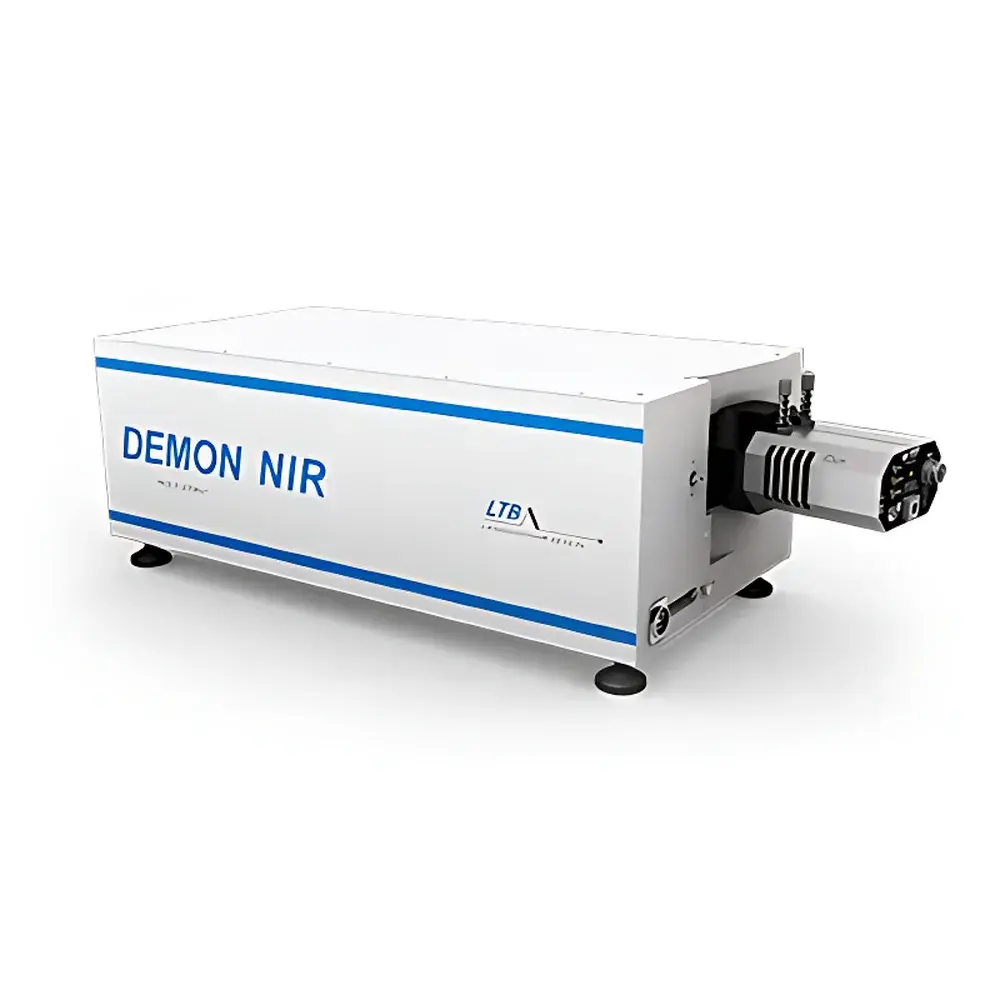
LTB DEMON NIR Laser-Induced Breakdown Spectroscopy (LIBS) Spectrometer
| Brand | LTB |
|---|---|
| Origin | Germany |
| Model | DEMON NIR Series |
| Form Factor | Benchtop |
| Integration | Integrated Monolithic Design |
| Optical Configuration | Littrow-Mounted Echelle Spectrometer with Dual Grating Architecture |
| Wavelength Range | 600–1700 nm |
| Spectral Resolution (λ/Δλ) | >60,000 (e.g., <0.026 nm @ 1550 nm, <0.01 nm @ 600 nm, 0.011 nm @ 656 nm) |
| Linear Dispersion | λ/90,000 |
| Minimum Measurable FWHM | ≤0.014 nm @ 800 nm |
| Spectral Window | 2.5–8 nm (wavelength-dependent) |
| Detector Interface | Scientific-grade InGaAs area detector (16-bit) |
| Relative Aperture | f/10 |
| Minimum Exposure Time | 1 ms (CCD-compatible) |
| Stray Light Level | Ultra-low (optimized Littrow echelle optical path) |
| Absolute Wavelength Accuracy | Pixel dispersion × 10 pixels |
| Active Wavelength Stabilization | Built-in Hg reference lamp + automated self-calibration |
| Control Interface | Full PC-based motorized control via USB/Ethernet |
| Dimensions (L×W×H) | 600 × 310 × 230 mm |
| Weight | 25 kg |
| Software Platform | SOPHI spectral acquisition & analysis suite (LabVIEW driver optional) |
Overview
The LTB DEMON NIR is a benchtop, monolithically integrated echelle spectrometer engineered for ultra-high-resolution laser-induced breakdown spectroscopy (LIBS) and precision emission/absorption spectroscopy in the near-infrared (NIR) spectral region (600–1700 nm). Based on a rigorously optimized Littrow-mounted dual-grating echelle architecture—combining a prism pre-monochromator with a high-efficiency echelle grating and an off-axis parabolic imaging mirror system—the DEMON NIR achieves exceptional spectral fidelity through minimized optical aberrations, ultra-low stray light (<10⁻⁵ relative intensity), and diffraction-limited imaging performance. Its core design principle prioritizes absolute wavelength stability and reproducibility: an internal mercury (Hg) spectral reference source enables fully automated, real-time wavelength calibration at user-defined intervals, ensuring long-term measurement integrity without manual intervention. This architecture delivers a resolving power exceeding λ/Δλ = 60,000 (e.g., 0.011 nm FWHM at 656 nm), making it uniquely suited for isotopic shift resolution—such as hydrogen/deuterium/tritium (H/D/T) line separation—and fine-structure analysis of atomic and ionic transitions in complex plasmas.
Key Features
- Monolithic, vibration-damped mechanical housing ensures thermal and mechanical stability across extended acquisition periods.
- Littrow echelle optical path with UV–NIR broadband high-reflectivity coated off-axis parabolic mirrors guarantees uniform imaging quality and minimal polarization sensitivity across the full operational range.
- Active wavelength stabilization via integrated Hg lamp and software-driven auto-calibration routine maintains absolute accuracy within ±0.005 nm over 24-hour continuous operation.
- High-throughput f/10 optical design maximizes photon collection efficiency—critical for low-energy LIBS plasma emissions and weak NIR absorption features.
- Motorized, fully programmable slit and grating positioning enable rapid reconfiguration between spectral windows (2.5–8 nm width, selectable by center wavelength).
- Native compatibility with scientific InGaAs area detectors (16-bit dynamic range) and optional CCD variants supports flexible signal-to-noise optimization for both pulsed and CW sources.
- Sub-millisecond exposure control (down to 1 ms) synchronized with external trigger inputs facilitates time-resolved plasma diagnostics and gated LIBS applications.
Sample Compatibility & Compliance
The DEMON NIR is designed for direct coupling to LIBS plasma sources, inductively coupled plasma (ICP) emission systems, tunable diode laser absorption setups, and solid-state or semiconductor laser characterization platforms. Its robust optical train tolerates moderate ambient temperature fluctuations (15–30 °C) and is compatible with standard 400 µm core NIR optical fibers (FC/PC or SMA connectors). From a regulatory standpoint, the instrument’s deterministic calibration traceability—anchored to NIST-traceable Hg emission lines—supports compliance with ISO/IEC 17025 analytical laboratory requirements. Data acquisition workflows implemented in SOPHI software are configurable to meet audit trail and electronic signature prerequisites aligned with FDA 21 CFR Part 11 for regulated environments. The system operates without hazardous materials and conforms to CE, RoHS, and IEC 61010-1 safety standards.
Software & Data Management
SOPHI is a modular, Windows-based spectral acquisition and analysis platform developed exclusively for LTB echelle instruments. It provides real-time spectrum visualization, multi-channel baseline correction, peak fitting (Voigt, Gaussian, Lorentzian), isotopic ratio quantification (e.g., D/H), and automated line identification against NIST Atomic Spectra Database (ASD) libraries. Raw data are saved in HDF5 format with embedded metadata (wavelength calibration coefficients, exposure parameters, detector gain, timestamp, instrument serial number), ensuring FAIR (Findable, Accessible, Interoperable, Reusable) data principles. A LabVIEW driver package is available for integration into custom automation frameworks, including PLC-triggered LIBS mapping systems and closed-loop process control architectures. All calibration logs, spectral acquisitions, and user actions are recorded in tamper-evident audit trails compliant with GLP/GMP documentation protocols.
Applications
- Quantitative and isotopic LIBS analysis of nuclear materials (e.g., uranium/plutonium isotopic fingerprinting in safeguards verification).
- Time-resolved plasma diagnostics in laser ablation experiments, including electron temperature and density estimation from Stark-broadened line profiles.
- NIR absorption spectroscopy of molecular gases (CH₄, NH₃, CO, H₂O) for environmental monitoring and combustion research.
- High-resolution characterization of diode-pumped solid-state (DPSS) and quantum cascade lasers (QCLs), including mode structure, linewidth, and drift behavior.
- Elemental mapping of geological samples, alloys, and thin-film semiconductors using spatially resolved LIBS coupled with XYZ scanning stages.
- Fundamental atomic physics studies requiring sub-picometer spectral discrimination—particularly in hydrogenic and helium-like ion spectra.
FAQ
What spectral resolution can be achieved at 1550 nm?
At 1550 nm, the DEMON NIR delivers a full-width-at-half-maximum (FWHM) resolution of 60,000.
Is active wavelength calibration mandatory for daily operation?
While passive stability is excellent, active calibration using the internal Hg lamp is recommended before each analytical session or after significant ambient temperature shifts (>2 °C) to maintain sub-pixel absolute accuracy.
Can the DEMON NIR be coupled to a time-gated ICCD detector?
Yes—the spectrometer supports external TTL triggering and delay synchronization; however, optimal performance in gated LIBS requires matching the detector’s gate width and jitter specifications with the instrument’s mechanical response time.
Does SOPHI support batch processing of large LIBS hyperspectral datasets?
Yes—SOPHI includes scripting capabilities (Python API) and parallelized peak integration engines capable of processing >10,000 spectra/hour on standard workstation hardware.
What is the typical warm-up time to achieve thermal equilibrium?
The optical bench reaches thermal equilibrium within 30 minutes of power-on under stable ambient conditions; full wavelength stability is achieved after 45 minutes.
Related Products





