
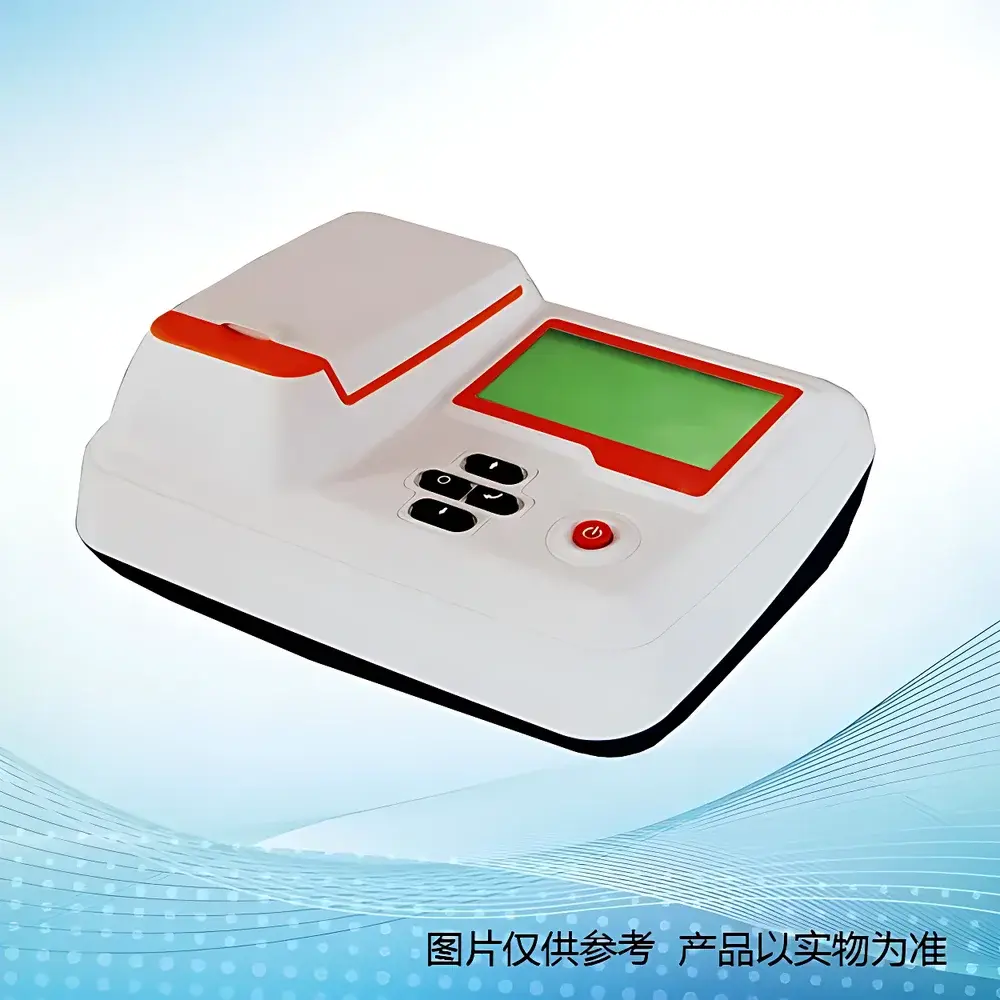
Food Safety Rapid Detector for Formaldehyde Sulfoxylate (Rongalite) – Jida Xiaotian’e GDYQ-100A2
| Brand | Jida Xiaotian’e |
|---|---|
| Model | GDYQ-100A2 |
| Origin | Jilin, China |
| Manufacturer Type | Direct Manufacturer |
| Country of Origin | China |
| Detection Limit | 5.0 mg/kg |
| Measurement Range | 0.0–500.0 mg/kg |
| Accuracy | ±2% |
| Assay Time | ≤10 min per sample |
| Display | Backlit LCD with Chinese interface |
| Control System | Embedded MCU with data logging, parameter configuration, statistical analysis, and USB/RS232 connectivity |
| Sample Prep | Dedicated extraction kit and single-use reagent cartridges |
| Compliance | Designed per GB 5009.287–2023 (National Food Safety Standard – Determination of Formaldehyde Sulfoxylate in Foods) |
Overview
The Jida Xiaotian’e GDYQ-100A2 Food Safety Rapid Detector for Formaldehyde Sulfoxylate (commonly known as “Diaobai Kuai” or Rongalite) is a dedicated quantitative analytical instrument engineered for routine screening and regulatory compliance testing of adulterated food matrices. It implements a standardized colorimetric assay based on the acidic hydrolysis of formaldehyde sulfoxylate to release formaldehyde, followed by chromogenic reaction with acetylacetone under controlled thermal conditions—principally aligned with the methodology specified in GB 5009.287–2023, China’s national standard for formaldehyde sulfoxylate determination in foods. Unlike generic spectrophotometers, the GDYQ-100A2 integrates hardware-optimized optical path design, temperature-stabilized reaction chambers, and factory-calibrated absorbance referencing to ensure reproducible quantification across diverse food substrates—including starch-based products (e.g., rice noodles, vermicelli), tofu, bean curd sheets, and dried seafood—where illegal bleaching or preservation with rongalite poses documented public health risks.
Key Features
- Quantitative detection within 10 minutes per sample, enabling high-throughput laboratory or on-site field deployment
- Embedded microcontroller unit (MCU) architecture supporting real-time data acquisition, automatic curve fitting, and internal calibration validation
- Backlit monochrome LCD display with native Chinese menu navigation—designed for operational efficiency in domestic food safety inspection agencies and QC laboratories
- Dedicated sample preparation module including centrifuge-compatible extraction tubes, pH-adjusted buffers, and pre-measured, lyophilized reagent cartridges to minimize operator variability
- Integrated data management: stores up to 1,000 test records with timestamp, sample ID, operator code, and raw absorbance values; exportable via USB or RS232 to LIMS or Excel-compatible formats
- Self-diagnostic routines for optical source stability, cuvette alignment verification, and reagent expiration tracking
Sample Compatibility & Compliance
The GDYQ-100A2 is validated for use with solid, semi-solid, and homogenized liquid food samples requiring minimal pretreatment—typically involving solvent-assisted extraction, centrifugation, and supernatant dilution. Its measurement range (0.0–500.0 mg/kg) and detection limit (5.0 mg/kg) satisfy the sensitivity requirements for enforcement-level monitoring under China’s current food safety regulations. While not certified to ISO/IEC 17025 for accredited testing, the instrument’s operational protocol conforms to the procedural rigor outlined in GB 5009.287–2023, and its performance characteristics (±2% accuracy at mid-range concentrations) are verified using NIST-traceable formaldehyde reference standards. For laboratories operating under GLP or GMP frameworks, audit trails—including method version logs, calibration history, and user access timestamps—are retained locally and exportable for regulatory review.
Software & Data Management
The onboard firmware supports multi-level user authentication (administrator/operator modes), configurable pass/fail thresholds, and batch-wise statistical reporting (mean, SD, CV%). All measurement sessions generate immutable records containing absorbance at 412 nm, calculated concentration, and QC flag status (e.g., “out-of-linear-range”, “reagent expired”). Data export adheres to CSV format with UTF-8 encoding, preserving Chinese characters for sample descriptors. No cloud dependency or proprietary software installation is required—raw files are directly readable in spreadsheet applications. For integration into enterprise systems, the RS232 interface supports Modbus RTU protocol, enabling bidirectional communication with central lab information management systems (LIMS) compliant with FDA 21 CFR Part 11 when deployed with supplementary electronic signature and audit trail modules.
Applications
- Routine surveillance of starch-based staples (e.g., wheat gluten, konjac jelly, tapioca pearls) for undeclared rongalite use
- Verification testing in food processing facilities subject to HACCP plan validation
- Field-deployable verification during market supervision campaigns targeting informal food vendors
- Teaching and method development in food science curricula focusing on adulterant detection principles
- Pre-screening prior to confirmatory analysis by LC-MS/MS or GC-MS in reference laboratories
FAQ
What is the principle behind the GDYQ-100A2’s detection method?
It relies on acid-catalyzed hydrolysis of formaldehyde sulfoxylate to formaldehyde, followed by derivatization with acetylacetone under boiling water bath conditions to form a yellow chromophore measured at 412 nm.
Can the instrument be used for regulatory reporting without further confirmation?
Results are admissible for preliminary enforcement actions per local food safety authorities’ protocols; however, positive findings above action limits require confirmatory analysis by chromatographic methods per GB 5009.287–2023 Annex B.
Is third-party calibration certification available?
Jida Xiaotian’e provides factory calibration certificates traceable to national metrological standards; external ISO/IEC 17025 calibration services are offered through authorized regional metrology institutes upon request.
How often must the optical system be recalibrated?
Baseline calibration is performed automatically at power-on; full photometric calibration using supplied neutral density filters is recommended every 30 days or after 200 measurements.
Does the system support multi-language firmware beyond Chinese?
Firmware is currently localized exclusively for Chinese-language operation; English UI is not supported in this model variant.






