
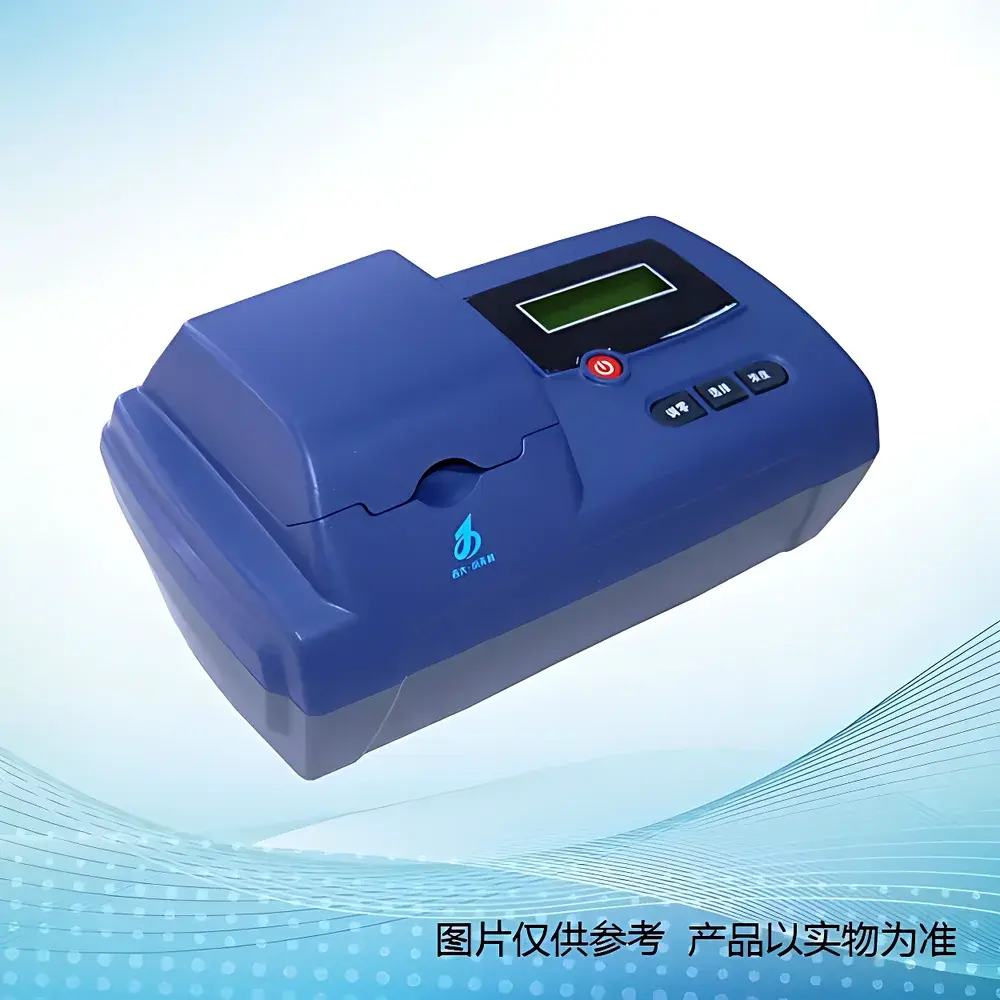
Jiada Xiaotian’e GDYS-601S Six-Parameter Portable Water Quality Analyzer
| Brand | Jiada Xiaotian'e |
|---|---|
| Origin | Jilin, China |
| Manufacturer Type | Direct Manufacturer |
| Region of Origin | Domestic (China) |
| Model | GDYS-601S |
| Instrument Type | Portable / Handheld Water Quality Analyzer |
| Measurable Parameters | Nitrite Nitrogen, Ammonia Nitrogen, Dissolved Oxygen, pH, Salinity, Temperature |
| Measurement Range | Nitrite-N: 0.01–0.40 mg/L |
| Ammonia-N | 0.1–9.0 mg/L |
| DO | 0.1–10.0 mg/L |
| pH | 0.0–14.0 |
| Salinity | 0.2–28% |
| Temperature | −50 to +150 °C |
| Accuracy | Nitrite-N: ±5% |
| Ammonia-N | ±5% |
| DO | ±5% |
| pH | ±0.2 |
| Salinity | ±2% |
| Temperature | ±1% |
| Analysis Time | 3–20 min per parameter |
| Methodology | Standardized Colorimetric Methods (GB-based) |
| Reagent Format | Single-use, parameter-specific test kits |
| Display | Direct digital concentration readout |
Overview
The Jiada Xiaotian’e GDYS-601S Six-Parameter Portable Water Quality Analyzer is an engineered field-deployable instrument designed for rapid, on-site quantification of six critical water quality indicators: nitrite nitrogen (NO₂⁻-N), ammonia nitrogen (NH₃-N), dissolved oxygen (DO), pH, salinity, and temperature. It operates on standardized colorimetric principles aligned with Chinese national standards (GB/T series), ensuring methodological consistency with regulatory testing protocols used in environmental monitoring, wastewater treatment verification, aquaculture management, and source water assessment. Unlike benchtop spectrophotometers requiring lab infrastructure, the GDYS-601S integrates optical detection, microprocessor-controlled timing, and calibrated LED-based photometry into a rugged handheld chassis—enabling reproducible measurements under variable ambient conditions without external power or consumable calibration fluids.
Key Features
- Multi-parameter capability in a single compact unit: simultaneous support for six distinct analytical chemistries without hardware reconfiguration.
- Standard-compliant methodology: all assays follow GB/T 7493–1987 (nitrite), GB/T 7479–1987 (ammonia), GB/T 7489–1987 (DO), and GB/T 6920–1986 (pH), facilitating data traceability in regulatory reporting contexts.
- Optimized assay kinetics: full-color development and measurement completed within 3–20 minutes per parameter, minimizing field time and operator dependency.
- Single-use, pre-formulated reagent kits: each parameter uses a dedicated, factory-calibrated test vial—eliminating manual reagent preparation, cross-contamination risk, and lot-to-lot variability.
- Integrated digital display with direct concentration readout: eliminates need for reference charts or secondary calculations; results shown in native units (mg/L, %, °C, pH scale).
- Ruggedized portable design: IP65-rated enclosure, shock-absorbing casing, and extended battery life (>8 hours continuous operation) suitable for outdoor deployment in municipal, industrial, and rural settings.
Sample Compatibility & Compliance
The GDYS-601S accepts untreated or filtered natural water samples—including surface water, groundwater, effluent, aquaculture ponds, and drinking water distribution points—without dilution or pretreatment for most routine applications. Sample volume requirements range from 5–10 mL depending on assay. While not certified to ISO/IEC 17025 or ASTM D1293/D3370 by default, its adherence to GB methodologies provides technical equivalence for domestic compliance and preliminary screening under China’s Environmental Monitoring Technical Specifications (HJ/T 91–2002). For international use, users should validate method performance against local regulatory benchmarks (e.g., EPA Method 353.2 for nitrate/nitrite, APHA 4500-NH₃ F for ammonia) prior to adoption in GLP or GMP environments.
Software & Data Management
The GDYS-601S operates as a standalone instrument with no embedded software or Bluetooth/Wi-Fi connectivity. All measurements are displayed in real time on a high-contrast LCD screen and retained in non-volatile memory for up to 500 test records. Data export requires manual transcription or optional infrared printer interface (sold separately). Though lacking FDA 21 CFR Part 11-compliant audit trails or electronic signature functionality, its deterministic colorimetric workflow supports documented manual data capture compliant with basic laboratory record-keeping practices per ISO/IEC 17025 Clause 7.5.2.
Applications
- Field-based environmental monitoring: rapid assessment of eutrophication indicators (NO₂⁻-N, NH₃-N, DO) in rivers, lakes, and reservoirs.
- Wastewater treatment plant process control: spot-checking influent/effluent parameters to verify nitrification/denitrification efficiency.
- Aquaculture health management: daily tracking of pH, DO, and ammonia levels to prevent stress-induced mortality in fish and shrimp farms.
- Drinking water safety screening: on-site verification of residual disinfectant interference (via pH/salinity correlation) and oxygen saturation in distribution networks.
- Educational and training use: hands-on instruction in fundamental water chemistry principles and standard method execution for environmental science curricula.
FAQ
Is the GDYS-601S suitable for drinking water compliance testing under WHO or EPA guidelines?
The instrument implements GB-standard colorimetric methods, which differ in reagent composition and calibration from EPA-approved methods (e.g., EPA 354.1 for DO). Users must perform method validation and spike recovery studies before using it for regulatory submission.
Can reagent kits be sourced outside the original manufacturer?
No. Reagents are proprietary, lot-calibrated, and optically matched to the GDYS-601S’s LED wavelength and photodiode sensitivity. Third-party kits will compromise accuracy and repeatability.
What is the recommended maintenance interval?
Optical path cleaning with lint-free swabs and isopropyl alcohol every 50 tests; annual verification of photometric baseline using supplied blank vials.
Does the device require periodic recalibration?
No field recalibration is supported. Accuracy relies on stable LED output and fixed optical geometry. Performance verification is conducted via control sample testing using included reference standards.
Is temperature compensation automatic across all parameters?
Yes. Internal NTC thermistor continuously monitors sample temperature and applies algorithmic correction to pH, DO, and conductivity-derived salinity readings in real time.
Related Products







