
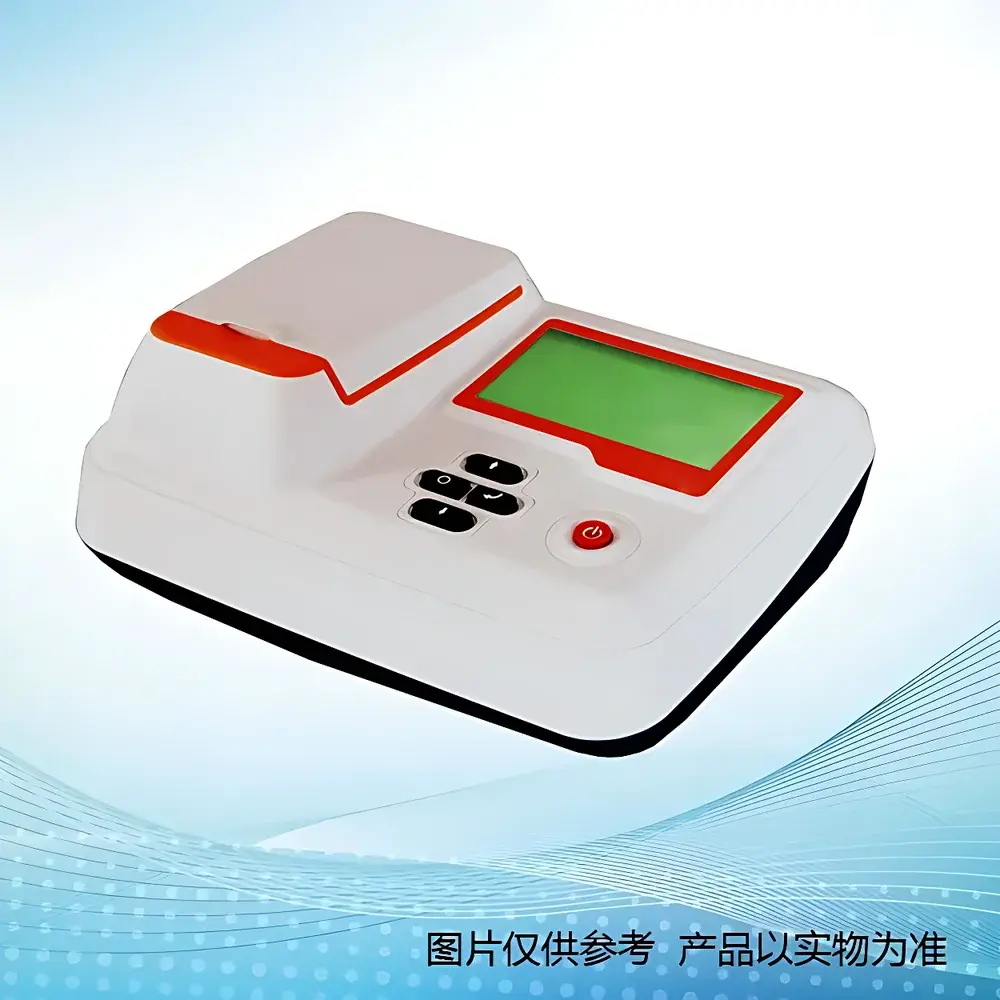
Jiada Xiaotianshe GDYQ-6000S Food & Dietary Supplement Hydrogen Peroxide (H₂O₂) Rapid Quantitative Analyzer
| Brand | Jiada Xiaotianshe |
|---|---|
| Origin | Jilin, China |
| Manufacturer Type | Direct Manufacturer |
| Regional Category | Domestic (China) |
| Model | GDYQ-6000S |
| Function Type | Single-Analyte Quantitative Detection |
| Sample Versatility | Multi-Sample Compatible |
| Optical Detection Wavelength | 400 nm |
| Detection Channels | 1 |
| Lower Detection Limit | 10.0 mg/kg |
| Quantification Range | 0.0–1000.0 mg/kg |
| Measurement Accuracy | ±2% |
Overview
The Jiada Xiaotianshe GDYQ-6000S is a dedicated rapid quantitative analyzer engineered for the selective determination of hydrogen peroxide (H₂O₂) residues in food products and dietary supplements. It operates on the principle of colorimetric quantification: H₂O₂ reacts with a proprietary chromogenic reagent under controlled acidic conditions to generate a stable colored complex, the absorbance of which is measured at 400 nm using a fixed-wavelength photometric sensor. This method aligns with established spectrophotometric protocols referenced in AOAC Official Method 2005.07 and ISO 8467:1993 for peroxide detection in aqueous matrices. The instrument is not a general-purpose spectrophotometer but a purpose-built system optimized for regulatory screening and QC release testing where speed, repeatability, and method standardization are critical. Its design targets laboratories performing routine surveillance of H₂O₂—commonly used as a sterilant in aseptic packaging, dairy processing, and functional ingredient manufacturing—and supports compliance with national food safety standards including GB 2760–2024 (China’s Standard for Use of Food Additives) and EU Regulation (EC) No 1333/2008 Annex II.
Key Features
- Fixed-wavelength photometric detection at 400 nm ensures consistent spectral alignment without calibration drift across operational cycles.
- Integrated single-channel optical path with temperature-stabilized LED source and silicon photodiode detector enables high signal-to-noise ratio measurements within the defined quantification range (0.0–1000.0 mg/kg).
- Dedicated microprocessor-based control architecture provides embedded data handling: real-time calculation of concentration from absorbance via preloaded calibration curves, automatic blank subtraction, and statistical validation of replicate readings.
- Large backlit LCD display with Chinese-language interface supports intuitive menu navigation, parameter configuration, and on-device result review—designed for use in production-floor environments with minimal operator training.
- Built-in data management functions include time-stamped measurement logging, local storage of up to 500 test records, USB export capability for raw absorbance and concentration values, and support for external printer output.
- Includes validated sample preparation accessories (e.g., centrifuge tubes, filtration units) and single-use reagent kits—each lot traceably certified for batch-specific calibration slope and limit of detection verification.
Sample Compatibility & Compliance
The GDYQ-6000S accommodates liquid, semi-solid, and homogenized solid samples—including milk, fruit juices, honey, herbal extracts, probiotic powders, and gelatin-based supplements—following standardized extraction and dilution protocols provided in the instrument’s operating manual. All sample preparation steps comply with GLP-aligned documentation requirements: reagent lot numbers, analyst ID, sample ID, and environmental temperature are automatically appended to each record. While not FDA 21 CFR Part 11–validated out-of-the-box, the system supports audit-ready operation when deployed with supplementary procedural controls (e.g., dual-operator verification, periodic system suitability checks using NIST-traceable H₂O₂ reference standards). It meets essential performance criteria outlined in China’s JJF 1523–2015 Technical Specification for Rapid Detection Instruments in Food Safety Supervision.
Software & Data Management
The analyzer features embedded firmware (v3.2+) with no external PC dependency for core operation. Data export is supported via USB 2.0 to FAT32-formatted drives in CSV format, containing columns for timestamp, sample ID, blank absorbance, sample absorbance, calculated concentration (mg/kg), operator code, and pass/fail flag relative to user-defined action limits. Optional companion software (GDYQ-Link v2.1, Windows 10/11 compatible) enables centralized database aggregation, trend analysis across batches, and automated report generation compliant with internal QA templates. All stored data retain immutable timestamps; firmware enforces write-once logic to prevent post-acquisition editing—supporting basic data integrity requirements under ISO/IEC 17025:2017 Clause 7.5.2.
Applications
- Routine monitoring of residual H₂O₂ in UHT-treated dairy beverages prior to aseptic filling.
- Verification of rinse efficacy after H₂O₂-based surface sterilization of packaging materials (e.g., cartons, pouches).
- Stability testing of antioxidant-rich functional foods where unintended H₂O₂ formation may indicate oxidative degradation.
- QC release testing of enzyme-modified ingredients (e.g., glucose oxidase preparations) where H₂O₂ is a reaction byproduct.
- Regulatory inspection support for municipal food safety agencies conducting field-level noncompliance screening.
FAQ
Does the GDYQ-6000S require daily recalibration?
No—calibration is performed per reagent kit lot using the included standard solution; the instrument stores the slope and intercept internally and applies them automatically during analysis.
Can it detect H₂O₂ in viscous samples like syrups or gels?
Yes, provided samples undergo specified dilution and clarification (e.g., centrifugation at 4000 × g for 10 min) to reduce turbidity interference below 0.1 NTU.
Is method validation documentation available?
Yes—each instrument shipment includes a Certificate of Conformance with summary validation data (precision, linearity R² ≥ 0.999, recovery 95–105% across 3 matrices) per CNAS-CL01:2018 requirements.
What maintenance is required beyond routine cleaning?
Annual optical path inspection and LED intensity verification using the manufacturer-provided diagnostic card; no consumable optics or lamp replacements are scheduled within the first 5 years.
How does it handle interferences from other peroxides or reducing agents?
The assay exhibits >98% selectivity for H₂O₂ over common interferents (e.g., peracetic acid, sodium percarbonate, ascorbic acid) due to pH-controlled reaction kinetics and stoichiometric reagent formulation.





