
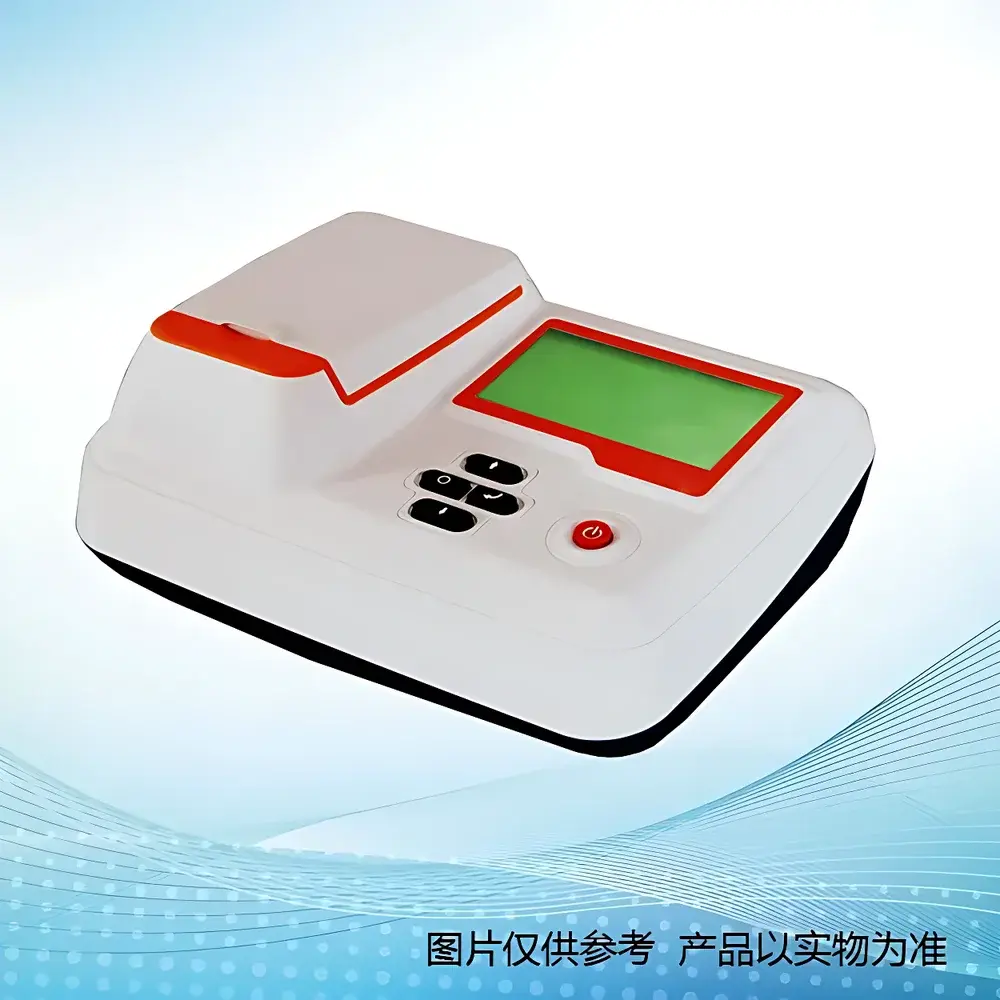
Jiada Xiaotianshe GDYQ-210SD Sorbic Acid Rapid Detection Analyzer
| Brand | Jiada Xiaotianshe |
|---|---|
| Origin | Jilin, China |
| Manufacturer Type | Direct Manufacturer |
| Country of Origin | China |
| Model | GDYQ-210SD |
| Function Type | Single-Analyte Detection System |
| Sample Compatibility | Multi-Matrix Food Samples |
| Detection Limit | 50.0 mg/kg |
| Quantification Range | 0.0–2000.0 mg/kg |
| Measurement Accuracy | ±5% (relative standard deviation under controlled conditions) |
| Control System | Embedded MCU-based platform |
| Data Interface | RS-232 and USB 2.0 |
| Display | Backlit LCD with Chinese UI |
| Portability | Handheld form factor, <1.2 kg |
Overview
The Jiada Xiaotianshe GDYQ-210SD Sorbic Acid Rapid Detection Analyzer is a dedicated, field-deployable photometric instrument engineered for the quantitative determination of sorbic acid in food matrices using standardized colorimetric methodology. It operates on the principle of visible-spectrum absorbance measurement following derivatization of sorbic acid with proprietary reagents supplied in certified test kits. The system implements a modified version of the national standard method GB 5009.28–2016 (National Food Safety Standard – Determination of Sorbic Acid and Benzoic Acid in Foods), adapted for rapid, on-site implementation without reliance on laboratory-grade HPLC or GC-MS infrastructure. Designed for routine screening at production lines, cold-chain checkpoints, regulatory inspection sites, and third-party testing hubs, the GDYQ-210SD delivers trace-level quantification within 15 minutes per sample while maintaining metrological traceability to reference standards.
Key Features
- Embedded microcontroller unit (MCU) architecture enabling autonomous operation—no external computer required for basic assay execution.
- Pre-calibrated optical path with fixed-wavelength LED source (525 ± 5 nm) and silicon photodiode detector optimized for the characteristic absorption peak of the sorbic acid–reagent complex.
- Integrated data logging: stores up to 500 test records with timestamp, sample ID, operator code, and raw absorbance values.
- Dual communication interface (RS-232 serial and USB 2.0) compliant with Windows-based desktop software for data export, calibration management, and audit trail generation.
- Low-reagent-consumption design: each test requires ≤1.0 mL sample extract and ≤0.5 mL reagent volume, minimizing hazardous waste and reducing per-test cost.
- Ergonomic handheld enclosure (185 × 85 × 45 mm) with IP54-rated casing for dust and splash resistance during field use.
- Backlit monochrome LCD display with intuitive Chinese-language menu navigation and real-time guidance prompts during assay steps.
Sample Compatibility & Compliance
The GDYQ-210SD supports direct analysis of aqueous extracts from diverse food categories including beverages (soft drinks, juices), dairy products (cheese, yogurt), baked goods, jams, sauces, and processed meats—provided samples undergo standardized pretreatment per GB 5009.28–2016 (e.g., solvent extraction, pH adjustment, filtration). All reagent kits are manufactured under ISO 9001-certified processes and accompanied by Certificate of Analysis (CoA) specifying lot-specific calibration curves and shelf-life validation. Instrument performance meets the repeatability and linearity requirements outlined in CNAS-CL01:2018 (equivalent to ISO/IEC 17025) for rapid screening devices used in food safety compliance verification. While not intended as a definitive confirmatory tool, results are admissible as preliminary evidence in GLP-aligned internal quality control programs and regulatory pre-screening workflows.
Software & Data Management
The companion PC software (GDYQ-DataLink v3.2) provides secure, role-based access control and full 21 CFR Part 11–compatible audit trail functionality—including user login history, method version tracking, electronic signature capture for report approval, and immutable record archiving. Calibration curves are stored with digital signatures; any modification triggers automatic version increment and metadata logging. Export formats include CSV (for LIMS integration), PDF (print-ready reports with QR-coded result verification), and XML (for automated ingestion into enterprise QA platforms). All data transfers comply with TLS 1.2 encryption when interfacing with networked laboratory information systems.
Applications
- Routine in-process monitoring of sorbic acid levels during beverage formulation and canning operations.
- On-site verification of label claims for “preservative-free” or “low-preservative” product lines.
- Regulatory field inspections by municipal food safety bureaus conducting unannounced sampling at wet markets and distribution centers.
- Supplier qualification audits where rapid turnaround (<30 min/sample) is required to assess incoming raw material compliance.
- Academic and vocational training labs demonstrating principles of food additive analysis, spectrophotometry, and standard method adaptation.
FAQ
Is the GDYQ-210SD suitable for regulatory submission as primary analytical data?
No—it is validated as a rapid screening device per GB/T 27404–2008 (Guidelines for Laboratory Quality Control in Food Microbiology and Chemistry) and intended for triage and trend analysis, not final compliance certification.
Can the instrument be recalibrated by end users?
Yes—field recalibration is supported using certified reference standards (NIST-traceable sorbic acid solutions, 100 mg/L and 1000 mg/L) via the built-in calibration wizard.
What is the shelf life of the included reagent kits?
Unopened kits retain stability for 18 months when stored at 2–8 °C; post-opening stability is 7 days under refrigerated conditions with desiccant protection.
Does the system support multi-analyte detection?
No—the GDYQ-210SD is purpose-built exclusively for sorbic acid; parallel benzoic acid detection requires the GDYQ-211SD variant.
Is firmware update capability available?
Yes—updates are distributed quarterly via encrypted USB dongle and include enhanced outlier detection algorithms, expanded language options, and updated regulatory logic modules.





