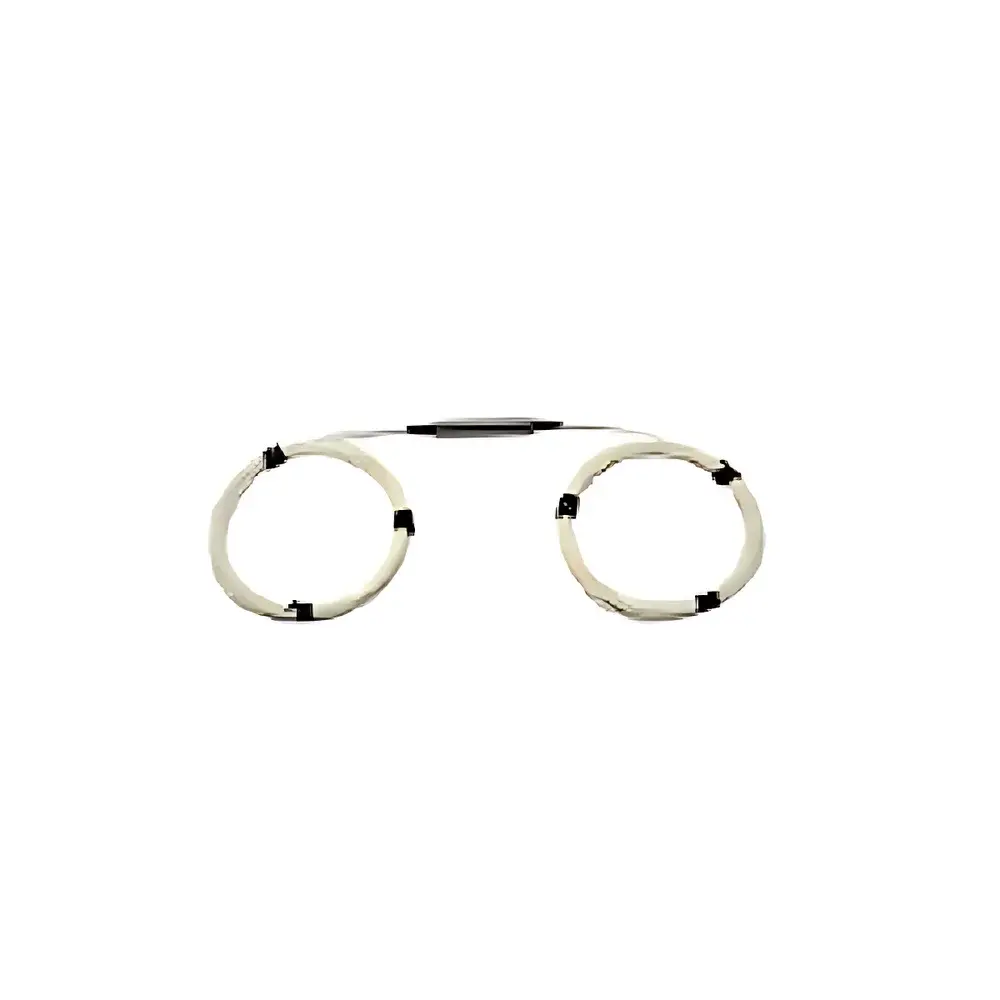
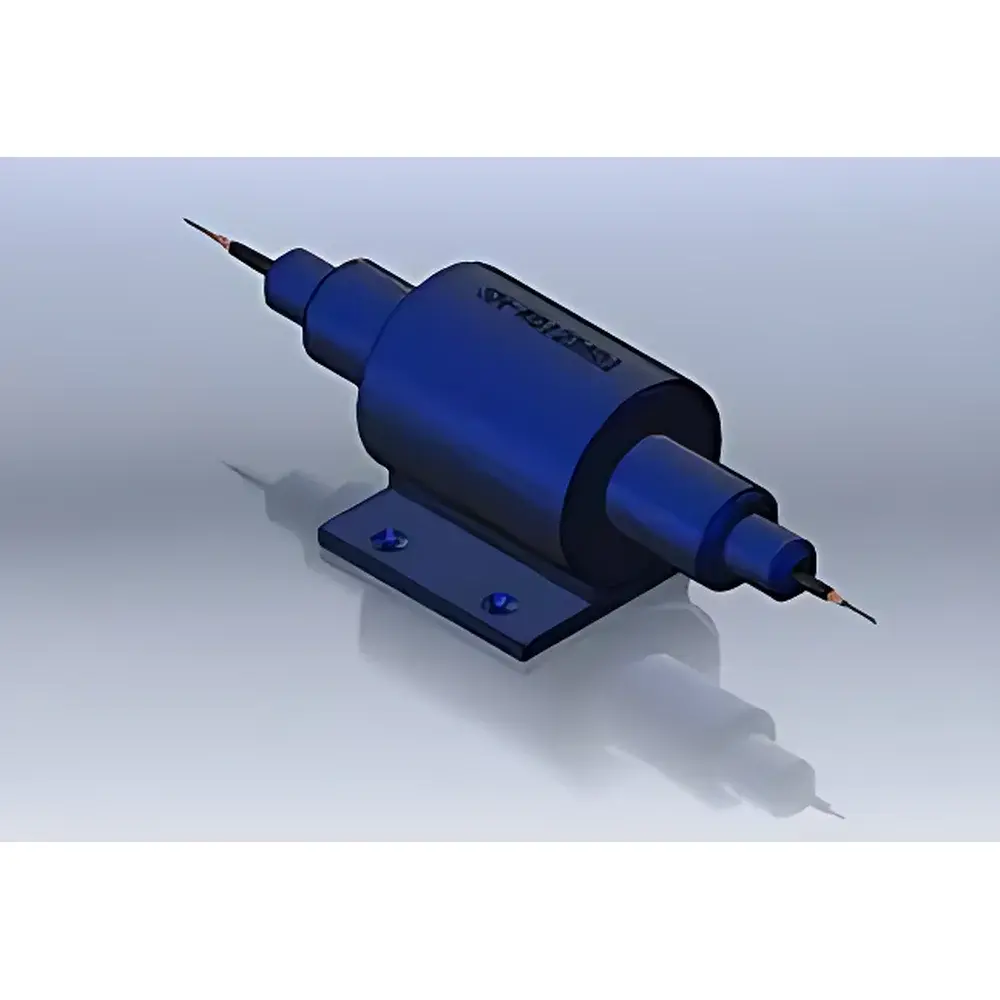
AOE Tech PMIS Series 980 nm Polarization-Maintaining Optical Isolator
| Brand | AOE Tech |
|---|---|
| Model | PMIS |
| Center Wavelength | 980 nm |
| Operating Wavelength Range | ±10 nm |
| Isolation (typ.) | 32 dB |
| Isolation at λc, 23 °C | ≥25 dB |
| Insertion Loss (typ., 23 °C) | 0.8 dB |
| Max. Insertion Loss (23 °C) | ≤1.0 dB |
| Extinction Ratio | ≥20 dB |
| Return Loss (Input/Output) | ≥50/50 dB |
| Max. Optical Power Handling | 300 mW |
| Fiber Type | Panda PM Fiber |
| Operating Temperature | −5 to +50 °C |
| Storage Temperature | −20 to +75 °C |
| Package Dimensions (L×W×H) | 118 × 32 × 32 mm |
| Connector Options | FC/APC, FC/UPC, SC/APC, SC/UPC, LC/APC, LC/UPC, or bare fiber |
| Axis Alignment | Fast Axis (F) or Dual-Axis (B) |
| Fiber Coating | 250 µm bare, 900 µm loose tube, or 3000 mm length options |
| Customization | Optional connectorization, polarization axis labeling, and hermetic packaging available |
Overview
The AOE Tech PMIS Series 980 nm Polarization-Maintaining Optical Isolator is a passive, non-reciprocal photonic component engineered for high-fidelity polarization state preservation in demanding fiber-optic systems operating at the 980 nm pump band. Based on the Faraday magneto-optic effect, it enables unidirectional transmission while suppressing backward-propagating light—critical for stabilizing laser cavities and preventing feedback-induced instabilities. Unlike standard isolators, the PMIS variant integrates precision-aligned birefringent elements and stress-engineered Panda-type polarization-maintaining fiber to ensure minimal coupling between orthogonal polarization modes. This architecture maintains extinction ratio integrity across thermal and mechanical perturbations, making it suitable for integration into polarization-sensitive architectures such as narrow-linewidth fiber lasers, quantum optics testbeds, and interferometric sensing platforms.
Key Features
- High isolation performance: ≥25 dB at 980 nm (23 °C), with typical values reaching 32 dB—ensuring robust suppression of reflected light from amplifiers, modulators, or splices
- Low insertion loss: ≤1.0 dB (typ. 0.8 dB) at operational temperature, minimizing signal attenuation without compromising polarization fidelity
- Superior polarization extinction ratio: ≥20 dB, verified under controlled thermal conditions, supporting stable operation in PM-based coherent systems
- High return loss: ≥50 dB at both input and output ports, reducing residual reflections that could destabilize seed lasers or saturable absorbers
- Power handling capability: Rated for continuous-wave optical power up to 300 mW—compatible with high-brightness 980 nm pump diodes used in EDFA and YDFA pre-amplification stages
- Thermally stable design: Operational range from −5 °C to +50 °C; storage specification extends to −20 °C to +75 °C, enabling deployment in laboratory, industrial, and field-deployable instrumentation environments
- Modular mechanical interface: Compact 118 × 32 × 32 mm housing supports OEM integration; optional connectorization (FC/APC, SC/UPC, LC/APC, etc.) and axis-aligned pigtail configurations facilitate alignment-critical setups
Sample Compatibility & Compliance
The PMIS isolator is optimized for use with Panda-type polarization-maintaining fiber (PMF), with factory-aligned fast-axis orientation clearly marked per Telcordia GR-1221-CORE and IEC 61300-2-40 standards. It complies with RoHS Directive 2011/65/EU and meets IEC 60825-1:2014 Class 1 laser product safety requirements when integrated into fully enclosed systems. While not certified to specific ISO/IEC 17025 or FDA 21 CFR Part 11 frameworks—given its status as a passive optical component—the device is routinely deployed in GLP-compliant optical test benches and GMP-aligned fiber laser manufacturing lines where traceable calibration and documented batch-level performance data are maintained per internal quality protocols.
Software & Data Management
As a purely passive optical component, the PMIS isolator does not incorporate embedded firmware, digital interfaces, or real-time monitoring capabilities. Performance validation is conducted using industry-standard test instrumentation—including tunable laser sources (TLS), polarization analyzers (e.g., Thorlabs PAX1000), and optical power meters calibrated to NIST-traceable standards. AOE Tech provides full parametric test reports per unit or batch upon request, including measured isolation vs. wavelength curves, insertion loss distribution, and extinction ratio stability over temperature (−5 °C to +50 °C). These reports support audit readiness in regulated environments and enable correlation with system-level optical budget models in LCA (laser cavity analysis) or PMD (polarization mode dispersion) simulations.
Applications
- Pump protection in 980 nm-pumped erbium-doped fiber amplifiers (EDFAs) and ytterbium-doped fiber amplifiers (YDFAs)
- Back-reflection isolation in narrow-linewidth distributed feedback (DFB) and external cavity diode lasers (ECDLs) operating near 980 nm
- Stabilization of polarization-maintaining fiber laser oscillators, including Q-switched and mode-locked configurations
- Optical front-end conditioning in fiber-optic gyroscopes (FOGs) and interferometric current sensors requiring high polarization extinction integrity
- Research-grade setups involving quantum key distribution (QKD) source modules, where backscattered photons must be suppressed below detection thresholds
- Calibration reference paths in metrology-grade optical coherence tomography (OCT) systems utilizing PM fiber delivery arms
FAQ
Is the PMIS isolator compatible with other PM fiber types besides Panda?
The device is factory-terminated and aligned specifically for Panda PM fiber. While fusion splicing to Bow-tie or elliptical-clad PM fibers is technically feasible, polarization extinction ratio degradation may occur due to modal mismatch and stress-field misalignment; AOE Tech recommends Panda fiber for guaranteed specification compliance.
Can the isolator be used at wavelengths outside the ±10 nm band around 980 nm?
Performance parameters—including isolation, insertion loss, and extinction ratio—are specified only within the stated operating window. Operation beyond ±10 nm may result in reduced isolation (>10 dB drop) and increased polarization-dependent loss; spectral characterization data is available upon request for custom evaluation.
Does the device require magnetic shielding in high-field environments?
The Faraday rotator uses terbium-doped glass with high Verdet constant and intrinsic resistance to external DC magnetic fields below 50 Gauss. No additional shielding is required for standard lab or rack-mounted deployment; however, proximity to MRI systems or high-current conductors warrants empirical verification.
What documentation accompanies each unit?
Each shipment includes a Certificate of Conformance (CoC), mechanical drawings, fiber axis identification diagram, and—if requested—a full optical test report with traceable measurement uncertainty budgets per ISO/IEC 17025 principles.