
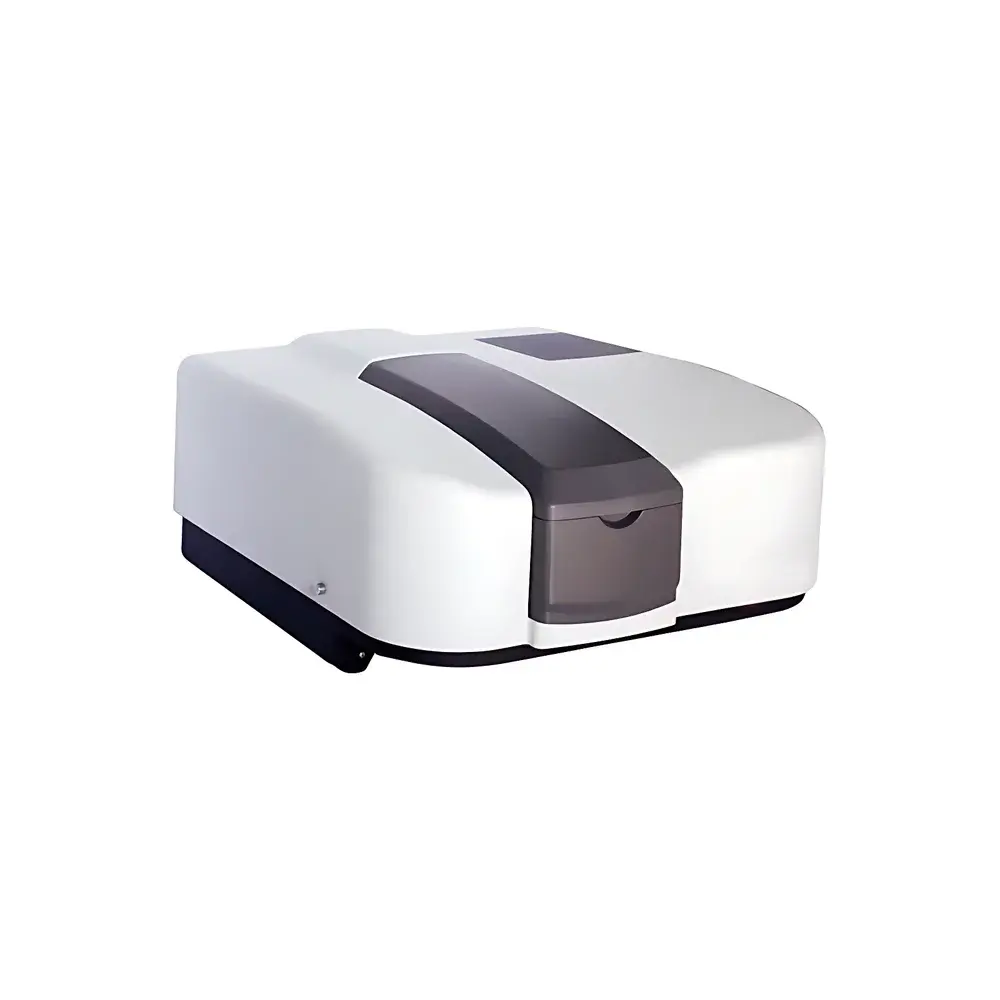
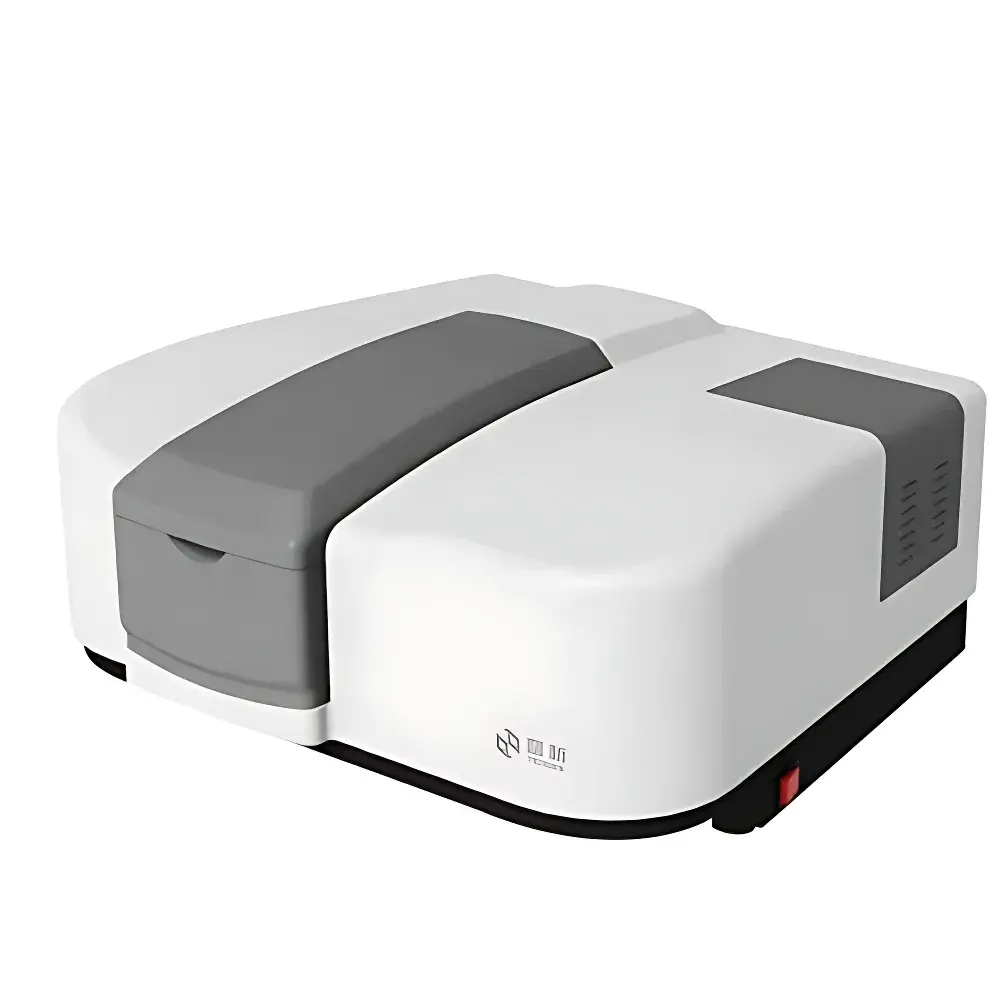
Purkinje TU-1950 Dual-Beam Ultraviolet-Visible Spectrophotometer
| Brand | Purkinje |
|---|---|
| Origin | Beijing, China |
| Manufacturer Type | OEM Manufacturer |
| Instrument Architecture | Dual-Beam |
| Detector Type | Photomultiplier Tube (PMT) |
| Wavelength Range | 190–900 nm |
| Wavelength Accuracy | ±0.3 nm (auto-calibrated at startup) |
| Wavelength Repeatability | ≤0.15 nm |
| Spectral Bandwidth | Continuously Variable from 0.1 to 5.0 nm (0.1 nm increments) |
| Stray Light | ≤0.01% T at 220 nm (NaI), ≤0.05% T at 360 nm (NaNO₂) |
| Baseline Flatness | ±0.001 Abs |
| Drift | ≤0.1%/h |
| Dimensions | 610 × 570 × 300 mm |
| Weight | 39 kg |
Overview
The Purkinje TU-1950 is a high-performance dual-beam ultraviolet-visible (UV-Vis) spectrophotometer engineered for precision quantitative and qualitative analysis across research, quality control, and regulatory environments. Based on the Beer–Lambert law, it measures absorbance, transmittance, and reflectance by comparing sample and reference beam intensities in real time using a dynamically balanced optical path. Its continuous variable spectral bandwidth (0.1–5.0 nm, adjustable in 0.1 nm steps) enables rigorous method development and compliance with application-specific resolution requirements—particularly critical in pharmaceutical assay validation, nucleic acid quantification, and trace-level contaminant detection. The instrument employs a high-stability deuterium lamp (UV) and tungsten-halogen lamp (visible/NIR), coupled with a photomultiplier tube (PMT) detector optimized for signal-to-noise ratio across the full 190–900 nm range. All optical components are housed in a thermally stabilized monochromator assembly to minimize thermal drift and ensure long-term photometric stability.
Key Features
- Dual-beam dynamic feedback architecture with real-time reference compensation, delivering high photometric reproducibility and resistance to environmental fluctuations.
- Continuously variable slit width mechanism enabling precise spectral bandwidth selection from 0.1 nm to 5.0 nm in 0.1 nm increments—ideal for optimizing resolution versus sensitivity trade-offs per analytical method.
- Auto-wavelength calibration at power-on using internal holmium oxide and didymium filters, ensuring traceable wavelength accuracy of ±0.3 nm across the operational range.
- Low-stray-light optical design: ≤0.01% T at 220 nm (using sodium iodide) and ≤0.05% T at 360 nm (using sodium nitrite), meeting stringent requirements for high-absorbance measurements (e.g., >3.0 Abs).
- Modular lamp design with plug-in deuterium and tungsten-halogen sources—no optical alignment required during lamp replacement, reducing maintenance downtime and technician dependency.
- CE-certified construction compliant with IEC 61010-1 safety standards and electromagnetic compatibility (EMC) Directive 2014/30/EU.
Sample Compatibility & Compliance
The TU-1950 supports standard 10-mm quartz or fused-silica cuvettes, as well as specialized sample holders including thermostatted cells (CH19-2), integrating spheres (IS19-2), mirror-reflection stages (MR19-1), and variable-angle solid-sample holders (DS19-1). Its broad 190–900 nm spectral coverage accommodates diverse analytes—from UV-absorbing aromatic compounds and proteins (280 nm) to visible dyes and NIR-active materials. The system meets foundational performance criteria outlined in ASTM E275, ISO 6223, and USP for spectrophotometric instrumentation. When operated with audit-trail-enabled software (optional), it supports GLP/GMP workflows aligned with FDA 21 CFR Part 11 requirements for electronic records and signatures.
Software & Data Management
The TU-1950 operates with Purkinje’s proprietary SpectraPro™ v3.x software, a Windows-based platform supporting method storage, kinetic scanning, multi-wavelength quantitation, derivative spectroscopy, and spectral subtraction. Data files are saved in vendor-neutral CSV and XML formats; raw absorbance/time or absorbance/wavelength datasets include metadata such as date/time stamp, operator ID, instrument serial number, and calibration history. Optional software modules enable automated compliance reporting, peak identification with library matching (NIST SRM reference spectra), and integration with LIMS via ODBC connectivity. All software updates are delivered through secure, authenticated firmware channels with version-controlled release notes.
Applications
- Pharmaceutical QC: Assay of active pharmaceutical ingredients (APIs), dissolution testing, and excipient interference studies per USP monographs.
- Biochemistry: Quantification of DNA/RNA (A260/A280 ratios), protein concentration (Bradford/Lowry assays), and enzyme kinetics (NADH/NADPH monitoring at 340 nm).
- Environmental analysis: Detection of nitrate, phosphate, and heavy metal complexes (e.g., Cr(VI) at 370 nm) in water matrices per EPA Method 353.2.
- Food & beverage: Colorimetric assessment of anthocyanins, carotenoids, and Maillard reaction products; authenticity verification of olive oil and honey.
- Materials science: Thin-film thickness determination via interference fringe analysis and bandgap estimation of semiconductor nanomaterials.
FAQ
What is the minimum detectable absorbance change supported by the TU-1950?
The instrument achieves photometric noise ≤±0.0005 Abs (RMS, 1 nm bandwidth, 2 nm/s scan speed), enabling reliable detection of absorbance changes down to 0.001 Abs under optimized conditions.
Can the TU-1950 be integrated into an automated laboratory workflow?
Yes—via RS-232 and optional Ethernet interfaces, it supports remote command execution (SCPI protocol), scheduled scans, and data push to network drives or LIMS platforms.
Is spectral bandwidth validation included in routine qualification?
Yes—Purkinje provides a certified bandwidth verification kit (traceable to NIST SRM 2034) and SOP templates for IQ/OQ/PQ documentation per ISO/IEC 17025.
How does the dual-beam design improve measurement stability compared to single-beam systems?
Real-time reference beam compensation corrects for source intensity drift, detector aging, and ambient temperature fluctuations—reducing baseline drift to ≤0.1%/h and improving inter-day repeatability by up to 40% versus comparable single-beam instruments.
Are accessories like the integrating sphere or thermostatted cell supplied with calibration certificates?
All optically critical accessories (IS19-2, CH19-2, MR19-1) ship with individual factory calibration reports referencing NIST-traceable standards and include mounting alignment verification data.





