
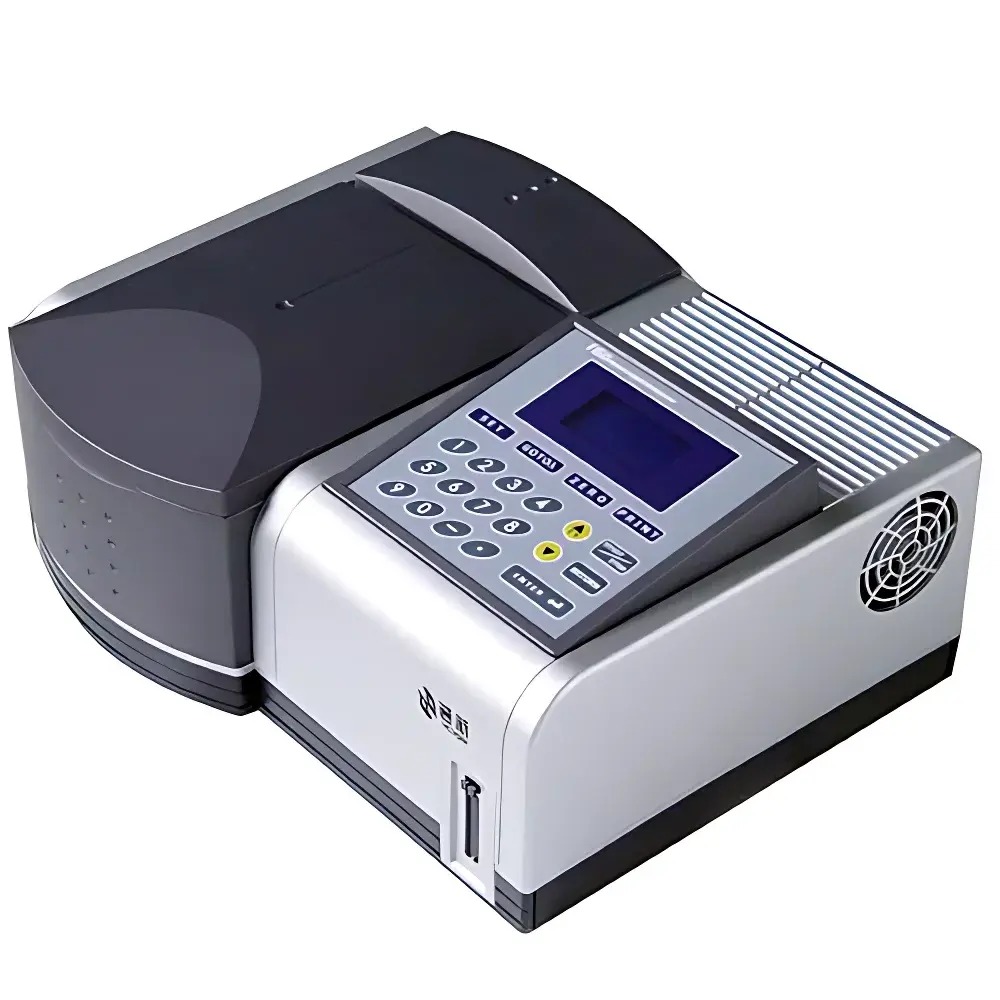
Persee T6 Series Ultraviolet-Visible Spectrophotometer
| Brand | Persee |
|---|---|
| Origin | Beijing, China |
| Manufacturer Type | Original Equipment Manufacturer (OEM) |
| Product Type | Domestic |
| Model | T6 Series |
| Price Range | USD 1,400–2,800 |
| Optical Design | Pseudo-Double-Beam |
| Detector | Photomultiplier Tube (PMT) |
| Wavelength Range | 190–1100 nm |
| Wavelength Scanning | Motorized Auto-Positioning |
| Spectral Bandwidth | 2.0 nm |
| Wavelength Accuracy | ±1 nm |
| Wavelength Repeatability | ≤0.2 nm |
| Stray Light | 0.05% T at 220 nm |
Overview
The Persee T6 Series Ultraviolet-Visible Spectrophotometer is a precision optical instrument engineered for quantitative and qualitative analysis of absorbance, transmittance, and reflectance across the ultraviolet (190 nm), visible (400–700 nm), and near-infrared (up to 1100 nm) spectral regions. Based on pseudo-double-beam optical architecture, the system compensates for source intensity drift and detector sensitivity fluctuations by continuously monitoring reference and sample beam intensities using a single photomultiplier tube (PMT) with time-shared detection. This design delivers high photometric stability without the complexity and cost of true dual-beam optics—making it suitable for routine QC labs, academic teaching laboratories, and regulatory-compliant environments where reproducibility and long-term baseline integrity are critical. Certified under China’s National Torch Program in September 2006, the T6 platform integrates robust mechanical engineering with modular electronics, supporting traceable calibration protocols and alignment-free operation over extended service intervals.
Key Features
- Pseudo-double-beam optical path with real-time reference correction for enhanced photometric stability and reduced baseline drift
- High-sensitivity PMT detector with low-noise signal amplification circuitry, optimized for low-light UV measurements
- Stepper-motor-driven grating monochromator with micro-stepping control—eliminates mechanical backlash and wear associated with traditional screw-driven mechanisms
- Silicon dioxide (SiO₂)-coated optical mirrors provide long-term resistance to atmospheric oxidation and humidity-induced degradation
- Integrated lamp life monitoring system with automatic deuterium/tungsten lamp switching and diagnostic feedback
- Modular functional card slots enabling field-upgradable capabilities: pesticide residue quantification, nucleic acid/protein A260/A280 analysis, full-spectrum scanning, and kinetic assay support
- Open sample compartment design compatible with standard 10 mm cuvettes, long-path cells (up to 100 mm), and 8-position automated cell changers
- Removable, washable dust filter at air intake—minimizes particulate accumulation on internal optics and reduces maintenance frequency
Sample Compatibility & Compliance
The T6 Series accommodates a wide range of sample formats including quartz, glass, and plastic cuvettes (10 mm, 20 mm, 50 mm, and custom-length cells), as well as solid reflectance accessories and flow-through cells (with optional add-on modules). Its wavelength accuracy (±1 nm) and stray light performance (≤0.05% T at 220 nm) meet the minimum requirements specified in ASTM E275, ISO 6223, and USP for UV-Vis spectrophotometers used in pharmaceutical excipient testing and raw material identification. While not pre-certified for FDA 21 CFR Part 11, the instrument’s firmware supports audit-trail-enabled data logging when paired with compliant PC-based software; all spectral data files include embedded timestamps, operator ID fields, and instrument configuration metadata required for GLP/GMP documentation.
Software & Data Management
The T6 operates with Persee’s proprietary SpectraManager™ workstation software, offering intuitive graphical interface for method development, multi-wavelength quantitation, kinetics, and spectral overlay. Data export is supported in CSV, TXT, and JCAMP-DX formats for interoperability with LIMS and third-party chemometric tools (e.g., MATLAB, Unscrambler). The software implements configurable user roles, password-protected method editing, and electronic signature prompts aligned with ALCOA+ principles. All scan data include embedded calibration history, lamp usage hours, and wavelength verification logs—facilitating internal audit readiness and traceable instrument qualification (IQ/OQ/PQ).
Applications
- Pharmaceutical quality control: assay of active ingredients, dissolution testing, and excipient purity screening per USP monographs
- Environmental analysis: nitrate, phosphate, and heavy metal ion quantification via colorimetric methods (e.g., APHA Standard Methods)
- Biochemistry: DNA/RNA concentration and purity assessment (A260/A280, A260/A230 ratios), Bradford/Lowry protein assays
- Food & beverage: antioxidant capacity (DPPH assay), pigment content (chlorophyll, carotenoids), and adulterant detection
- Academic research: reaction kinetics, equilibrium constant determination, and ligand-binding studies
- Agricultural chemistry: pesticide residue screening using enzyme inhibition or derivatization protocols
FAQ
What is the difference between “pseudo-double-beam” and true double-beam optics?
Pseudo-double-beam systems use a single detector with time-multiplexed sampling of reference and sample beams via a rotating mirror or chopper wheel. This achieves drift compensation comparable to true double-beam instruments but with simplified alignment, lower cost, and higher optical throughput.
Does the T6 Series support compliance with ISO/IEC 17025 laboratory accreditation?
Yes—the instrument’s documented wavelength accuracy, stray light specification, and photometric linearity (verified per ISO 10012) support metrological traceability when calibrated using NIST-traceable standards and validated using certified reference materials.
Can the T6 be integrated into an automated lab workflow?
The RS-232 and USB interfaces enable bidirectional communication with external controllers and LIMS. Optional TTL-triggered auto-sampling synchronization allows integration with robotic liquid handlers and conveyor-based sample introduction systems.
Is firmware upgrade available remotely?
Firmware updates are delivered via encrypted USB drive or secure FTP download; each release includes version-controlled change logs and impact assessments for regulated users.
What maintenance is required beyond routine cleaning?
No periodic optical realignment is needed. Recommended annual verification includes wavelength calibration (using holmium oxide or didymium filters), photometric accuracy check (neutral density filters), and lamp output profiling—procedures fully supported by built-in diagnostic routines.




