
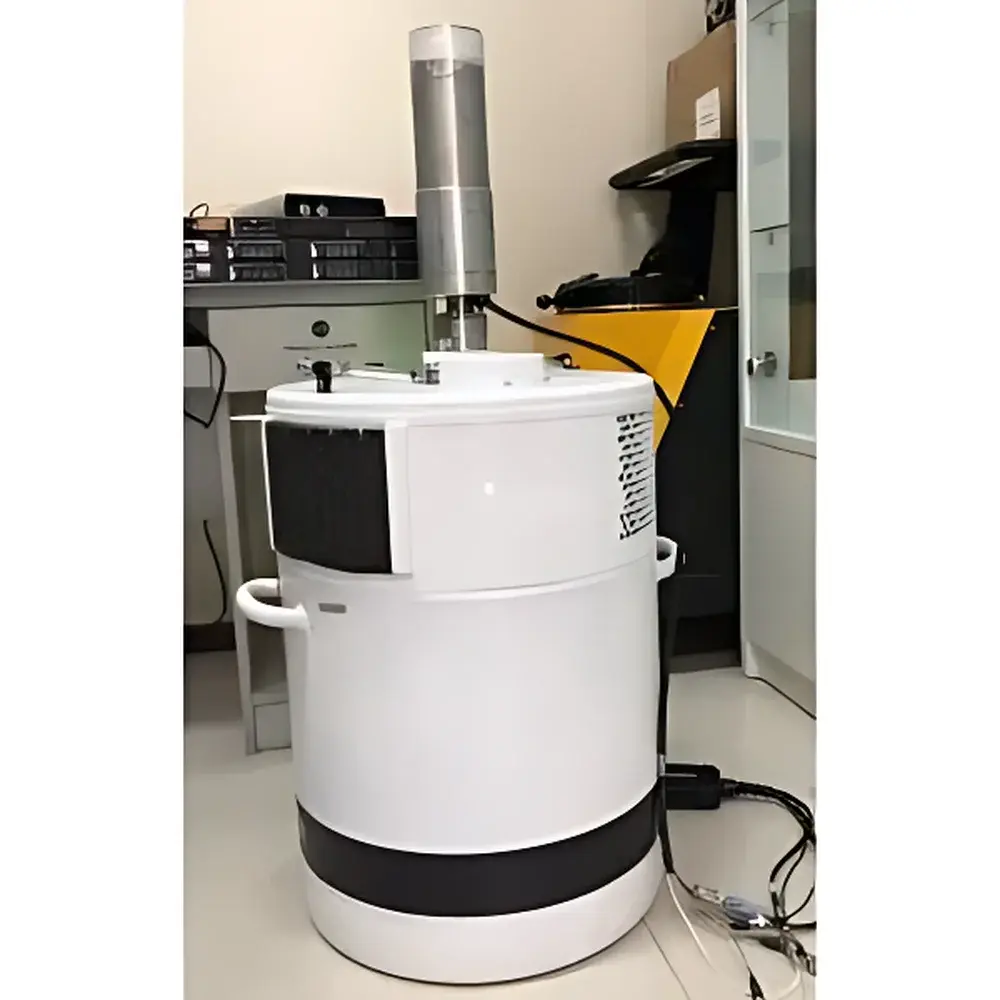
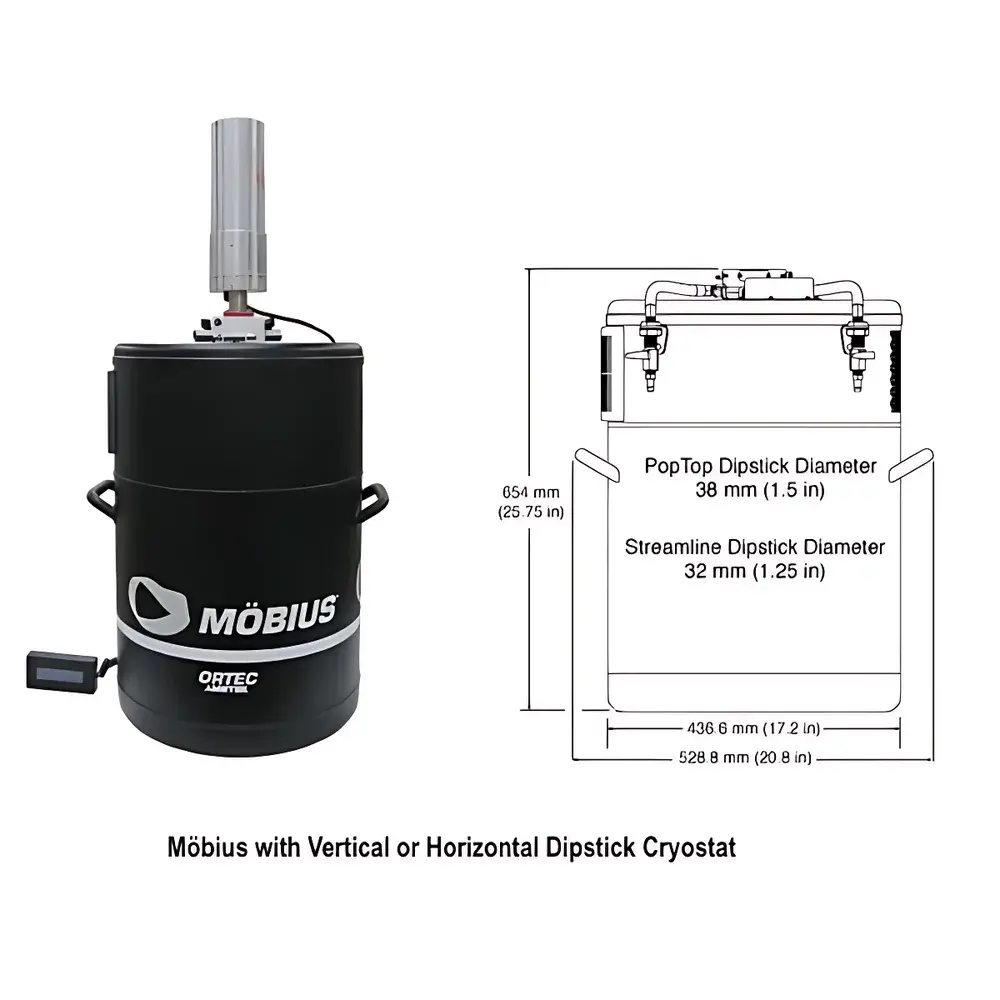
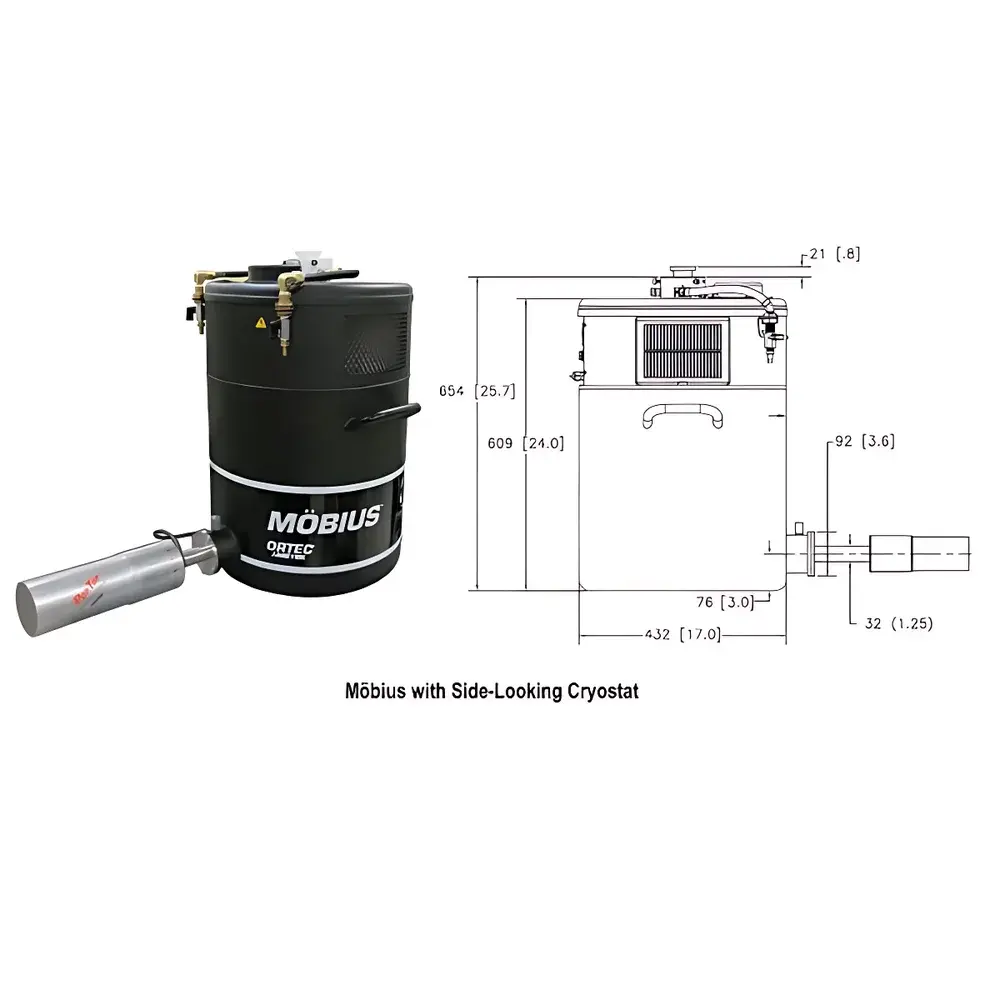
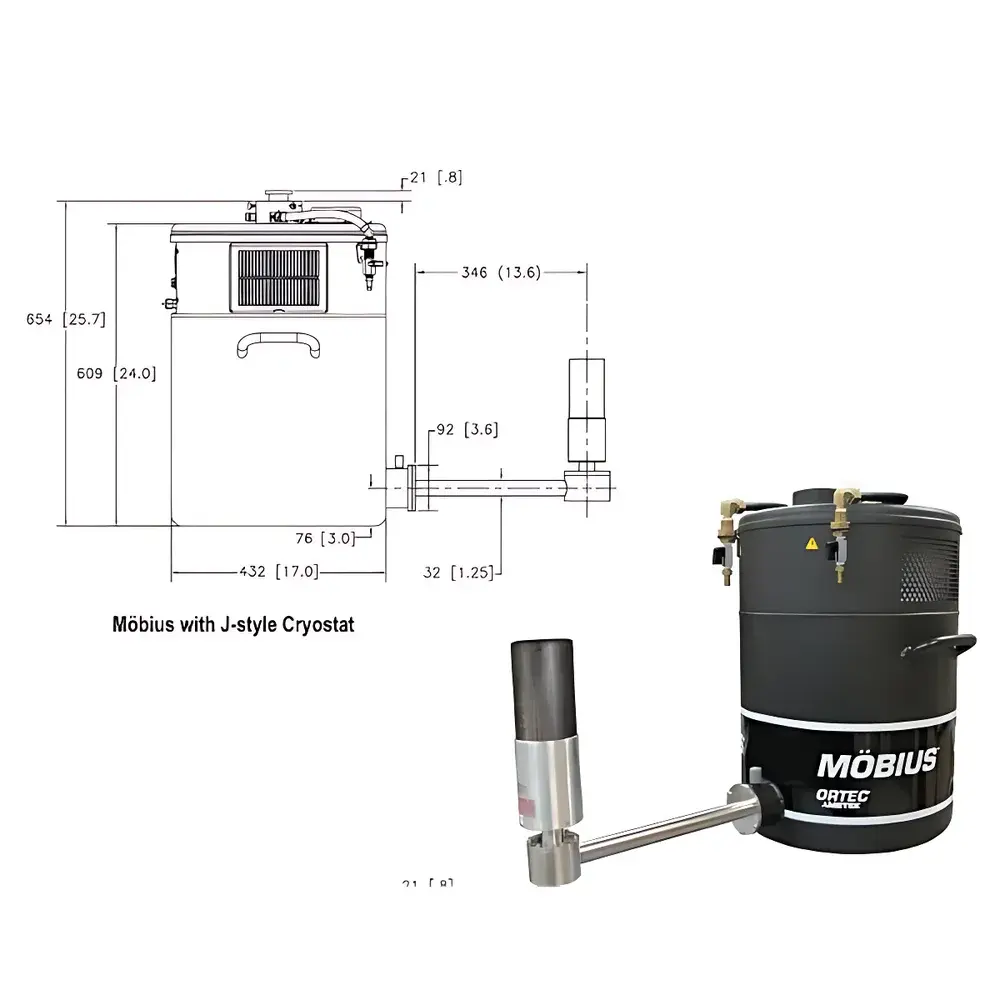
TK-Mobius High-Purity Germanium (HPGe) Cryogenic Cooling System with Liquid Nitrogen Recondensation
| Brand | TaiKun |
|---|---|
| Origin | Beijing, China |
| Manufacturer Type | Authorized Distributor |
| Country of Origin | China |
| Model | TK-Mobius |
| Instrument Category | Gamma-Ray Spectrometer |
| Instrument Type | Laboratory-Based |
| Sample Form | Solid |
| Detector Type | High-Purity Germanium (HPGe) |
| Cooling Method | Liquid Nitrogen Recondensation (Closed-Cycle) |
| Operating Temperature | ≤ 77 K |
| Nominal Dewar Capacity | 28 L |
| Continuous Operation (Uninterrupted Power) | Up to 2 Years |
| Power Consumption | 125 W (Typical), 300 W (Max) |
| Ambient Operating Conditions | 0–40 °C, 20–90% RH (Non-Condensing) |
| Acoustic Noise Level | < 60 dB(A) at 1 m |
| Displayed Parameters | Cryocooler Status, Estimated Remaining Cryogenic Hold Time (h), LN₂ Level, Low-Level Warning Threshold (48 h) |
| Physical Dimensions (Dewar Only) | 66.5 cm H × 44.1 cm Ø |
| Air Filter Maintenance Interval | Monthly |
| Mounting Flexibility | Vertical or Horizontal Cold Finger Orientation |
| Electronics Architecture | Decoupled Cryo-Control and Signal Processing Circuitry (Separated from Dewar) |
Overview
The TK-Mobius is a laboratory-grade high-purity germanium (HPGe) gamma-ray spectrometer system engineered for long-term, stable, low-background nuclear spectroscopy. It employs a liquid nitrogen (LN₂) recondensation cooling architecture—combining traditional cryogenic performance with modern closed-cycle reliability. Unlike conventional dewars requiring weekly or biweekly LN₂ refills, the TK-Mobius integrates a Stirling-cycle cryocooler that continuously recondenses evaporated nitrogen vapor back into liquid phase within the 28-liter vacuum-insulated Dewar. This enables uninterrupted detector operation at ≤ 77 K for up to two years under continuous power supply, significantly reducing operational overhead, logistical dependency on LN₂ logistics, and thermal cycling-induced detector stress. The HPGe crystal—grown to impurity levels below 10¹⁰ atoms/cm³—is housed in an ultra-low-background cryostat with optimized shielding geometry and electronic decoupling: all control electronics, HV supply, and preamplifier circuitry are physically isolated from the Dewar to eliminate microphonic coupling, thermal drift, and electromagnetic interference. The system is designed for quantitative radionuclide identification and activity determination in solid environmental samples (e.g., soil, sediment, filter media, vegetation ash) per ISO 11929, ASTM D3648, and IAEA Technical Reports Series No. 295.
Key Features
- Stirling-assisted LN₂ recondensation technology enabling >17,500 hours of continuous cryogenic operation without manual refilling
- Modular cold finger design supporting both vertical and horizontal detector mounting configurations for flexible lab integration
- Real-time embedded display showing cryocooler status, remaining hold time (in hours), LN₂ level, and predictive low-level alert (triggered at ≥48 h remaining)
- Electronically decoupled architecture: signal chain and power management circuits mounted externally to minimize thermal load and noise injection into the detector assembly
- Low-noise mechanical design: acoustic emission < 60 dB(A) at 1 m distance, compliant with ISO 7779 and ANSI S12.2 for laboratory environments
- Robust environmental tolerance: operational across 0–40 °C ambient temperature and 20–90% relative humidity (non-condensing)
- Maintenance-intuitive design: accessible front-panel air filter requiring monthly cleaning or replacement to sustain optimal compressor airflow and thermal efficiency
Sample Compatibility & Compliance
The TK-Mobius is validated for solid-phase environmental matrices including but not limited to soil cores, airborne particulate filters (e.g., PM₁₀/PM₂.₅), dried biological tissues, and geological digests sealed in standardized Marinelli beakers or cylindrical polyethylene containers. Its energy resolution (< 1.8 keV FWHM at 1332 keV, typical for 70 cm³ coaxial HPGe) supports isotopic discrimination of complex decay chains (e.g., ²³⁸U, ²³²Th, ⁴⁰K, ¹³⁷Cs, ⁶⁰Co). System compliance includes adherence to IEC 61540 (radiation protection instrumentation), ISO/IEC 17025:2017 requirements for calibration traceability, and compatibility with GLP audit frameworks. Data acquisition firmware supports 21 CFR Part 11-compliant user access controls and electronic signature logging when integrated with validated third-party spectroscopy software.
Software & Data Management
The TK-Mobius interfaces via USB 3.0 or Ethernet to industry-standard gamma spectroscopy platforms—including ORTEC GammaVision®, Canberra Genie™ 2000, and open-source alternatives such as RadWare or PyMCA. All spectral data are stored in standard IEEE 32-bit or 64-bit binary formats (e.g., .cnf, .spc) with embedded metadata (detector ID, acquisition start time, live time, real time, high-voltage setting, LN₂ level timestamp). Firmware supports automated background subtraction, peak search with second-derivative validation, and nuclide library matching against IAEA NuDat 3.0 and ENSDF databases. Audit trails record all parameter changes, calibration updates, and user-initiated corrections—enabling full traceability required under EPA Method 901.1 and EU Council Directive 2013/59/Euratom.
Applications
- Environmental radioactivity monitoring in regulatory compliance programs (e.g., NORM/TENORM assessment, post-remediation verification)
- Radioecological studies: radionuclide distribution mapping in terrestrial and aquatic ecosystems
- Nuclear forensics and safeguards verification through high-resolution isotopic fingerprinting
- Decommissioning waste characterization per IAEA RS-G-1.7 and ASTM C1492
- Reference material certification and inter-laboratory comparison exercises (e.g., IAEA proficiency tests)
- Low-level counting of legacy contamination in archived environmental archives (ice cores, sediment varves)
FAQ
Does the TK-Mobius require periodic liquid nitrogen refills?
No—under uninterrupted mains power, the integrated Stirling recondenser maintains stable LN₂ volume for up to two years. Refill is only necessary after extended power outages exceeding the hold time buffer.
Can the system operate in high-humidity laboratory environments?
Yes—the Dewar and electronics enclosure meet IP54 ingress protection standards; operation is certified for 20–90% RH provided no condensation forms on internal surfaces.
Is the detector compatible with existing gamma spectroscopy software?
Yes—hardware abstraction layer (HAL) drivers support Windows/Linux-based acquisition engines via standard ASB or TCP/IP protocols; raw spectrum export conforms to ANSI N42.42-2023.
What maintenance is required beyond air filter servicing?
Annual verification of cryocooler performance (vibration amplitude, LN₂ recondensation rate) and biennial calibration using traceable ¹⁵²Eu and ⁶⁰Co point sources are recommended per ISO/IEC 17025 Clause 7.7.
How is data integrity ensured during long-term unattended runs?
Firmware implements cyclic redundancy checks (CRC-32) on all spectral buffers, timestamps every acquisition cycle, and logs thermal drift metrics—enabling retrospective correction of minor baseline shifts in post-processing.
Related Products







