
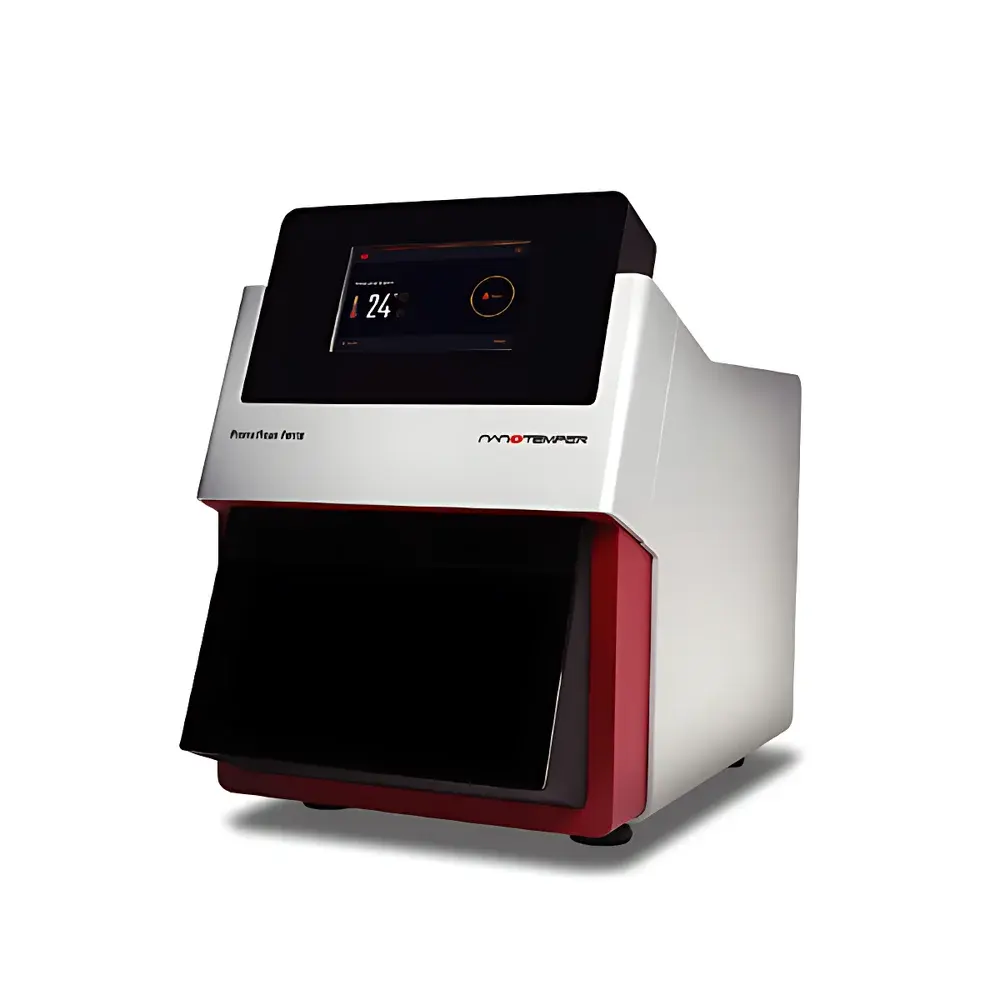
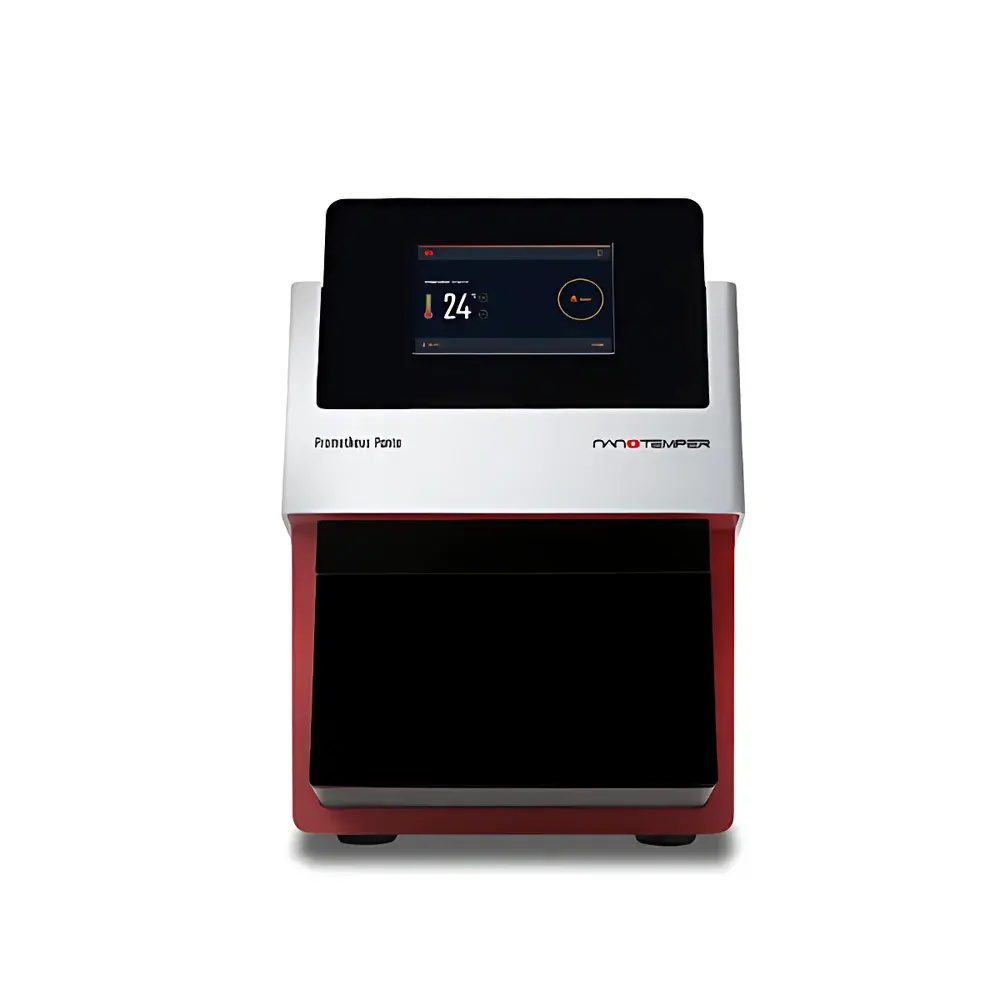
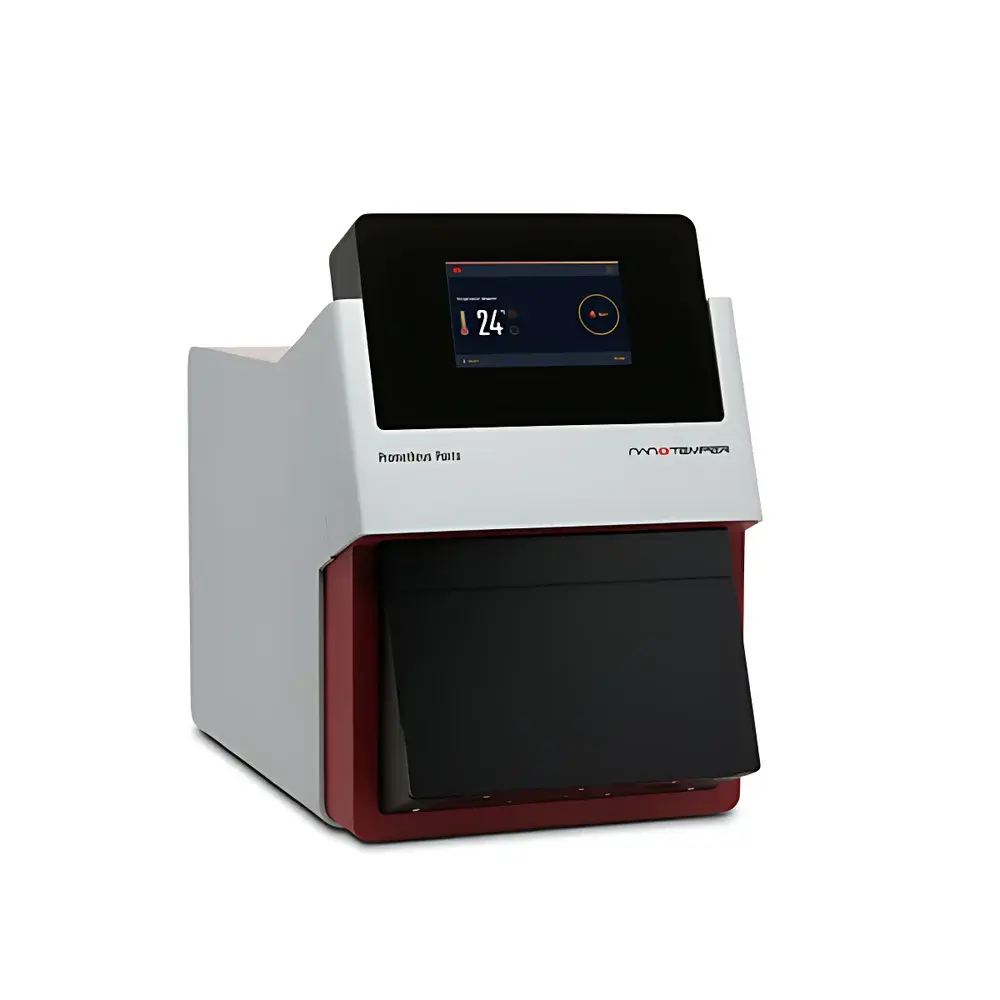
NanoTemper PR Panta Multi-Parameter Protein Stability Analyzer
| Brand | NanoTemper |
|---|---|
| Origin | Germany |
| Model | PR Panta |
| Temperature Control Range | 15 °C–95 °C (upgradeable to 110 °C with High-Temp Module) |
| Sample Volume | 10 μL |
| Sample Introduction | Capillary or capillary array |
| Dimensions | 35 cm (L) × 51 cm (H) × 52 cm (W) |
Overview
The NanoTemper PR Panta Multi-Parameter Protein Stability Analyzer is an integrated biophysical platform engineered for label-free, high-resolution characterization of protein conformational stability and colloidal behavior under native solution conditions. Leveraging orthogonal optical detection modalities—microscale differential scanning fluorimetry (oDSF), backreflection turbidity sensing, dynamic light scattering (DLS), and static light scattering (SLS)—the PR Panta simultaneously quantifies thermal unfolding transitions (Tm, Tonset), aggregation onset (Tturbidity), hydrodynamic radius (Rh), polydispersity, molecular weight, second virial coefficient (B22), and self-interaction parameters (kD). Unlike conventional techniques requiring covalent labeling, buffer exchange, or dilution, the PR Panta operates directly in formulation-relevant buffers—including viscous, high-salt, or low-pH media—enabling physiologically and industrially relevant measurements. Its capillary-based microfluidic architecture ensures minimal sample consumption (as low as 10 μL at ≥5 μg/mL), reproducible thermal ramping (0.1–5 °C/min), and intrinsic resistance to optical artifacts from particulates or air bubbles.
Key Features
- Label-free, native-state analysis: No dyes, tags, or buffer modification required; compatible with undiluted formulations and complex excipients.
- Multi-parameter acquisition in a single run: Concurrent measurement of Tm, Tonset, Tturbidity, Rh, size distribution, B22, and kD without method reconfiguration.
- Capillary-based microsampling: Automated or manual loading into precision-fused silica capillaries; eliminates pipetting variability and cross-contamination.
- High-temperature capability: Standard 15–95 °C range; optional high-temperature module extends operational range to 110 °C for extreme stability profiling.
- Scalable throughput: Supports 1–48 samples per run; compatible with robotic liquid handlers for unattended 1,356-sample screening campaigns.
- Robust optical architecture: Dual UV excitation (280 nm/295 nm) for ratiometric tryptophan/tyrosine fluorescence; calibrated backreflection detection for sub-micron aggregate resolution; temperature-stabilized DLS/SLS optics.
Sample Compatibility & Compliance
The PR Panta accepts native protein solutions—including monoclonal antibodies, Fc-fusions, enzymes, membrane proteins solubilized in detergents, intrinsically disordered proteins, and nucleic acid–protein complexes—across a broad range of viscosities (up to 20 cP), conductivities (≤500 mS/cm), and pH (3.0–10.5). It complies with Good Laboratory Practice (GLP) and Good Manufacturing Practice (GMP) data integrity requirements: audit trails, electronic signatures, and user-access controls are fully implemented in Panta Control and Panta Analysis software. Data export formats (CSV, PDF, HDF5) support traceability per FDA 21 CFR Part 11 and ISO/IEC 17025. Instrument qualification documentation (IQ/OQ/PQ) is available, and all optical calibrations are traceable to NIST-certified standards.
Software & Data Management
The PR Panta is operated via three interoperable software modules: Panta Control (instrument control and real-time acquisition), Panta AutoControl (high-throughput scheduling and robotic integration), and Panta Analysis (statistical comparison, batch processing, and report generation). Panta Analysis supports custom parameter overlays, replicate averaging, outlier detection (Grubbs’ test), and automated pass/fail criteria against user-defined stability thresholds (e.g., ΔTm ≤ 0.5 °C across batches). All raw intensity time-series, correlation functions, and scattering spectra are retained with full metadata (temperature, ramp rate, capillary ID, operator, timestamp). Exported datasets comply with FAIR principles (Findable, Accessible, Interoperable, Reusable) and integrate natively with ELN systems (e.g., LabArchives, Benchling) and statistical platforms (R, Python pandas).
Applications
- Developability assessment of therapeutic antibodies and bispecifics: ranking candidates by thermal margin, aggregation propensity, and colloidal stability.
- Comparability studies across manufacturing scales, cell lines, or purification processes per ICH Q5E guidelines.
- Formulation screening: systematic evaluation of pH, buffer species, ionic strength, surfactants, and cryoprotectants on conformational and colloidal stability.
- Chemical denaturation assays: determination of Gibbs free energy of unfolding (ΔG°) and m-values using urea or GdnHCl gradients.
- Accelerated stability testing: prediction of long-term storage behavior via Arrhenius modeling of Tturbidity and kD.
- Membrane protein detergent screening: identification of stabilizing micellar environments without detergent removal steps.
- Fragment-based drug discovery: detection of ligand-induced stabilization shifts (ΔTm) at sub-micromolar concentrations.
- Liquid–liquid phase separation (LLPS) studies: quantification of concentration-dependent condensate formation kinetics and reversibility.
FAQ
What sample volume is required per measurement?
A single measurement requires only 10 μL of sample at a minimum concentration of 5 μg/mL.
Can the instrument measure proteins in high-viscosity formulations?
Yes—the capillary loading system and label-free optical detection enable reliable measurements in solutions up to 20 cP without dilution or filtration.
How does oDSF differ from conventional DSF?
Orthogonal DSF (oDSF) uses ratiometric UV fluorescence (280 nm/295 nm) to eliminate inner-filter effects and buffer interference, delivering higher accuracy in complex matrices than single-wavelength DSF.
Is calibration required between runs?
No—optical pathways are factory-calibrated and thermally stabilized; capillaries are single-use consumables ensuring zero carryover and consistent pathlength.
Does the system support 21 CFR Part 11 compliance?
Yes—Panta software includes role-based access control, electronic signatures, immutable audit trails, and secure data archiving per regulatory requirements.




