
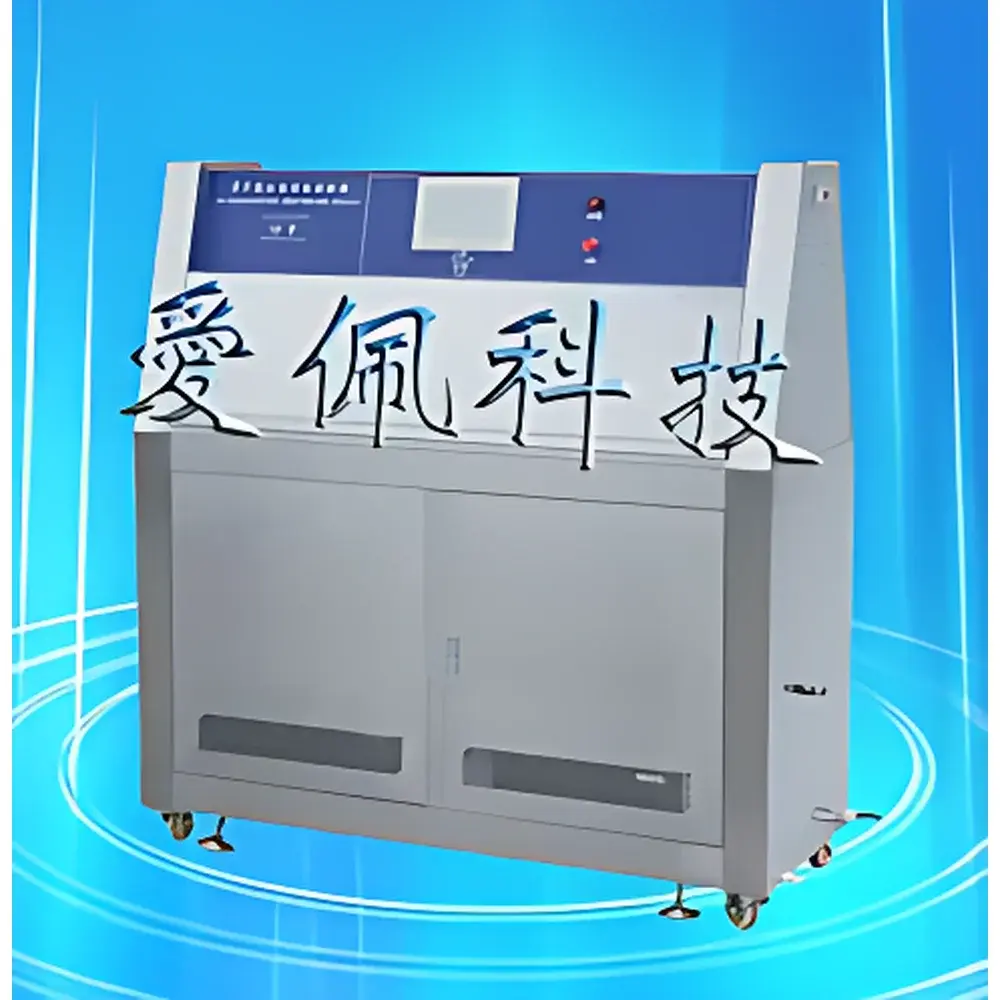
Apkji AP-UV-01 UV Aging Test Chamber
| Brand | Apkji |
|---|---|
| Origin | Guangdong, China |
| Manufacturer Type | OEM/ODM Manufacturer |
| Country of Origin | China |
| Model | AP-UV-01 |
| Pricing | Upon Request |
| UV Lamps | 8 × 40 W imported Atlas UVA-340 or UVB-313 fluorescent lamps |
| Lamp Life | 1600–1800 h |
| Irradiance Control | Optional CR-10 calibrated radiometer |
| Test Temperature Range | 50–75 °C (UV), 40–60 °C (condensation) |
| Temperature Uniformity | ±3 °C |
| Cycle Options | 4 h UV / 4 h condensation or 8 h UV / 4 h condensation |
| Sample Capacity | 48 pcs (75 × 150 mm or 75 × 300 mm standard clamps, max thickness 20 mm) |
| Chamber Dimensions (W×H×D) | 137 × 135 × 53 cm |
| Weight | 136 kg |
| Power Supply | 1φ 3W AC 220 V ±10%, 50/60 Hz, 2.2 kW (max) |
| Water Consumption | 8–18 L/day (deionized/distilled water) |
| Compliance | ASTM G154, ISO 4892-3, GB/T 16422.3, ASTM D4587, D4799, SAE J2020 |
Overview
The Apkji AP-UV-01 UV Aging Test Chamber is an engineered environmental test system designed to accelerate the evaluation of material degradation under simulated solar ultraviolet radiation and moisture exposure. It operates on the principle of controlled fluorescent UV irradiation combined with condensation cycles—mimicking the synergistic effects of sunlight, dew, and rain in outdoor environments. Unlike broad-spectrum xenon arc or carbon arc systems, this chamber employs narrow-band UV fluorescent lamps (UVA-340 or UVB-313) to replicate specific spectral regions critical for polymer photochemical degradation. The UVA-340 lamp closely matches terrestrial solar UV down to 295 nm, while UVB-313 provides enhanced short-wavelength output for aggressive stress testing. Degradation mechanisms assessed include photolysis, oxidation, chain scission, surface embrittlement, chalking, gloss loss, color shift, microcracking, and tensile strength reduction. By compressing years of natural weathering into days or weeks, the AP-UV-01 supports predictive durability modeling, formulation optimization, and comparative benchmarking across material batches and supplier alternatives.
Key Features
- Eight 40 W imported Atlas UV fluorescent lamps (4 per side), configurable as UVA-340 (for realistic sunlight simulation) or UVB-313 (for accelerated failure analysis)
- Precise thermal control: UV irradiation temperature range 50–75 °C; condensation temperature range 40–60 °C; uniformity maintained within ±3 °C across sample plane
- Programmable dual-phase cycling: selectable 4 h UV / 4 h condensation or 8 h UV / 4 h condensation sequences, enabling protocol alignment with ASTM G154 and ISO 4892-3
- Dedicated black panel thermometer placement on rear rack for accurate specimen surface temperature monitoring
- Standard sample capacity: 48 positions using 75 × 150 mm or 75 × 300 mm stainless-steel clamps (max sample thickness: 20 mm); non-standard fixtures available upon specification
- Integrated deionized water reservoir with daily consumption monitoring (8–18 L); automatic drain and clean-access design prevents scale accumulation during lamp replacement
- Lamp life management system: scheduled rotation and replacement strategy ensures stable irradiance output over 1600–1800 h per lamp; one lamp replaced after initial 400–500 h UV exposure
Sample Compatibility & Compliance
The AP-UV-01 accommodates rigid and semi-rigid flat specimens—including coatings, plastics, automotive trim, roofing membranes, textiles, and composites—without requiring complex mounting hardware. Its open-frame rack design allows unobstructed UV exposure and uniform condensate formation across all samples. All operational parameters adhere to internationally recognized standards for accelerated UV exposure testing: ASTM G154 (Standard Practice for Operating Fluorescent Ultraviolet (UV) Lamp Apparatus for Exposure of Non-Metallic Materials), ISO 4892-3 (Plastics — Methods of Exposure to Laboratory Light Sources — Part 3: Fluorescent UV Lamps), GB/T 16422.3 (Chinese national standard equivalent), ASTM D4587 (Coating Durability), ASTM D4799 (Roofing Membrane Testing), and SAE J2020 (Automotive Exterior Materials). While the chamber itself does not carry CE or UL certification, its architecture and control logic support integration into GLP-compliant laboratories when paired with validated SOPs and audit-ready documentation protocols.
Software & Data Management
The AP-UV-01 operates via a microprocessor-based digital controller with real-time display of chamber temperature, cycle phase status, elapsed exposure time, and lamp operating hours. Though it does not include embedded PC software or cloud connectivity, the system supports external data logging through optional accessories: a calibrated CR-10 radiometer enables traceable irradiance measurement (in W/m² at 340 nm or 313 nm), and an external recorder (optional) can archive temperature and cycle events for regulatory review. For laboratories subject to FDA 21 CFR Part 11 requirements, third-party validation packages—including IQ/OQ documentation templates, calibration certificates, and electronic audit trail configurations—are available upon request. All firmware revisions are version-controlled and documented per ISO/IEC 17025 traceability guidelines.
Applications
- Quality assurance of automotive interior/exterior components exposed to long-term solar loading
- Formulation screening for UV-stabilized polymers, pigments, and protective topcoats
- Comparative lifetime assessment of roofing membranes, geotextiles, and façade sealants
- Regulatory pre-submission testing for ISO 10993 biocompatibility or IEC 60601 medical device housing validation
- Supplier qualification and incoming material verification against contractual weathering specifications
- Correlation studies between accelerated UV exposure and real-world field performance databases
FAQ
What UV lamp types are supported, and how do they differ in application?
The AP-UV-01 accepts both UVA-340 and UVB-313 fluorescent lamps. UVA-340 replicates solar UV down to 295 nm and is recommended for realistic outdoor durability prediction. UVB-313 emits shorter wavelengths (down to 280 nm) and induces faster degradation—suitable for quality control screening or failure mode analysis.
Is irradiance monitoring included as standard equipment?
No. Irradiance measurement requires the optional CR-10 calibrated radiometer, which must be specified at time of order. This accessory provides NIST-traceable intensity readings essential for inter-laboratory reproducibility.
Can the chamber accommodate curved or three-dimensional samples?
The standard clamp geometry supports only flat specimens. Custom fixture engineering is available for non-planar parts, subject to dimensional constraints and UV shadowing analysis.
How is temperature uniformity verified across the test area?
Uniformity is validated during factory acceptance testing using 9-point thermocouple mapping per ASTM G154 Annex A1. A certificate of conformance is supplied with each unit.
Does the system meet FDA 21 CFR Part 11 requirements for electronic records?
The base controller does not provide audit trails or electronic signatures. However, full Part 11 compliance can be achieved through validated external data acquisition systems and documented procedural controls implemented by the end user.



