
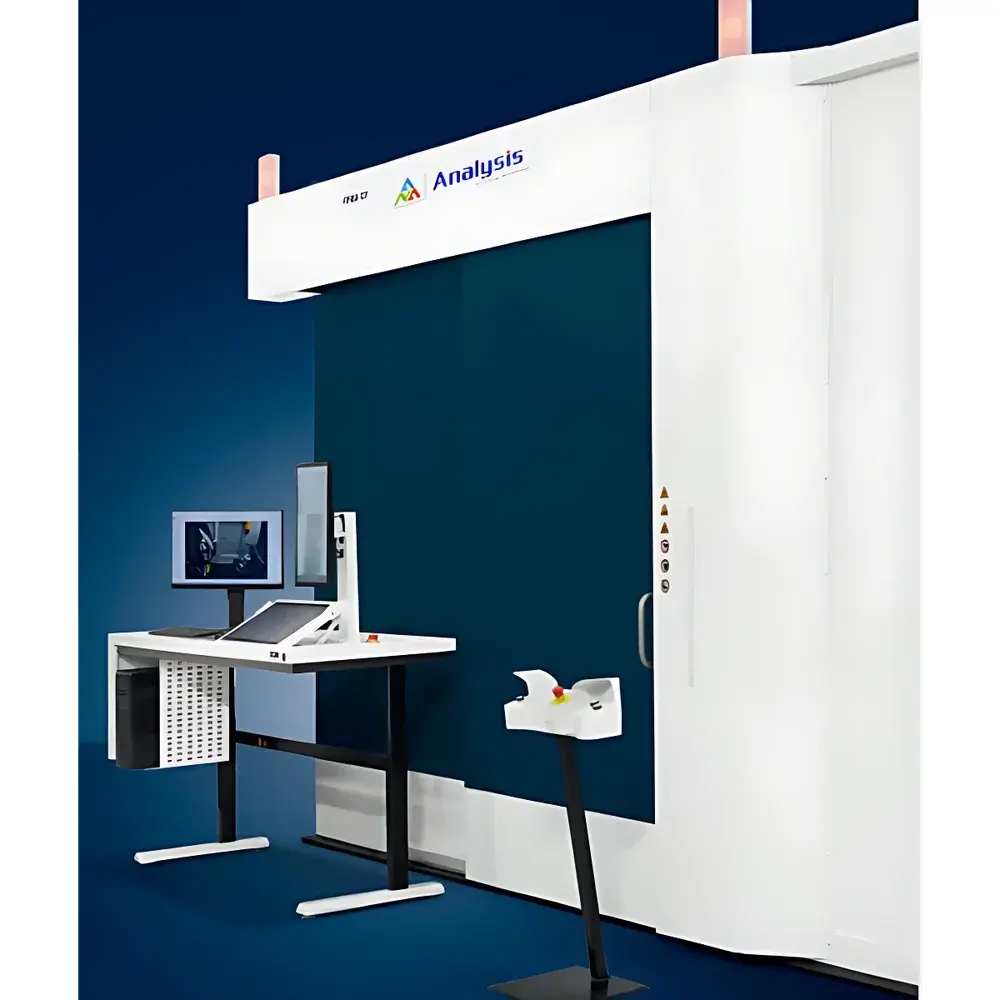
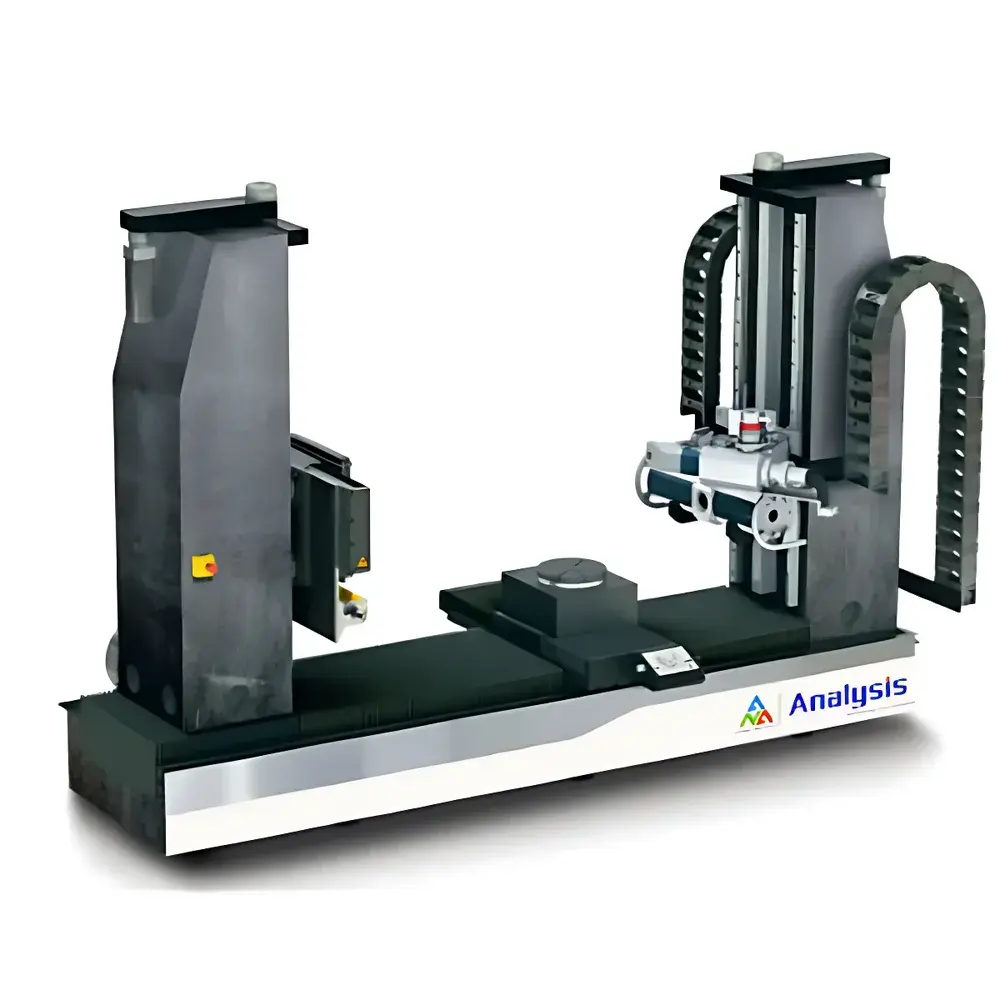
Analysis FF85 CT Industrial Micro-CT System
| Brand | Analysis |
|---|---|
| Origin | Germany |
| Model | FF85 CT |
| Detector Type | Flat-Panel Detector (FPD) & Linear Detector Array (LDA) |
| Scan Mode | Translation-Rotation (TR) |
| Spatial Resolution | Up to 2.5 lp/mm |
| Density Resolution | 0.2–0.5% |
| X-ray Energy | 450 kV (dual-source: up to 600 kV microfocus + 300 kV minifocus) |
| Penetration Capability | 60 mm steel equivalent |
| Measurement Accuracy (Dimensional) | 0.001 mm |
| Density Measurement Accuracy | Up to 0.2% |
| Sample Weight Capacity | 100 kg |
| Max Sample Dimensions | Ø800 mm × H1100 mm |
| System Dimensions | 3700 mm × 2300 mm × 2800 mm (L×W×H) |
| Base Material | Precision Granite |
| Motion Axes | 7-axis motorized manipulator |
| Software Platform | Gemini CTScan Suite (including CTScan 3 LDA support, HeliExtend, ScatterFix 2.0, BHC, MAR) |
Overview
The Analysis FF85 CT is a high-performance industrial micro-computed tomography (micro-CT) system engineered for non-destructive, high-fidelity 3D volumetric imaging across demanding R&D and production environments. Built upon dual X-ray source architecture—comprising a high-energy minifocus tube (up to 600 kV) and a high-resolution microfocus tube (up to 300 kV)—the system delivers scalable penetration depth and sub-millimeter structural fidelity in a single platform. Its core measurement principle relies on cone-beam and fan-beam CT reconstruction algorithms applied to projection data acquired via translation-rotation (TR) scanning geometry. This enables quantitative 3D analysis of internal geometry, material density distribution, porosity, cracks, inclusions, and assembly integrity—without physical sectioning. The system’s granite base provides exceptional thermal stability and mechanical rigidity, minimizing drift-induced artifacts during long-duration scans. Designed for compliance with international NDT standards—including ASTM E1441 (Standard Guide for Computed Tomography), ISO 15747 (Industrial CT terminology), and EN 16907 (CT-based dimensional metrology)—the FF85 CT serves as a traceable, audit-ready tool in GLP and GMP-regulated workflows.
Key Features
- Dual-source X-ray configuration: Independent minifocus (≤600 kV) and microfocus (≤300 kV) tubes enable seamless transition between high-penetration inspection of dense components (e.g., turbine blades, castings) and high-resolution imaging of fine features (e.g., solder joints, lattice structures in AM parts).
- Hybrid detector system: Integrated flat-panel detector (FPD) for high-throughput 3D cone-beam CT and proprietary CTScan 3 linear detector array (LDA) with 254 µm pixel pitch, optimized for low-noise, high-dynamic-range fan-beam acquisition—particularly effective for large or highly attenuating samples.
- 7-axis precision manipulator: Motorized rotation, tilt, translation (X/Y/Z), and detector positioning allow full geometric flexibility—supporting helical, dual-helical, and extended-field-of-view (EFOV) trajectories without hardware reconfiguration.
- Gemini user interface: Touch-enabled, workflow-driven software with graphical scan planning, real-time dose monitoring, and automated calibration routines—designed for both novice operators and expert metrologists.
- Advanced artifact suppression: Embedded ScatterFix 2.0 (scattering correction), beam hardening correction (BHC), and metal artifact reduction (MAR) algorithms ensure quantitatively accurate voxel intensity values across heterogeneous materials.
- Granite mechanical foundation: Monolithic granite base with integrated vibration isolation minimizes thermal expansion and mechanical hysteresis—critical for sub-micron repeatability in dimensional metrology applications.
Sample Compatibility & Compliance
The FF85 CT accommodates specimens ranging from small electronic assemblies (<50 mm) to large aerospace components (up to Ø800 mm × 1100 mm height) with maximum payload of 100 kg. It supports non-destructive evaluation of metallic alloys (Al, Ti, steel, superalloys), fiber-reinforced composites, additively manufactured parts, battery cells/modules, geological cores, paleontological specimens, and cultural heritage objects. All scanning protocols adhere to ISO/IEC 17025 requirements for testing laboratories, and the system supports FDA 21 CFR Part 11-compliant audit trails when deployed with optional electronic signature modules. Calibration certificates are traceable to PTB (Physikalisch-Technische Bundesanstalt) standards. For regulated industries, the platform integrates with enterprise QMS systems via standardized DICOM-CT and ASTM E2737-22 export formats.
Software & Data Management
The Gemini CTScan Suite provides end-to-end control—from scan parameterization and real-time projection monitoring to reconstruction, segmentation, and metrological analysis. Reconstruction leverages iterative (SART/SIRT) and filtered back-projection (FBP) engines with GPU acceleration. Quantitative analysis includes GD&T-compliant dimensional metrology (per ASME Y14.5 and ISO 1101), porosity/volume fraction mapping (ASTM E2903), wall thickness analysis, and defect classification (size, shape, location). Data export supports standard formats: DICOM-CT, VTK, STL, PLY, and CSV for statistical process control (SPC) integration. Optional CTScan Metrology Module delivers ISO 15530-3 traceable uncertainty budgets for certified measurements. All user actions, parameter changes, and reconstruction logs are timestamped and stored with digital signatures for full GLP/GMP compliance.
Applications
- R&D material characterization: Internal pore network analysis in lightweight alloys, binder burnout validation in ceramic green bodies, phase distribution in multiphase composites.
- First-article inspection: Full-volume verification of AM part conformity against CAD models—including overhang angle validation, support structure residue detection, and surface roughness mapping.
- Failure analysis: Non-invasive identification of fatigue cracks, delamination in laminates, dendritic growth in battery electrodes, and void coalescence in high-pressure die-cast components.
- Assembly verification: Positional accuracy of embedded sensors, solder joint integrity in PCBs, and clearance validation in gearboxes or hydraulic manifolds.
- Digital twin generation: High-fidelity 3D volume datasets serve as input for multiphysics simulation (e.g., CFD, FEA) and AI-driven anomaly detection model training.
- Cultural heritage documentation: Subsurface pigment layer mapping, corrosion assessment beneath patina, and virtual unwrapping of fragile manuscripts or mummified remains.
FAQ
What is the minimum detectable defect size under standard operating conditions?
Defects as small as 10–50 µm can be resolved depending on sample composition, geometry, and chosen acquisition parameters—validated per ASTM E2698 for resolution phantoms.
Does the system support automated batch scanning for production line integration?
Yes—Gemini supports scriptable workflows via Python API and OPC UA connectivity for integration into MES/SCADA environments.
Can the FF85 CT perform traceable dimensional metrology per ISO 15530-3?
With the optional Metrology Module and calibrated reference standards, it achieves measurement uncertainties down to ±(1.5 + L/300) µm (L in mm), compliant with VDI/VDE 2630-1.3.
Is remote operation and diagnostics supported?
Full remote access—including real-time scan supervision, parameter adjustment, and predictive maintenance alerts—is enabled via secure TLS-encrypted web interface.
How is radiation safety managed during operation?
The system complies with IEC 61331-1 and local regulatory requirements; fully interlocked shielded enclosure (lead-equivalent ≥5 mm Pb) with integrated dosimetry monitoring and emergency stop circuitry.



