
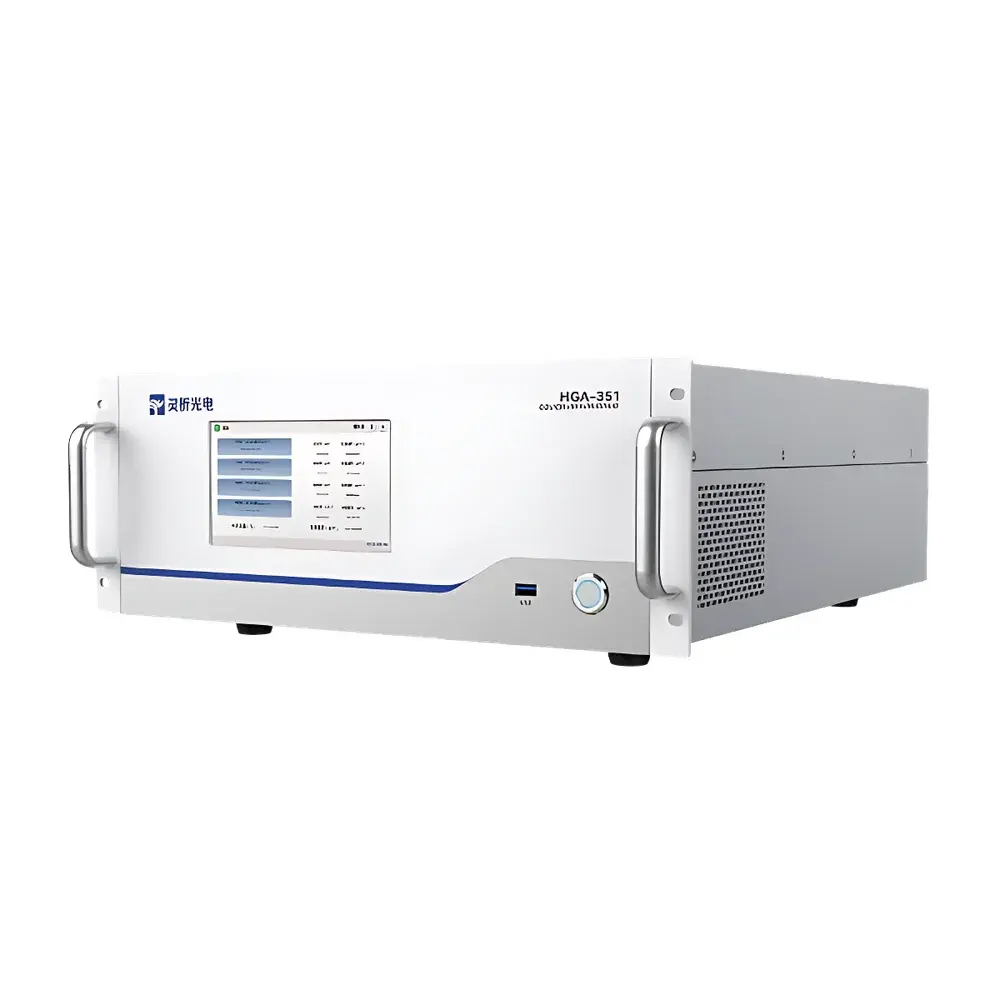
Lingxi Optoelectronics HGA-351 High-Precision Greenhouse Gas Analyzer
| Brand | Lingxi Optoelectronics |
|---|---|
| Origin | Zhejiang, China |
| Model | HGA-351 |
| Measurement Principle | Cavity Ring-Down Spectroscopy (CRDS) |
| Target Gases | CO₂, CH₄, NH₃, N₂O, H₂O |
| Detection Sensitivity | <1 ppb (for CO₂, CH₄, N₂O) |
| Water Vapor Correction | Integrated proprietary algorithm for dilution correction and dry-mole-fraction output |
| Operating Environment | Temperature- and pressure-stabilized optical cavity |
| Compliance | Designed for GLP-compliant environmental monitoring |
| Dimensions | Compact cavity design enabling effective optical path length >20 km in <1 L volume |
Overview
The Lingxi Optoelectronics HGA-351 High-Precision Greenhouse Gas Analyzer is a laboratory- and field-deployable CRDS-based instrument engineered for simultaneous, real-time quantification of five key atmospheric trace gases: carbon dioxide (CO₂), methane (CH₄), nitrous oxide (N₂O), ammonia (NH₃), and water vapor (H₂O). Leveraging Cavity Ring-Down Spectroscopy, the HGA-351 achieves sub-part-per-trillion (ppt) detection limits and long-term stability without reliance on frequent calibration gas injections. Its core optical architecture integrates a temperature- and pressure-controlled ultra-low-loss optical cavity, where laser pulses at precisely selected near-infrared absorption lines (e.g., 1.57 µm for CO₂, 1.65 µm for CH₄, 1.53 µm for NH₃, 4.5 µm for N₂O via quantum cascade laser option) are measured for decay time—directly proportional to gas concentration. This first-principles photonic measurement eliminates interference from matrix effects and provides absolute traceability to fundamental physical constants. The analyzer is purpose-built for continuous unattended operation in ambient air, soil flux chambers, eddy covariance systems, and mobile monitoring platforms.
Key Features
- Simultaneous multi-gas detection: CO₂, CH₄, N₂O, NH₃, and H₂O in a single integrated optical path—no external gas switching or hardware multiplexing required.
- ppb-level detection sensitivity with <±0.1 ppb long-term drift over 30 days (typical, under controlled lab conditions); verified via NIST-traceable reference standards.
- Proprietary water vapor correction algorithm that dynamically computes and compensates for dilution and spectroscopic interference effects, delivering validated dry-mole-fraction outputs for all target gases.
- Ammonia-optimized internal flow path featuring chemically inert, low-adsorption coating (e.g., SilcoNert® or equivalent) to minimize surface residence time and ensure <15-second T₉₀ response for NH₃.
- Compact high-finesse optical cavity (20 km effective pathlength—enabling laboratory-grade precision in a ruggedized, transportable enclosure rated IP54.
- Onboard thermal and barometric stabilization: PID-controlled cavity temperature (±0.01 °C) and pressure regulation (±0.05 mbar) ensure metrological consistency across diurnal and seasonal environmental gradients.
Sample Compatibility & Compliance
The HGA-351 accepts sample gas streams at flow rates of 0.5–2.0 L/min and pressures from 70–110 kPa (absolute), with inlet filtration (0.5 µm PTFE) and optional heated line integration for humid or particulate-laden environments. It complies with data integrity requirements for environmental reporting under ISO 14064-2 (GHG inventory verification), ASTM D6348 (standard test method for determination of gaseous compounds by GC/FTIR), and supports audit-ready metadata logging per GLP/GMP principles. While not FDA 21 CFR Part 11 certified out-of-the-box, its firmware supports configurable user access levels, electronic signature prompts, and tamper-evident audit trails when deployed with validated third-party LIMS interfaces.
Software & Data Management
The analyzer operates via embedded Linux-based firmware with dual communication protocols: Ethernet (TCP/IP) for SCADA integration and RS-232/RS-485 for legacy PLC interfacing. The included Lingxi Analytics Suite v3.2 provides real-time spectral visualization, automated baseline correction, multi-point zero/span validation logs, and export in CF-standard-compliant NetCDF-4 format. All raw ring-down decay curves, cavity pressure/temperature telemetry, and diagnostic flags are timestamped with UTC-synchronized GPS or NTP source. Data files include embedded MD5 checksums and support SHA-256 hashing for chain-of-custody documentation in regulatory submissions.
Applications
- Soil-atmosphere flux measurements using static/dynamic chambers or automated chamber networks—enabling high-temporal-resolution N₂O and CH₄ emission quantification aligned with IPCC Tier 2 methodologies.
- Urban and regional atmospheric monitoring networks for source attribution, trend analysis, and model validation—particularly in megacities implementing carbon neutrality roadmaps.
- Controlled-environment agriculture and livestock facility emissions profiling, where NH₃ co-monitoring with CH₄ and N₂O supports integrated air quality and nutrient management strategies.
- Calibration transfer and reference intercomparison studies at national metrology institutes and WMO-GAW stations requiring stable, drift-free baselines over extended deployment cycles.
- Mobile platform integration (e.g., vehicle-mounted or drone-payload configurations) for spatial mapping of fugitive emissions from landfills, wastewater treatment plants, and natural gas infrastructure.
FAQ
What is the recommended calibration frequency for routine environmental monitoring?
For GLP-aligned operation, a two-point (zero and span) verification every 7 days is advised; full multi-point calibration using certified standard gases is recommended quarterly or after maintenance.
Can the HGA-351 operate unattended for extended field deployments?
Yes—designed for continuous operation up to 12 months with remote diagnostics, watchdog-triggered self-recovery, and low-power sleep modes compatible with solar/battery hybrid power systems.
Does the analyzer require external cooling or chiller units?
No—the integrated thermoelectric cooler (TEC) and passive heat-sink architecture maintain cavity thermal stability without liquid coolant or compressor-based refrigeration.
How is cross-sensitivity between NH₃ and H₂O mitigated during humid sampling?
The instrument applies a physics-based multivariate correction model trained on >10⁴ synthetic and empirical spectra, accounting for both collisional broadening and H₂O-induced baseline shifts in the NH₃ absorption band.
Is raw spectral data accessible for custom post-processing?
Yes—full decay waveform datasets (time-resolved photon count arrays) are streamed via Ethernet and archived alongside processed concentration values, enabling independent reanalysis using user-defined fitting algorithms.







