
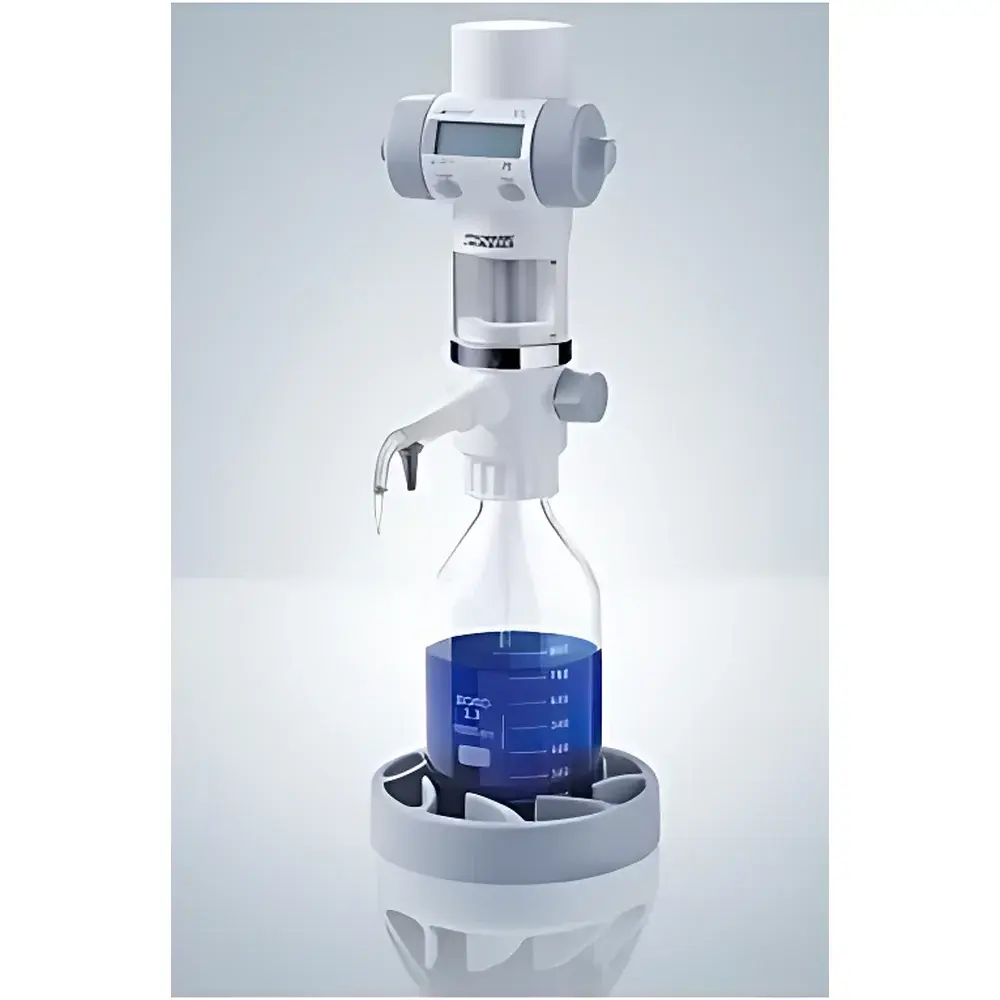
Hirschmann solarus® Photovoltaic Electronic Titrator
| Brand | Hirschmann |
|---|---|
| Origin | Germany |
| Model | solarus® |
| Volume Options | 10 mL, 20 mL, 50 mL |
| Power Source | Integrated monocrystalline silicon photovoltaic cell (no batteries required) |
| Minimum Dispensing Increment | 10 µL |
| Compliance | ISO 9001, DIN EN ISO 9000, GLP, GMP, DIN 12650, ASTM E202–22 |
| Calibration | Onboard Quick-Cal self-calibration routine |
| Data Interface | RS-232 or USB (optional) for PC connectivity |
| Construction | Fully disassemblable PTFE/PP/POM modular body with hardened stainless-steel linear guide rails |
| Display | High-contrast LCD with real-time volume and rate indication |
| Bubble Management | Integrated reflux priming system with automatic air expulsion and retraction |
| Environmental Certification | RoHS 3, REACH compliant |
| Quality Documentation | Individual serial-numbered full inspection report traceable to DIN EN ISO 9000 quality management framework |
Overview
The Hirschmann solarus® Photovoltaic Electronic Titrator is a precision-engineered liquid dispensing instrument designed for volumetric titration in analytical, quality control, and production environments. Unlike conventional electronic titrators reliant on disposable or rechargeable batteries, the solarus® employs an integrated monocrystalline silicon photovoltaic cell—capable of generating sufficient power under ambient laboratory lighting (≥300 lux) or direct LED/fluorescent illumination—to drive its micro-stepping motor, optical encoder, and digital display continuously. This photovoltaic architecture eliminates battery dependency, mitigating risks associated with electrolyte leakage, voltage drift, and periodic replacement downtime. The device operates on the principle of positive displacement via a high-tolerance glass syringe barrel and PTFE-coated plunger, coupled with closed-loop position feedback from an optical rotary encoder. Its mechanical design conforms to DIN 12650 for burette accuracy and repeatability, delivering certified volumetric performance across its three calibrated volume ranges (10 mL, 20 mL, and 50 mL), each independently verified per ISO/IEC 17025-accredited test protocols.
Key Features
- Photovoltaic energy harvesting: No batteries required; operational under standard lab lighting conditions without external power supply.
- Precision dispensing at 10 µL resolution with ±0.2% volumetric accuracy (at 20 °C, water, Class A calibration).
- Fully disassemblable modular construction using chemically resistant polymers (PP, POM) and PTFE-sealed glass syringes for easy cleaning, sterilization, and maintenance.
- Hardened stainless-steel linear guide rails ensure long-term mechanical stability and resistance to wear during repeated actuation cycles.
- Integrated reflux priming system enables rapid deaeration prior to titration and full retraction of residual reagent post-run—minimizing waste, preventing cross-contamination, and enhancing operator safety.
- Onboard Quick-Cal function allows user-initiated calibration verification and adjustment without external standards or service intervention.
- Real-time LCD display shows dispensed volume, flow rate, and cumulative total—eliminating parallax error inherent in analog burettes.
- Compact footprint (145 × 85 × 290 mm) optimized for fume hood integration and space-constrained workstations.
Sample Compatibility & Compliance
The solarus® is compatible with aqueous solutions, organic solvents (e.g., ethanol, acetone, chloroform), and mild acids/bases within pH 1–12. All wetted materials comply with USP Class VI and FDA 21 CFR 177.2440 specifications. Each unit undergoes individual volumetric verification against NIST-traceable reference standards and ships with a serial-numbered full inspection report—fully embeddable into ISO 9000, ISO 17025, or GxP quality documentation systems. The device meets DIN EN ISO 9001 requirements for design control, manufacturing traceability, and post-delivery support. It supports audit-ready operation under GLP and GMP frameworks, including electronic record integrity (when paired with compliant data acquisition software adhering to 21 CFR Part 11 principles).
Software & Data Management
The solarus® supports bidirectional communication via RS-232 or optional USB interface, enabling seamless integration with LIMS, ELN, or custom laboratory software. Raw titration logs—including timestamp, volume increment, direction (dispense/aspirate), and calibration status—are exportable in CSV or XML format. When used with Hirschmann’s TitraSoft™ Suite (v3.2+), users gain automated report generation, statistical process control (SPC) charts, and electronic signature functionality aligned with FDA 21 CFR Part 11 Annex 11 expectations. All data transfers are checksum-verified to prevent corruption, and local storage retains ≥1,000 titration events with metadata tagging for method versioning and analyst identification.
Applications
This titrator is routinely deployed in pharmaceutical QC labs for acid-base, redox, and complexometric assays (e.g., EDTA titrations per USP <541>); in food & beverage testing for acidity (titratable acidity per AOAC 942.05) and salt content analysis; in environmental labs for COD and alkalinity determination (APHA 2310B, 2320B); and in academic research settings requiring trace-level reagent delivery with documented metrological traceability. Its solar-powered autonomy makes it especially suitable for mobile labs, field-deployable analytical units, and sustainability-certified facilities pursuing LEED or ISO 14001 compliance.
FAQ
Does the solarus® require direct sunlight to operate?
No. It functions reliably under typical laboratory illumination (≥300 lux), including LED and fluorescent overhead lighting. Direct sunlight is neither necessary nor recommended for prolonged exposure.
Can the solarus® be used with viscous or particulate-containing solutions?
It is optimized for low-viscosity liquids (<50 mPa·s). Suspensions or highly viscous media may impair plunger seal integrity and volumetric fidelity; pre-filtration or alternative dispensing methods are advised.
How often must Quick-Cal be performed?
Hirschmann recommends daily verification before first use and after any significant temperature shift (>5 °C) or mechanical impact. Full recalibration is required annually or per internal SOPs aligned with ISO/IEC 17025 Clause 6.5.
Is the photovoltaic module replaceable?
Yes—the PV assembly is a field-serviceable subassembly with a rated service life of >10 years under continuous lab lighting. Replacement kits and technical bulletins are available through authorized Hirschmann service centers.
Does the reflux system accommodate all common titration reagents?
The reflux path is compatible with non-aggressive reagents meeting material compatibility guidelines (e.g., no concentrated HNO₃, HF, or strong oxidizers above 30% w/w). Compatibility charts are provided in the Technical Manual Rev. 4.1.



