
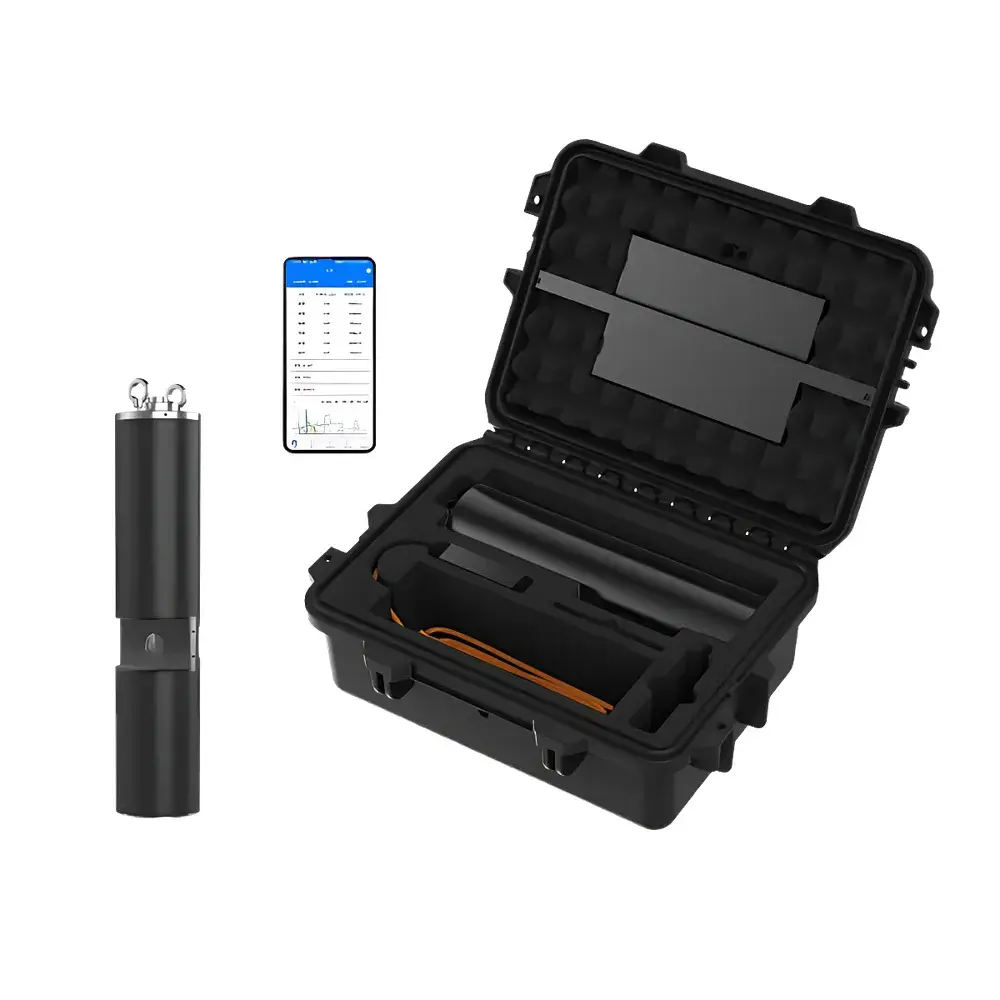
EXPEC BGA-3000 Automated Algal Analyzer
| Brand | EXPEC (Puyu Technology) |
|---|---|
| Origin | Zhejiang, China |
| Model | BGA-3000 |
| Measurement Principle | In-situ Fluorescence Spectroscopy |
| Dual Parameters | Algal Density & Chlorophyll-a Concentration |
| Depth Rating | Up to 200 m |
| Compensation | Automatic Temperature & Turbidity Compensation |
| Algorithm | Background Fluorescence Subtraction |
| Portability | Integrated Hand-Carried Case Design |
| Software Platforms | Android, iOS, Windows |
| Compliance | Designed for GLP-aligned environmental monitoring workflows |
Overview
The EXPEC BGA-3000 Automated Algal Analyzer is an in-situ field instrument engineered for rapid, reagent-free quantification of phytoplankton biomass and chlorophyll-a concentration in natural and engineered aquatic systems. It operates on the principle of multi-wavelength excitation fluorescence spectroscopy, leveraging the intrinsic fluorescence emission signatures of photosynthetic pigments—primarily chlorophyll-a, phycocyanin, phycoerythrin, and fucoxanthin—to differentiate algal taxonomic groups (e.g., Cyanobacteria, Chlorophyta, Bacillariophyta, Cryptophyta) and estimate their relative abundance. Unlike traditional lab-based methods requiring filtration, extraction, and spectrophotometric or HPLC analysis, the BGA-3000 delivers real-time, depth-resolved data without sample preservation or chemical reagents. Its optical architecture integrates narrow-band LEDs and high-sensitivity photodiodes calibrated against NIST-traceable standards, enabling stable signal acquisition under variable ambient light and turbid conditions. The system is purpose-built for deployment in dynamic freshwater environments where rapid response to bloom development, vertical stratification, and diel pigment dynamics is operationally critical.
Key Features
- Multi-parameter in-situ measurement: Simultaneous quantification of total algal density (cells/mL equivalent) and chlorophyll-a concentration (µg/L), with unit conversion traceable to standard fluorometric protocols (e.g., ASTM D3731–19).
- Depth-profiling capability: Integrated pressure sensor and winch-compatible cable enable continuous vertical profiling from surface to 200 m depth; data logged with synchronized depth, temperature, and fluorescence metrics.
- Optical interference mitigation: Real-time background fluorescence subtraction algorithm removes contributions from dissolved organic matter (DOM), humic substances, and non-algal particulates—validated using Suwannee River Natural Organic Matter (SRNOM) reference matrices.
- Environmental compensation: Onboard thermistor and backscatter turbidity sensor feed into a dual-compensation model that corrects for temperature-dependent quantum yield drift and scattering-induced signal attenuation.
- Modular optical head design: High-integration optoelectronic subassembly minimizes alignment sensitivity and thermal drift, contributing to long-term field stability and reduced calibration frequency per ISO 17025 maintenance guidelines.
- Cross-platform data interface: Native applications for Android, iOS, and Windows support offline configuration, live telemetry visualization, GPS-tagged station metadata capture, and CSV/NetCDF export compliant with EPA STORET and EU WISE data schemas.
Sample Compatibility & Compliance
The BGA-3000 is validated for use in low-to-moderate conductivity freshwater matrices including oligotrophic lakes, eutrophic reservoirs, drinking water intake zones, and urban canal systems (EC < 1,500 µS/cm). It is not intended for marine or hypersaline applications due to refractive index mismatch and halide-induced quenching effects on chlorophyll fluorescence. All firmware and data handling routines adhere to principles outlined in ISO/IEC 17025:2017 for testing laboratories, with audit trails enabled for GLP-compliant deployments. While not FDA 21 CFR Part 11 certified out-of-the-box, the Windows desktop application supports optional digital signature logging and user-access-controlled data export—facilitating integration into GMP-aligned water quality surveillance programs.
Software & Data Management
Data acquisition and post-processing are managed via the EXPEC AquaView Suite—a modular software environment supporting both real-time telemetry and batch-mode analysis of depth-stacked profiles. Raw fluorescence spectra (excitation: 450 nm, 520 nm, 570 nm, 610 nm; emission: 680 nm, 710 nm) are stored with full metadata (UTC timestamp, GPS coordinates, pressure, temperature, tilt angle). Spectral unmixing employs constrained non-negative matrix factorization (cNMF) trained on laboratory-cultured monocultures and field-collected mixed assemblages. Export options include standardized WaterML 2.0 encoding, compatibility with QGIS and ArcGIS for spatial interpolation, and direct ingestion into LimnoLogic or ELCOM hydrodynamic-ecological modeling frameworks.
Applications
- Early-warning monitoring of cyanobacterial blooms in drinking water source protection zones
- Vertical distribution mapping of phytoplankton during thermal stratification in deep lakes
- Long-term trend analysis of chlorophyll-a dynamics across seasonal cycles in reservoir management
- Regulatory compliance reporting under China’s “Blue Sky and Clear Water Protection Campaign” and EU Water Framework Directive (WFD) Article 8 monitoring requirements
- Field validation of satellite-derived chlorophyll-a products (e.g., Sentinel-3 OLCI, Landsat-9 OLI-2)
- Research-grade phytoplankton community structure assessment in limnological and climate change impact studies
FAQ
Does the BGA-3000 require daily calibration?
No—factory calibration is stable for ≥6 months under typical field conditions; annual verification against secondary chlorophyll-a standards (e.g., Sigma-Aldrich Chl-a in acetone) is recommended.
Can it distinguish Microcystis from Anabaena in mixed blooms?
Yes—the multi-wavelength excitation profile enables partial spectral separation; quantitative discrimination is enhanced when combined with concurrent temperature and nutrient context.
Is the optical head waterproof to 200 m static pressure?
Yes—the titanium-housed probe meets IP68 rating and has passed hydrostatic pressure testing at 2.1 MPa (equivalent to 214 m SWL) per IEC 60529.
How is data security handled during wireless transmission?
All Bluetooth and Wi-Fi communications use TLS 1.2 encryption; local device storage employs AES-256 encryption with user-defined passcode enforcement.
What maintenance is required between deployments?
Rinsing with deionized water post-use, inspection of O-rings, and quarterly cleaning of optical windows with lens-grade tissue and isopropanol—no optical recalibration needed.
Related Products







