
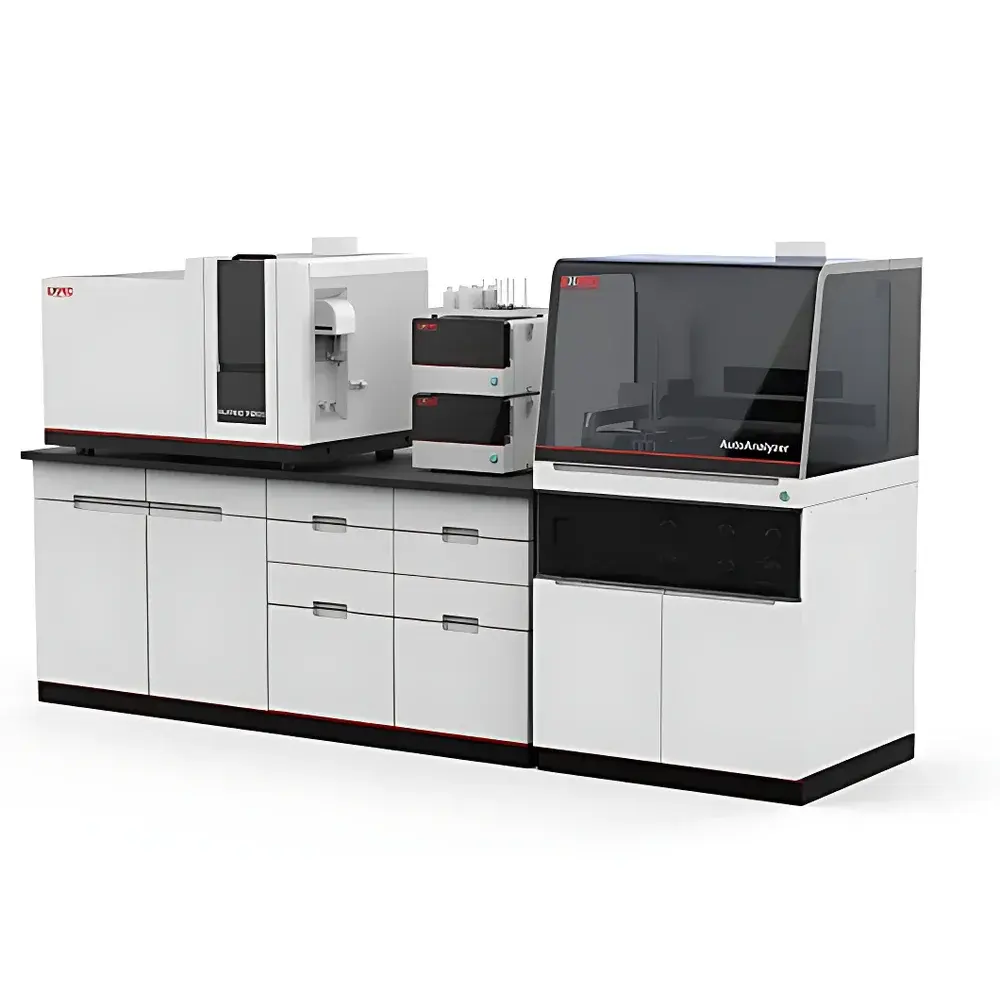
EXPEC SUPEC 7020 Fully Automated Heavy Metal Analysis System (ICP-MS)
| Brand | EXPEC |
|---|---|
| Origin | Zhejiang, China |
| Manufacturer Type | Authorized Distributor |
| Product Category | Domestic |
| Model | SUPEC 7020 |
| Instrument Type | Quadrupole ICP-MS |
| Application Environment | Laboratory |
| Key Features | Integrated Auto-Digestion (Graphite/Super Microwave) + ICP-MS Analysis |
| Automation Level | Full End-to-End Sample-to-Result |
| Safety Compliance | Corrosive Acid Handling (HNO₃, HCl, HF, HClO₄), Auto-Quenching, Acid Fume Management |
| Calibration & QC | Auto-Standard Curve Generation, Multi-Point QC Triggering (BLK, CRM, LOD), Smart Re-Run Logic |
| Sample Throughput | ≤60 Samples/Day (Configurable) |
| Sample Forms | Solid & Liquid Matrices |
| Software | EXPEC LabManager v4.x (21 CFR Part 11 Compliant Audit Trail) |
Overview
The EXPEC SUPEC 7020 Fully Automated Heavy Metal Analysis System is an integrated quadrupole inductively coupled plasma mass spectrometer (ICP-MS) platform engineered for unattended, end-to-end elemental quantification—from solid or liquid sample introduction through digestion, dilution, filtration, and isotopic detection. Unlike conventional benchtop ICP-MS systems requiring manual sample preparation, the SUPEC 7020 embeds either an automated graphite block digester or a high-pressure super-microwave digestion module directly into its workflow architecture. This integration enables true walk-away operation: samples are loaded once, and the system autonomously executes acid addition, temperature-ramped digestion, cooling, lid sealing/unsealing, post-digestion fume extraction, volumetric定容 (5–50 mL range), ultrasonic volume sensing, bubble-assisted homogenization, inline filtration, and finally, nebulized introduction into the plasma source. The core measurement principle relies on ionization of analytes in a 7,000–10,000 K Ar plasma, followed by mass separation via a robust RF-driven quadrupole mass filter and detection using a discrete-dynode electron multiplier. The system targets regulatory-grade trace metal analysis in environmental, food safety, clinical toxicology, and geochemical laboratories where reproducibility, contamination control, and auditability are non-negotiable.
Key Features
- Fully synchronized digestion–analysis coupling: Eliminates inter-system transfer, reducing carryover risk and blank elevation.
- Corrosion-resistant fluidic path: Chemically inert PFA/ETFE tubing and ceramic valves rated for continuous use with HNO₃, HCl, HF, and HClO₄—validated per ASTM D5673 for acid digestion integrity.
- Intelligent volumetric control: Dual-mode precision—ultrasonic liquid-level sensing combined with 0.025 mL accuracy syringe pumps ensures gravimetrically traceable dilution across 5–50 mL ranges.
- Auto-ignition and plasma optimization: Real-time RF impedance matching and torch alignment algorithms initiate stable plasma within 90 seconds of startup; auto-tuning maintains optimal CeO⁺/Ce⁺ & Ba²⁺/Ba⁺ ratios during sequence execution.
- Dynamic QC decision engine: Configurable pass/fail thresholds trigger automatic re-analysis of blanks, certified reference materials (CRMs), or low-concentration spikes; supports multi-tiered action protocols (e.g., pause-and-alert vs. silent re-injection).
- Fail-safe thermal and pressure management: Super-microwave digestion modules incorporate dual IR temperature sensors and rupture-disc–protected vessels; graphite digesters feature redundant overtemperature cutoffs and active acid vapor condensation.
Sample Compatibility & Compliance
The SUPEC 7020 accommodates heterogeneous matrices including soils, sediments, biological tissues (fresh/frozen), wastewater, drinking water, food homogenates, and pharmaceutical excipients. Solid samples up to 1 g (dry weight) are accepted; liquids up to 10 mL. All digestion protocols adhere to ISO 17294-2:2016 (water analysis) and EPA Method 6020B (trace elements in solids/liquids). The system’s software architecture complies with FDA 21 CFR Part 11 requirements—including electronic signatures, immutable audit trails, role-based access control, and data integrity validation reports. Hardware design meets IEC 61010-1:2010 for laboratory equipment safety, with CE marking for EMC and LVD directives.
Software & Data Management
EXPEC LabManager v4.x provides a unified interface for method development, sequence scheduling, real-time status monitoring (digestion temperature/pressure, plasma stability, detector voltage), and post-run review. All calibration curves display residual error plots, weighting functions (1/x, 1/x²), and dynamic linear range annotations. Raw count-per-second (CPS) data, isotope ratios, and RSD% values are exported in ASTM E1382-compliant .csv and .xlsx formats. Audit logs record every user action, parameter change, and instrument state transition with timestamp, IP address, and operator ID. Data backups follow GLP-aligned retention policies (minimum 7-year archival), and optional integration with LIMS via ASTM E1467-compliant HL7 or ODBC drivers is supported.
Applications
- Environmental compliance testing: Pb, Cd, As, Hg, U quantification in soil leachates per TCLP (EPA 1311) and total recoverable metals in wastewater per EPA 200.8.
- Food safety surveillance: Screening of rice, infant formula, and seafood for inorganic arsenic speciation-ready digests (post-ICP-MS hyphenation).
- Clinical toxicology: Quantitative multi-element blood/urine panels (e.g., Co, Cr, Ni, V) aligned with CLIA and CAP proficiency testing guidelines.
- Pharmaceutical quality control: Residual catalyst screening (Pd, Pt, Rh) in APIs per ICH Q2(R2) validation requirements.
- Geochemical research: High-precision isotope ratio measurements (e.g., ⁸⁷Sr/⁸⁶Sr) following matrix separation via inline chelating columns.
FAQ
Does the SUPEC 7020 support method validation per ISO/IEC 17025?
Yes—the system includes built-in tools for linearity assessment (≥5-point curves), limit of detection (LOD) calculation per IUPAC recommendations, repeatability testing (n ≥ 6 replicates), and intermediate precision evaluation across operators/days.
Can the digestion module be upgraded from graphite to super-microwave post-purchase?
Yes—both modules share identical mechanical mounting interfaces and software command sets; field upgrade kits include hardware retrofitting and firmware reconfiguration.
Is remote monitoring supported during unattended overnight runs?
Yes—LabManager v4.x offers secure HTTPS-based web dashboard access with live video feed from onboard digestion chamber cameras and SMS/email alerting for critical events (e.g., pressure excursion, plasma extinction).
How is cross-contamination prevented between high- and low-level samples?
The system employs dedicated high-purity quartz sample introduction lines, programmable rinse cycles with 5% HNO₃ + 0.1% HF, and real-time memory effect diagnostics based on washout kinetics of ²⁰⁸Pb and ²³⁸U isotopes.
What documentation is provided for regulatory submissions?
A complete validation package is delivered: IQ/OQ/PQ protocols, 3Q summary report, software verification evidence (including Part 11 configuration files), and a traceable metrology certificate for all volumetric and temperature sensors.
Related Products






