
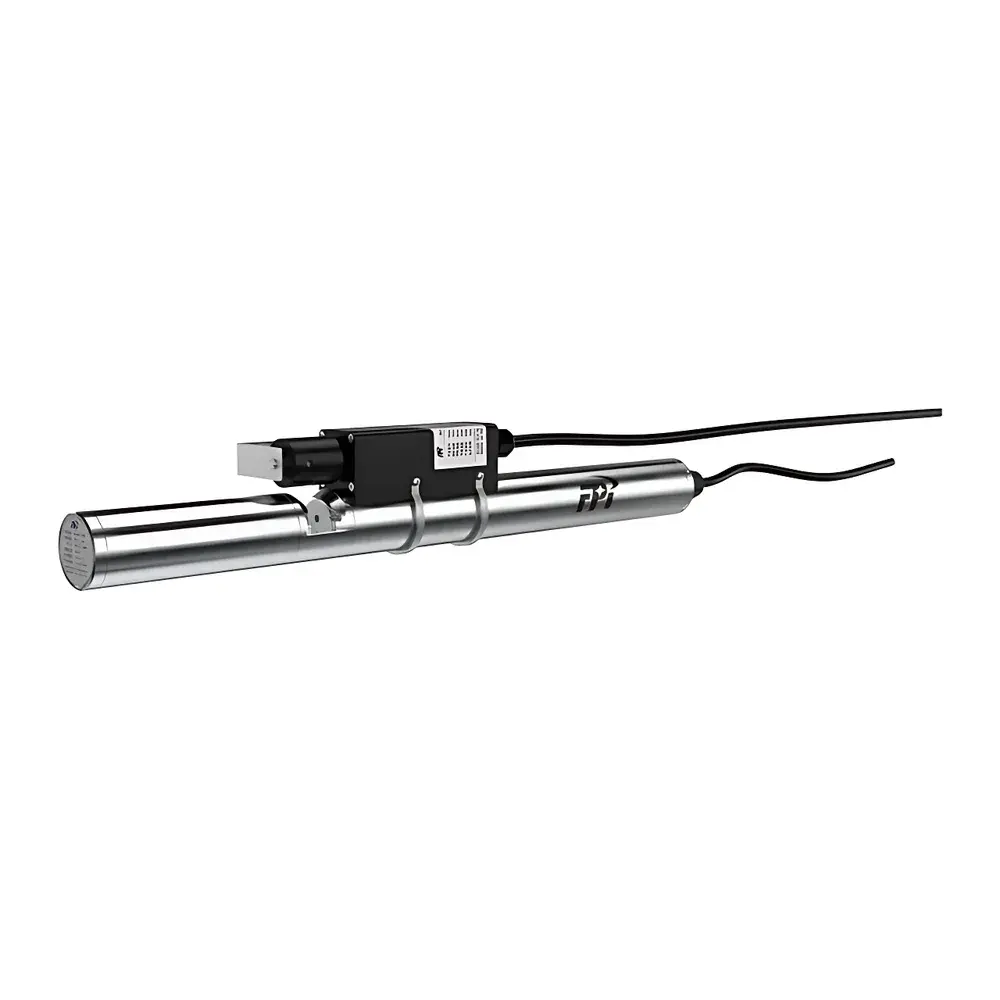
FPI BWATER-1000 UV-Vis Full-Spectrum In Situ Water Quality Analyzer
| Brand | FPI |
|---|---|
| Origin | Zhejiang, China |
| Manufacturer Type | Original Equipment Manufacturer (OEM) |
| Product Category | Domestic |
| Model | BWATER-1000 |
| Instrument Type | Online Water Quality Analyzer |
| Measurable Parameters | COD, TOC, BOD₅, Turbidity, Color, Total Suspended Solids (TSS), Nitrate, Nitrite, Specific UV Absorbance at 254 nm (SUVA₂₅₄) |
| Compliance Standard | T/CWEC 13–2019 |
| Detection Principle | Dual-Beam UV-Vis Absorption Spectroscopy (190–800 nm) |
| Response Time | ≤15 s |
| Deployment Mode | Submersible In Situ Probe |
| Data Transmission | 4G Cellular Real-Time Uplink |
| Maintenance Interval | ≥3 months (with automatic cleaning cycle) |
| Reagent-Free Operation | Yes |
Overview
The FPI BWATER-1000 is an in situ, reagent-free online water quality analyzer engineered for continuous, multi-parameter monitoring of natural and wastewater matrices using dual-beam ultraviolet–visible (UV-Vis) full-spectrum absorption spectroscopy. Operating across a calibrated wavelength range of 190–800 nm, the instrument captures high-resolution spectral absorbance profiles from water samples directly in the field—without physical sampling, filtration, or chemical reagents. By applying chemometric modeling (including partial least squares regression and multivariate curve resolution), the system deconvolves overlapping spectral signatures to quantify key water quality indicators with trace-level sensitivity and analytical reproducibility. Designed for permanent submersion in open channels, reservoirs, influent/effluent streams, and sewer networks, the BWATER-1000 delivers real-time, lab-grade data while eliminating operational risks associated with sample transport, storage, and manual analysis.
Key Features
- True in situ measurement: Submersible probe enables direct optical interrogation of water without extraction or flow-through cells.
- Reagent-free operation: Eliminates consumables, hazardous waste generation, and calibration drift caused by reagent degradation—supporting ISO 14001-aligned environmental stewardship.
- Dual-beam optical architecture: Compensates for lamp aging, fouling-induced signal attenuation, and ambient light interference, ensuring long-term photometric stability (±0.5% absorbance drift over 6 months).
- Integrated ultrasonic self-cleaning module: Activated on programmable intervals (default: every 4 hours), reducing biofilm accumulation and maintaining optical path integrity under high-fouling conditions.
- Multi-parameter quantification from single spectral acquisition: Simultaneous estimation of COD, TOC, BOD₅ (5-day biochemical oxygen demand proxy), turbidity (NTU), true color (Pt-Co units), TSS (mg/L), nitrate (NO₃⁻-N), nitrite (NO₂⁻-N), and SUVA₂₅₄—all traceable to NIST-traceable reference standards.
- Real-time telemetry via industrial-grade 4G LTE modem: Supports MQTT and Modbus TCP protocols; data packets include timestamp, QC flags, spectral raw data checksums, and diagnostic metadata.
- Ruggedized IP68 housing: Stainless steel 316L body with sapphire optical windows; rated for continuous operation at depths up to 10 m and temperatures from 0–40 °C.
Sample Compatibility & Compliance
The BWATER-1000 is validated for use in surface water (reservoirs, rivers, lakes), municipal wastewater (influent, secondary effluent, tertiary discharge), stormwater runoff, and combined sewer overflows. It meets the technical requirements of China’s T/CWEC 13–2019 standard for “Online Monitoring Instruments for Water Quality – Technical Requirements for UV-Vis Spectral Analyzers.” While not certified to ASTM D5129 (TOC), ASTM D1208 (color), or ISO 7027 (turbidity) as a standalone device, its output parameters are cross-validated against these methods during factory calibration and user site verification per GLP-compliant protocols. The analyzer supports audit-ready data logging compliant with 21 CFR Part 11 Annex 11 principles—including electronic signatures, immutable event logs, and version-controlled firmware updates.
Software & Data Management
The embedded firmware (v3.2+) features onboard spectral preprocessing (baseline correction, scatter compensation, Savitzky–Golay smoothing) and real-time chemometric inference. Data is transmitted to FPI’s cloud platform—WaterInsight™—which provides role-based dashboards, automated anomaly detection (using PCA-based residual thresholds), and exportable CSV/JSON reports with ISO/IEC 17025-aligned uncertainty statements. Local edge storage (32 GB microSD) retains 90 days of raw spectra and processed metrics. Remote configuration, spectral library updates, and model retraining are supported via secure TLS 1.3 API endpoints. All software modules undergo annual third-party penetration testing and comply with IEC 62443-3-3 SL2 cybersecurity requirements.
Applications
- Reservoir and drinking water source monitoring: Early detection of algal bloom precursors (e.g., elevated SUVA₂₅₄ + nitrate), organic loading shifts, and seasonal color/turbidity dynamics.
- Wastewater treatment plant process control: Real-time tracking of biodegradable organics (BOD₅ proxy), nitrification/denitrification efficiency (nitrate/nitrite ratio), and clarifier performance (TSS/turbidity correlation).
- Urban drainage network surveillance: Event-driven monitoring of CSO events, illicit discharge identification via spectral fingerprint mismatch, and hydraulic residence time estimation using temporal absorbance decay profiles.
- Regulatory compliance reporting: Automated generation of daily/monthly summary files aligned with local ecological monitoring mandates (e.g., China’s HJ 353–2019, HJ 354–2019).
FAQ
Does the BWATER-1000 require periodic calibration with standard solutions?
Yes—initial factory calibration is performed using NIST-traceable reference materials; field recalibration is recommended every 3 months or after major maintenance, using certified aqueous standards for COD, nitrate, and turbidity.
Can the instrument differentiate between humic substances and protein-like organics in the UV region?
Yes—the chemometric model incorporates second-derivative spectral features and PARAFAC decomposition to resolve overlapping peaks at ~210 nm (peptide bonds), ~230 nm (aromatic amino acids), and ~254 nm (humic chromophores).
Is the probe compatible with SCADA integration via Modbus RTU over RS-485?
No—only Modbus TCP over Ethernet or 4G LTE is supported; RS-485 is not implemented due to EMI susceptibility in wet utility environments.
What is the minimum detectable COD concentration under typical river water conditions?
The practical limit of quantitation (LOQ) is 5 mg/L COD in low-turbidity (<5 NTU), low-chloride (<100 mg/L Cl⁻) matrices; performance degrades linearly above 50 NTU or 500 mg/L Cl⁻ without matrix-specific model adaptation.
How is data integrity ensured during cellular network outages?
All measurements are buffered locally with timestamped CRC-32 checksums; upon connection restoration, queued data is transmitted with sequence validation and duplicate suppression logic.
Related Products







