
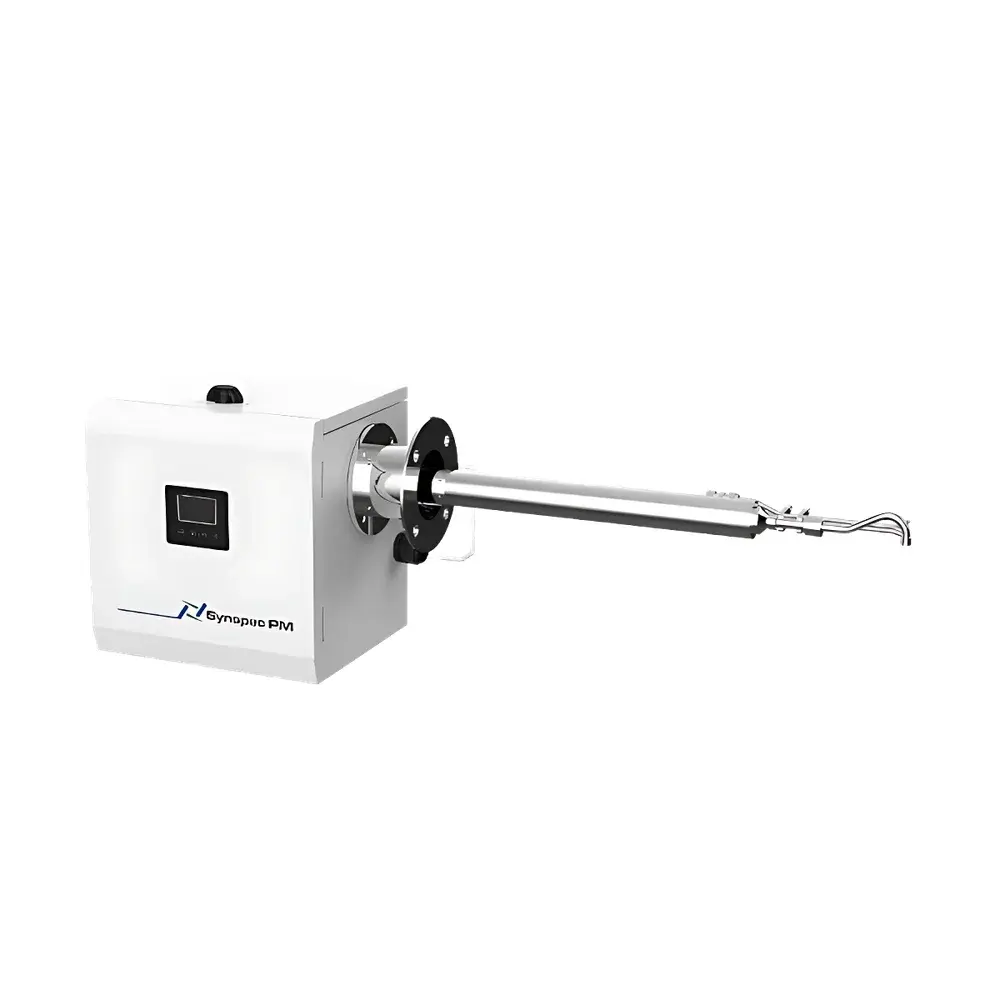
Synspec PM Series Online Particulate Matter Monitoring System
| Brand | EXPEC (Focusing Photonics) |
|---|---|
| Origin | Zhejiang, China |
| Manufacturer Type | Authorized Distributor |
| Country of Origin | China |
| Model | Synspec PM Series |
| Pricing | Available Upon Request |
Overview
The Synspec PM Series Online Particulate Matter Monitoring System is an extractive, isokinetic sampling-based continuous emission monitoring system (CEMS) engineered for accurate, real-time quantification of low-concentration particulate matter (PM) in flue gas streams. Designed specifically for compliance with ultra-low emission standards—particularly in coal-fired power plants, steel sintering facilities, and cement kiln stacks—the system employs forward-scatter optical detection principles grounded in Mie scattering theory. Light from a stable, temperature-compensated laser source interacts with suspended particles in a conditioned sample stream; the intensity and angular distribution of scattered light are correlated to mass concentration via factory-calibrated transfer functions traceable to NIST-traceable reference aerosols. Isokinetic sampling ensures representative particle capture across varying flue gas velocities (typically 5–30 m/s), while integrated thermal management maintains probe and transport line temperatures above dew point to prevent condensation-induced bias.
Key Features
- Isokinetic sampling probe compliant with U.S. EPA Method 5 and ISO 9096 requirements for representative particulate sampling under dynamic flow conditions
- High-temperature extractive sampling train operating continuously up to 200 °C, enabling stable operation in saturated, high-humidity flue gases without dilution or chiller-induced particle loss
- Forward-scatter optical detection geometry optimized for sub-1 mg/m³ measurement range, achieving detection limits ≤0.1 mg/m³ (at 95% confidence, 60-second averaging)
- Integrated multi-parameter sensor module providing simultaneous, synchronized measurements of flue gas temperature (±1 °C), static pressure (±10 Pa), and volumetric flow velocity (±2% FS, using pitot-static principle)
- Modular architecture with self-diagnostic firmware, automatic zero/span verification routines, and hot-swappable optical cells—designed for ≥85% operational uptime over 12-month intervals per EN 14181 QAL1 validation cycle
Sample Compatibility & Compliance
The Synspec PM Series accommodates both dry and moisture-saturated flue gas matrices containing particulates ranging from sub-micron soot aggregates to coarse fly ash (typical aerodynamic diameter dae: 0.1–100 µm). It meets performance criteria outlined in Chinese HJ 75-2017 and HJ 76-2017 for CEMS, and its measurement methodology aligns with international references including ISO 12141 (determination of PM in stationary source emissions) and EN 13284-1 (low-range dust measurement). All data acquisition and storage comply with GLP/GMP-aligned audit trail requirements, supporting 21 CFR Part 11-compliant electronic records when deployed with validated EXPEC DataHub software.
Software & Data Management
System operation, calibration logging, and diagnostics are managed through EXPEC CEMS Manager v3.x—a Windows-based platform supporting dual-mode deployment (local HMI or remote SCADA integration via Modbus TCP/RTU and OPC UA). Raw scatter signals, environmental compensation parameters, and QA/QC flags are timestamped with millisecond precision and stored locally on industrial-grade SSDs (≥18 months of 1-minute averaged data). Export formats include CSV, XML, and EPA-compatible DAS files. Remote firmware updates, alarm threshold configuration, and automated report generation (daily compliance summaries, drift logs, maintenance alerts) are enabled via TLS 1.2-secured web interface.
Applications
The Synspec PM Series is deployed at stack outlets and process ducts across regulated heavy industries requiring continuous, legally defensible PM reporting. Typical use cases include: real-time monitoring of electrostatic precipitator (ESP) and fabric filter (FF) outlet concentrations in thermal power generation; sinter machine and blast furnace gas cleaning verification in integrated steelworks; catalyst fines tracking in FCC units and fluidized bed reactors within petrochemical complexes; and clinker cooler exhaust PM surveillance in rotary kiln-based cement production. Its robustness in high-dust, high-moisture environments also supports applications in waste-to-energy incineration and biomass combustion facilities.
FAQ
Does the system require periodic manual calibration with reference aerosols?
No—zero and span verification are fully automated using built-in optical shutter and certified reference attenuation filters; optional gravimetric audit support per HJ 76-2017 is available upon request.
Can it operate without external cooling water or compressed air?
Yes—the system is air-cooled and does not rely on utility-supplied purge gases or coolant loops, reducing site infrastructure dependencies.
What is the recommended maintenance interval for optical components?
Optical windows and scatter chamber surfaces are rated for ≥6 months of continuous operation in typical coal flue gas; cleaning frequency is dynamically adjusted based on real-time signal stability metrics.
Is third-party certification (e.g., TÜV, MCERTS) available for this model?
Yes—TÜV-certified QAL1 test reports and MCERTS equivalency documentation are provided for EU and UK deployments upon project-specific validation.
How is isokinetic flow matching maintained during variable stack velocities?
A differential pressure-controlled sampling pump with closed-loop feedback adjusts suction rate in real time using upstream pitot tube signals, maintaining velocity ratio within ±5% of actual flue gas velocity.
Related Products







