
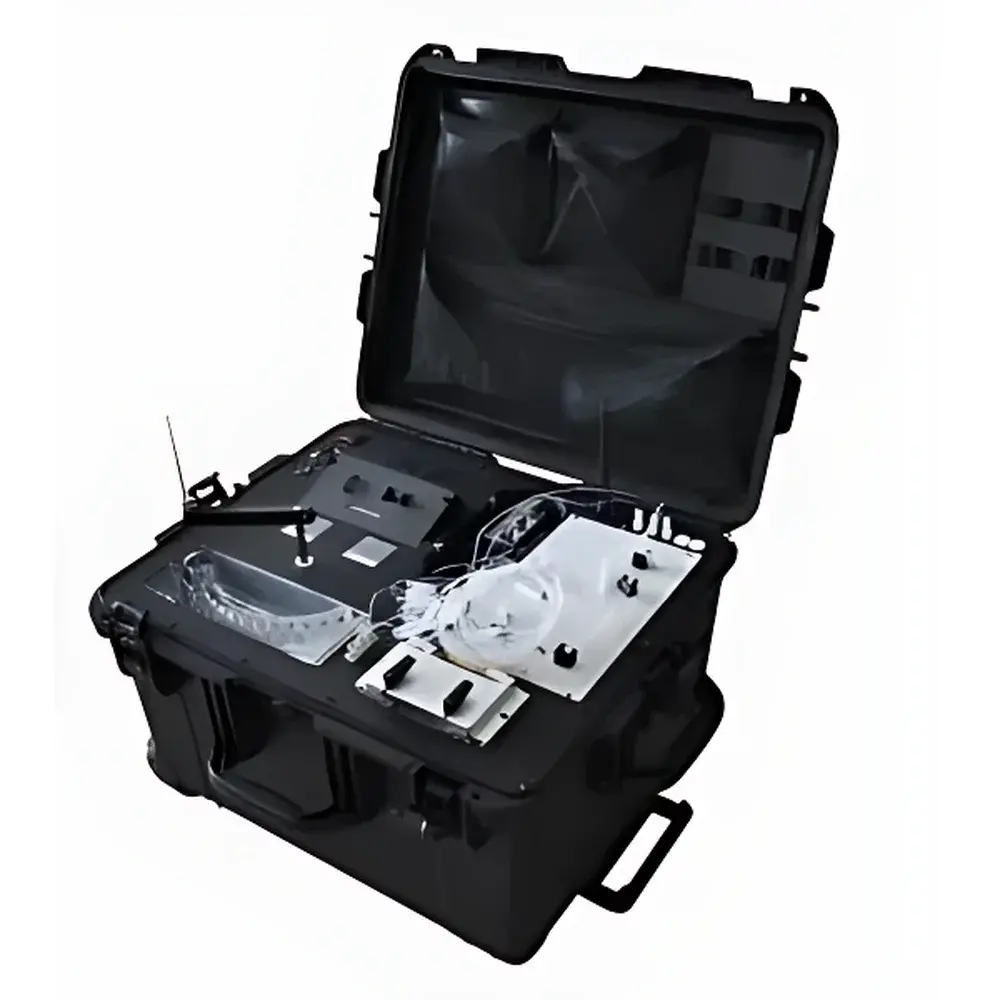
Titan Instruments M-lab iFIA5 Portable Flow Injection Analyzer
| Brand | Titan Instruments |
|---|---|
| Origin | Beijing, China |
| Model | M-lab iFIA5 |
| Wavelength Range | 340–1100 nm |
| Sample Capacity | 85–301 positions |
| Reagent Positions | 12 |
| Flow Cell Path Length | 10–30 mm |
| Light Source | Tungsten-Halogen Lamp |
Overview
The Titan Instruments M-lab iFIA5 Portable Flow Injection Analyzer is a field-deployable, fully integrated analytical platform engineered for high-precision, automated wet-chemical analysis using flow injection (FI) methodology. Based on the principle of controlled dispersion and reproducible reaction kinetics in a continuous carrier stream, the system enables rapid, reagent-efficient quantification of analytes—including ammonia nitrogen, total nitrogen, total phosphorus, cyanide, phenols, sulfide, anionic surfactants, hexavalent chromium, and more—directly in environmental water matrices. Its compact, ruggedized architecture integrates all core FI components—autosampler, peristaltic pumping manifold, chemical reaction coil modules (including optional on-board digestion, distillation, and extraction units), and a dual-beam photometric detector—into a single transportable unit compliant with IEC 60529 IP67 and IK08 mechanical impact resistance standards.
Key Features
- Field-ready portable design: Integrated into a wheeled, airline-compliant carry case with built-in rechargeable power supply, enabling uninterrupted operation for >8 hours without external AC input.
- Ruggedized enclosure: IP67-rated waterproof housing (submersible up to 1 m for ≥30 min), IK08 impact-resistant chassis, lockable latches, and ergonomic carrying straps ensure operational integrity under harsh field conditions—including low-temperature environments down to –10 °C.
- High-sensitivity dual-beam optical detection: Tungsten-halogen light source coupled with a thermally stabilized, miniaturized dual-beam spectrophotometer (340–1100 nm) minimizes baseline drift and enhances signal-to-noise ratio; typical method detection limits reach sub-ppb levels for key analytes such as cyanide and volatile phenols.
- Automated sample processing: Integrated pressure-regulated fluid handling system ensures stable, pulse-free reagent and sample delivery over extended run times; eliminates manual pretreatment steps via configurable on-board digestion (e.g., alkaline persulfate for TN), steam distillation (for NH₃-N), or liquid–liquid extraction modules.
- Modular expandability: Supports seamless integration of optional 50–300-position autosamplers for unattended batch analysis, accommodating diverse throughput requirements without hardware redesign.
Sample Compatibility & Compliance
The M-lab iFIA5 is validated for direct analysis of raw and treated drinking water, groundwater, surface water, wastewater effluents, and leachates. It complies with multiple national and international standard methods, including GB 8538–2016 (China), HJ 666–2013 through HJ 908–2017 (China EPA), and equivalent ISO, DIN, and U.S. EPA methodologies (e.g., EPA Method 353.2, ISO 11905-1, DIN EN ISO 11905-2). All certified methods meet GLP and GMP-aligned data integrity requirements, with full audit trail support for instrument status, method parameters, calibration history, and raw absorbance traces.
Software & Data Management
The proprietary iFIA Control Suite features a hierarchical, visual workflow interface with real-time system diagnostics—including pump rotation monitoring, valve actuation logging, temperature stabilization alerts, and optical path integrity checks. Preloaded with NIST-traceable calibration curves and standardized method templates, the software supports multi-point calibration, QC sample scheduling, automatic outlier rejection, and export of results in CSV, PDF, and LIMS-compatible formats. Full 21 CFR Part 11 compliance is achieved via electronic signatures, role-based access control, and immutable audit logs with timestamped operator actions.
Applications
- Regulatory environmental monitoring: On-site compliance testing for municipal water utilities and industrial discharge points per national water quality standards.
- Emergency response: Rapid deployment during contamination incidents (e.g., cyanide spills, phenol leaks) with minimal setup time and no laboratory infrastructure dependency.
- Research & method development: Flexible module configuration supports optimization of FI protocols—including zone trapping, solid-phase extraction coupling, and gradient reagent delivery—for emerging contaminants.
- Education & training: Used in university teaching labs to demonstrate kinetic-based analytical principles, fluidics engineering, and regulatory method validation workflows.
FAQ
Is the M-lab iFIA5 suitable for use in uncontrolled outdoor environments?
Yes—the system operates reliably between –10 °C and +45 °C and maintains full functionality when exposed to rain, dust, or temporary submersion.
Does the instrument support remote monitoring and data transmission?
It includes Ethernet and USB interfaces; optional 4G/LTE module enables secure cloud-based data upload and remote diagnostic access via TLS-encrypted connection.
Can existing laboratory FI methods be transferred to the M-lab iFIA5?
Method porting is supported through parameter mapping tools; retention time, dispersion coefficient, and reaction coil geometry adjustments are guided by built-in method conversion wizards.
What maintenance intervals are recommended for field deployments?
Pump tubing replacement every 200–300 hours of operation; optical window cleaning after 500 injections; full system verification using certified reference materials every 30 days or per project requirement.
Is third-party software integration possible?
Yes—open API (RESTful JSON) allows bidirectional communication with LIMS, ELN, and SCADA platforms, supporting automated result ingestion and instrument command orchestration.




