
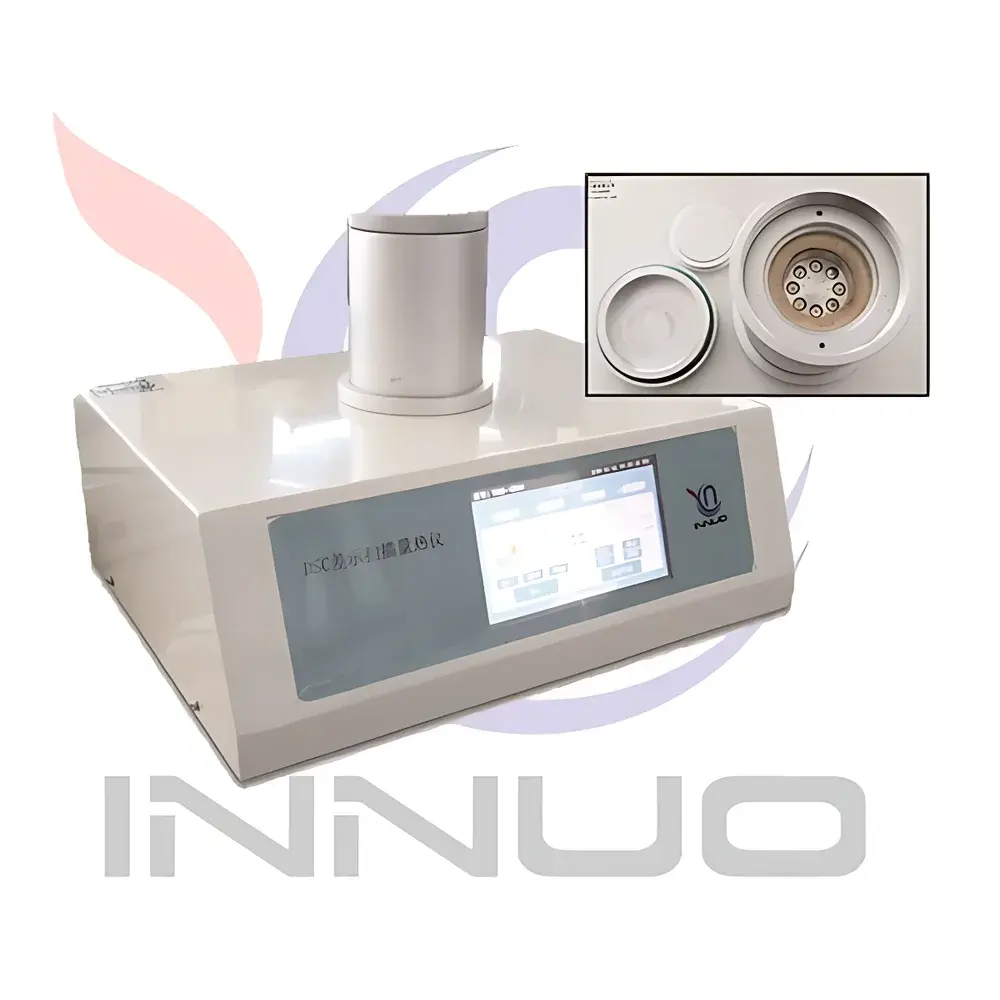
INNUO YND-OM4 Multi-Sample Differential Scanning Calorimeter
| Brand | INNUO |
|---|---|
| Origin | Shanghai, China |
| Model | YND-OM4 |
| Temperature Range | RT to 500 °C |
| Temperature Accuracy | ±0.01 °C |
| Heating/Cooling Rate | 0.1–80 K/min |
| Sample Capacity | Up to 8 samples per run (configurable for 4/6/8) |
| DSC Range | 0 to ±500 mW |
| DSC Resolution | 0.01 mW |
| DSC Sensitivity | 0.01 mW |
| Gas Control | Dual-channel mass flow control (N₂/O₂), 0–200 mL/min, accuracy ±0.2 mL/min |
| Power Supply | AC 220 V, 50 Hz |
| Interface | Integrated USB 2.0 |
| Display | 7-inch color capacitive touchscreen |
| Compliance | GB/T 19466.3–2009 / ISO 11357-3:1999 (OIT determination) |
Overview
The INNUO YND-OM4 Multi-Sample Differential Scanning Calorimeter is engineered for high-throughput thermal characterization of solid and semi-crystalline materials using heat-flux DSC methodology. It operates on the principle of measuring differential heat flow between a sample and inert reference as both are subjected to identical, precisely controlled temperature programs. This enables quantitative analysis of endothermic and exothermic transitions—including glass transition (Tg), melting (Tm), crystallization (Tc), cold crystallization, solid-solid phase changes, crosslinking enthalpy, and oxidation induction time (OIT) under isothermal or dynamic conditions. Designed for laboratories requiring statistical robustness and inter-sample comparability, the YND-OM4 integrates a single-furnace, multi-position sensor architecture—eliminating inter-run thermal drift and ensuring identical thermal history across all simultaneously measured specimens. Its core application domain spans polymer R&D, quality assurance in compounding and extrusion, stability assessment of pharmaceutical formulations, and regulatory compliance testing per international thermal analysis standards.
Key Features
- Simultaneous multi-sample measurement capability: configurable for 4, 6, or 8 samples per run—enabling up to 8× throughput increase versus conventional single-sample DSC systems.
- Patented symmetrical furnace design with integrated multi-zone thermal shielding ensures uniform heating profiles and minimal thermal lag across all sample positions.
- Hermetically sealed sensor-stage sample holder prevents particulate ingress and eliminates risk of crucible displacement or contamination during extended thermal cycling.
- Dual-gas mass flow control system with digital MFCs provides rapid, stable switching between N₂ and O₂ atmospheres (0–200 mL/min, ±0.2 mL/min accuracy) without manual valve intervention.
- Industrial-grade 7-inch capacitive touchscreen interface displays real-time parameters: sample temperature, setpoint, gas flow rates, DSC signal, atmosphere status, and auto-zero confirmation—all accessible without external PC connection.
- Embedded USB 2.0 interface supports plug-and-play connectivity with full auto-recovery from transient communication loss; no driver installation required on Windows OS (Win2000 through Win11).
- Pre-calibrated with certified reference materials (In, Sn, Zn) for traceable temperature and enthalpy calibration; users may perform in-house verification per ASTM E794 and ISO 11357-1 protocols.
Sample Compatibility & Compliance
The YND-OM4 accommodates standard aluminum crucibles (Φ6.7 × 3 mm) and supports hermetically sealed, high-pressure, and ceramic variants via optional accessories. It complies with GB/T 19466.3–2009 and its harmonized international counterpart ISO 11357-3:1999 for oxidation induction time (OIT) determination under both isothermal (e.g., 200 °C) and dynamic (ramped) conditions. The instrument’s thermal uniformity, reproducibility, and data integrity meet the technical prerequisites for GLP-compliant thermal analysis workflows. While not FDA 21 CFR Part 11–certified out-of-the-box, its software architecture supports audit-trail logging, user access levels, and electronic signature integration when deployed within validated laboratory information management systems (LIMS).
Software & Data Management
The included INNUO-Therm v4.x software offers full programmability via macro-based instruction sets—supporting over 30 discrete commands (e.g., “SetRate”, “HoldTemp”, “SwitchGas”, “AutoBaseline”) that users combine into custom thermal protocols. All methods are saved as encrypted .thm files with embedded metadata (operator ID, timestamp, instrument serial). The software dynamically scales curve rendering based on display resolution (tested on 1024×768 to 3840×2160), ensuring consistent visual interpretation across laptops, desktops, and touch-enabled workstations. Raw DSC thermograms are exported in ASCII (.txt) and universal .csv formats; derivative curves (dH/dt) and peak integration results comply with ASTM E1356 conventions. Batch processing tools enable parallel analysis of multi-sample datasets for statistical evaluation of Tg, ΔHf, or OIT variance.
Applications
- Quantification of oxidative stability in polyolefins (PP, PE), elastomers, and lubricants via standardized OIT testing per ISO 11357-6.
- Crystallinity assessment and melt behavior analysis of semi-crystalline polymers including PET, PBT, and nylon grades.
- Thermal cure kinetics modeling of epoxy, phenolic, and unsaturated polyester resins using isoconversional methods (e.g., Friedman, Ozawa-Flynn-Wall).
- Pharmaceutical solid-state characterization: detection of polymorphic transitions, amorphous content estimation, and excipient compatibility screening.
- Quality control of recycled polymer streams—rapid identification of compositional heterogeneity through comparative Tm/Tg clustering across 8 parallel samples.
FAQ
What is the maximum number of samples that can be analyzed simultaneously?
The YND-OM4 supports up to eight (8) samples per run, with hardware-configurable options for 4-, 6-, or 8-position operation.
Does the system support automated OIT measurement according to ISO 11357-6?
Yes—the instrument includes preloaded ISO-compliant OIT test templates with automatic gas-switching logic, isothermal hold initiation, and endpoint detection based on first-derivative threshold criteria.
Can the DSC sensitivity be verified independently by the user?
Yes—calibration verification is supported using supplied In, Sn, and Zn standards; temperature accuracy and enthalpy response are traceable to NIST SRMs.
Is nitrogen purge required before oxygen exposure during OIT testing?
The dual-channel MFC ensures sequential, zero-crossing gas purging: N₂ flow is maintained until thermal equilibrium, then automatically replaced with O₂ at user-defined flow rate and timing.
What operating systems are compatible with the acquisition software?
INNUO-Therm v4.x supports Windows 2000 through Windows 11 (32-bit and 64-bit), with native DPI scaling and multi-monitor configuration support.



