
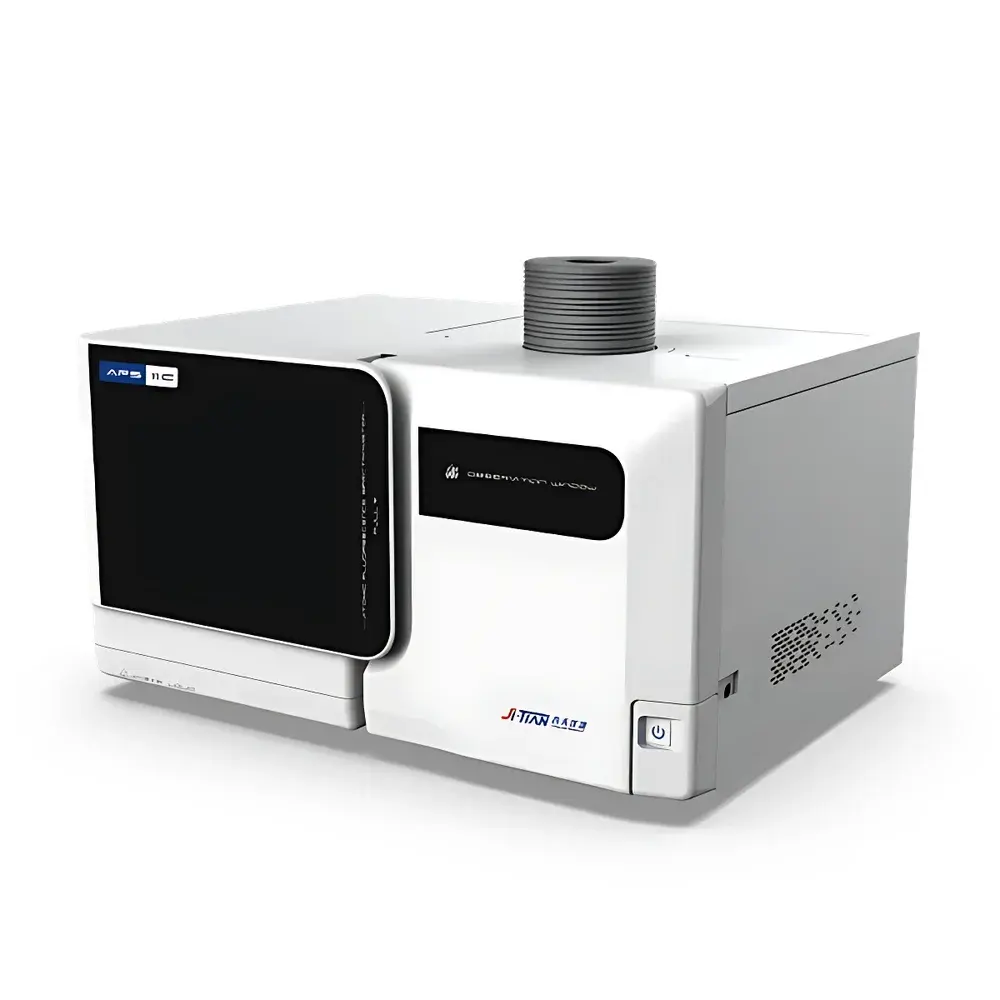
Titan Instruments AFS-11C Atomic Fluorescence Spectrometer
| Brand | Titan Instruments |
|---|---|
| Origin | Beijing, China |
| Manufacturer Type | Authorized Distributor |
| Country of Origin | China |
| Model | AFS-11C |
| Pricing | Available Upon Request |
Overview
The Titan Instruments AFS-11C Atomic Fluorescence Spectrometer is a high-performance, multi-channel analytical instrument engineered for trace-level quantification of hydride-forming elements—including arsenic (As), mercury (Hg), selenium (Se), antimony (Sb), bismuth (Bi), tellurium (Te), lead (Pb), tin (Sn), cadmium (Cd), and zinc (Zn)—in liquid samples. It operates on the principle of atomic fluorescence spectroscopy (AFS): analyte elements are chemically reduced to volatile hydride species or cold-vapor forms in situ, atomized in a quartz cell under argon-hydrogen flame or quartz furnace, and then excited by a high-intensity hollow cathode lamp (HCL) or electrodeless discharge lamp (EDL). The resulting element-specific fluorescence emission is measured at right angles to the excitation beam, delivering exceptional sensitivity (sub-pg/mL detection limits for Hg and As), low spectral interference, and high signal-to-noise ratio. Designed for routine laboratory environments—from QC labs in food safety and environmental monitoring agencies to university research facilities—the AFS-11C integrates robust hardware architecture with modular expandability and regulatory-compliant software functionality.
Key Features
- Multi-channel sequential injection system with dual syringe pumps: enables precise, bubble-free delivery of sample, carrier solution, and reducing agent (e.g., NaBH4) for reproducible on-line hydride generation.
- Integrated peristaltic pump module featuring six-roller design, compact pump head, and uniform pressure block—ensures consistent reagent flow and simultaneous carrier replenishment during analysis.
- Dedicated mercury drift correction algorithm and real-time QCP (Quality Control Protocol) monitoring: automatically compensates for signal drift during extended runs and validates calibration integrity before each sample batch.
- Intelligent lamp management: auto-ignition and dual-channel lamp activation; eccentricity-compensating lamp holder with infinite adjustment range accommodates HCLs/EDLs from multiple manufacturers with varying optical axis offsets.
- Programmable low-power mode: supports scheduled pre-heating, post-run sleep state, and timed wake-up—reducing energy consumption without compromising readiness or thermal stability.
- Furnace filament current monitoring: continuously logs filament resistance and operating current to predict lamp aging and prevent unexpected failure during critical analyses.
Sample Compatibility & Compliance
The AFS-11C accepts aqueous digests and extracts prepared via EPA Method 200.8, GB/T 5009.11–2014, GB/T 5009.17–2014, ISO 17294-2, and other standardized protocols for heavy metal speciation and total elemental determination. Sample introduction is compatible with discrete vial-based analysis, continuous-flow manifold configurations, and optional autosampler integration. All operational parameters—including gas flow rates, reaction coil temperature, and lamp current—are logged with timestamped metadata to support GLP/GMP audit trails. The system complies with data integrity requirements outlined in FDA 21 CFR Part 11 when used with validated software configuration, including electronic signatures, role-based access control, and immutable audit logging.
Software & Data Management
Titan’s proprietary AFS Control Suite provides a fully customizable, Windows-based interface supporting wizard-guided method setup, real-time dual-channel spectral overlay, dynamic baseline correction, and automated multi-point calibration curve generation. The software incorporates full audit trail functionality—recording user actions, parameter changes, and instrument status events—with exportable CSV/Excel reports and PDF certificate generation. Users may define custom report templates, import sample IDs via clipboard or CSV, and configure automated QA/QC flagging (e.g., recovery thresholds, RSD limits). All raw signal data—including time-resolved fluorescence intensity profiles—is retained in native binary format with lossless compression and SHA-256 hash verification for long-term archival integrity.
Applications
The AFS-11C delivers reliable performance across regulated and research-driven domains: routine testing of As/Hg in drinking water (EPA 1631E, ISO 17892-10), rice and seafood for inorganic arsenic compliance (EU No. 836/2012), soil and sediment extracts per TCLP and SPLP protocols, pharmaceutical excipients per USP /, clinical urine/blood matrices for occupational exposure assessment, and feed/forage samples under AOAC 999.10. Its modular architecture also supports future upgrade to hyphenated speciation analysis—via dedicated RS-232 port—for separation-coupled detection of As(III)/As(V), methylmercury/ethylmercury, or Se(IV)/Se(VI) using HPLC- or GC-AFS interfaces.
FAQ
Does the AFS-11C support regulatory-compliant data handling for pharmaceutical or clinical labs?
Yes—when deployed with validated software settings and documented SOPs, it meets core requirements of FDA 21 CFR Part 11, EU Annex 11, and ISO/IEC 17025 for electronic records and signatures.
Can the instrument be upgraded for elemental speciation analysis?
Yes—the system includes a dedicated serial interface and mechanical mounting provisions to integrate with HPLC or GC modules for As, Hg, and Se speciation workflows.
What types of lamps are supported, and how does the system ensure alignment stability?
It supports standard 1/4-inch-pin HCLs and EDLs from major suppliers; the dual-axis eccentric compensation mechanism maintains optimal focal alignment across lamp lifetime.
Is external gas supply required for operation?
Yes—a regulated source of high-purity argon (≥99.998%) and hydrogen (generated on-site or from cylinder) is necessary for hydride generation and quartz furnace atomization.
How is carryover minimized during high-concentration sample analysis?
The system employs programmable rinse cycles with optimized acid concentration and flow rate, plus inert gas purging between injections to reduce memory effects below 0.5% RSD.






