
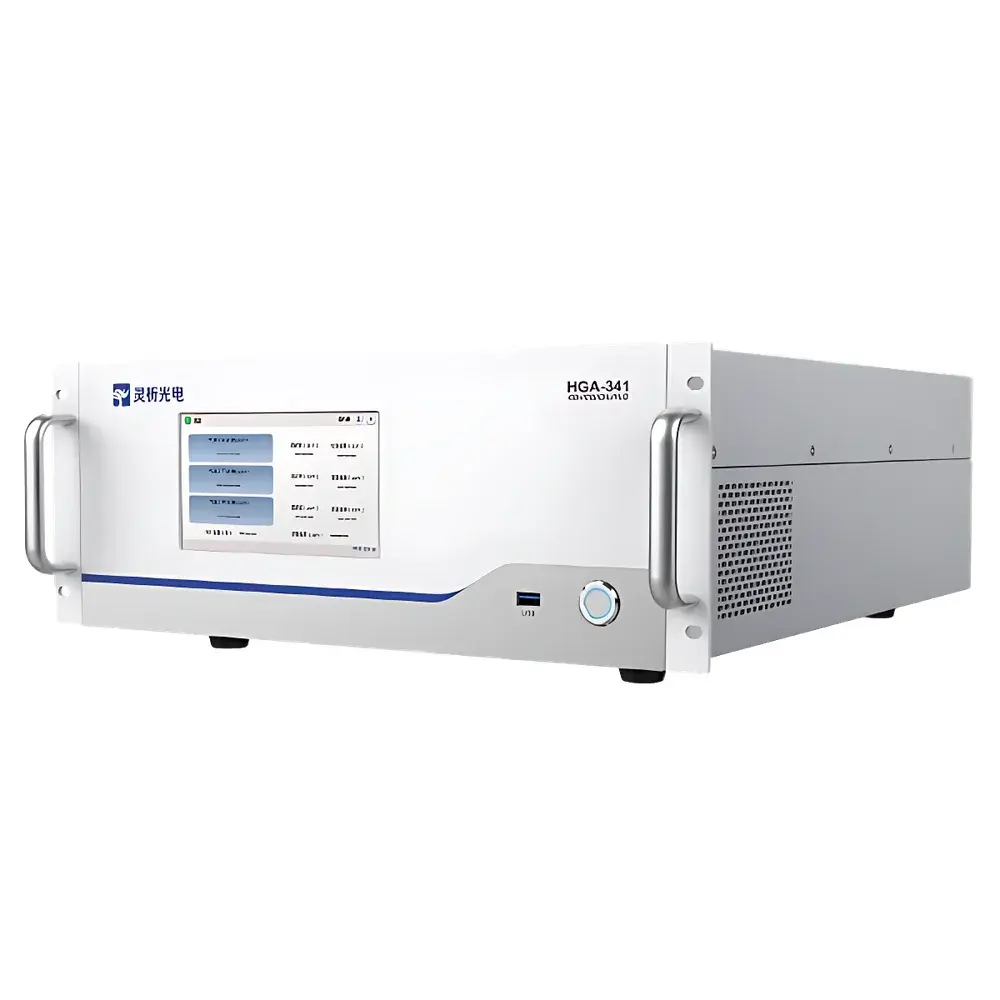
Lingxi Optoelectronics HGA-341 High-Precision Greenhouse Gas Analyzer
| Brand | Lingxi Optoelectronics |
|---|---|
| Origin | Zhejiang, China |
| Model | HGA-341 |
| Measurement Principle | Cavity Ring-Down Spectroscopy (CRDS) |
| Detection Gases | CO₂, CO, CH₄, H₂O (simultaneous) |
| Sensitivity & Accuracy | Sub-ppb level |
| Compliance | WMO GAW Performance Specifications |
| Output | Dry-mole-fraction concentrations with H₂O dilution correction |
| Effective Optical Path Length | ~20 km in compact cavity |
Overview
The Lingxi Optoelectronics HGA-341 High-Precision Greenhouse Gas Analyzer is a laboratory-grade, field-deployable trace gas measurement system engineered for continuous, unattended monitoring of atmospheric CO₂, CO, CH₄, and H₂O at parts-per-trillion (ppt) to parts-per-trillion-by-volume (pptv) sensitivity levels. Built upon the physical principle of Cavity Ring-Down Spectroscopy (CRDS), the instrument measures gas-phase absorption by quantifying the exponential decay time (ring-down time) of near-infrared laser light confined within a high-finesse optical cavity. This technique decouples sensitivity from path length limitations—achieving an effective optical path exceeding 20 km within a thermally and mechanically stabilized 30-cm cavity—enabling exceptional detection limits without requiring cryogenic cooling or vacuum pumping. The HGA-341 is explicitly designed to meet the stringent performance requirements defined by the World Meteorological Organization (WMO) Global Atmosphere Watch (GAW) Programme for baseline and regional atmospheric monitoring stations, including specifications for long-term stability, calibration traceability, and inter-laboratory comparability.
Key Features
- Simultaneous, real-time quantification of CO₂, CO, CH₄, and H₂O mole fractions with sub-ppb precision and accuracy
- Integrated, physics-based water vapor correction algorithm that computes dry-mole-fraction concentrations by dynamically compensating for dilution and spectroscopic interference effects in humid sample streams
- Active thermal and pressure stabilization architecture—employing dual-stage Peltier control and proportional solenoid regulation—to maintain cavity alignment and refractive index stability, minimizing instrumental drift to <±0.1 ppb CO₂ per month under continuous operation
- Automated zero/span verification capability compatible with certified standard gases traceable to NIST or WMO-calibrated reference scales
- Ruggedized industrial enclosure rated IP54, suitable for outdoor deployment in ambient temperature ranges from −20 °C to +45 °C with optional climate-controlled housing
Sample Compatibility & Compliance
The HGA-341 accepts sample air streams delivered via stainless-steel or electropolished tubing at flow rates of 0.5–2.0 L/min, with inlet pressure regulated between 80–110 kPa. It is compatible with standard WMO-compliant sampling manifolds, including those equipped with Nafion dryers, particulate filters, and catalytic scrubbers. All measurement outputs—including raw ring-down times, calibrated concentrations, diagnostic flags, and environmental metadata—are structured according to the WMO GAW Data Reporting Format v3.2. The analyzer supports full audit trail logging and meets key elements of ISO/IEC 17025:2017 for testing laboratories, including documented uncertainty budgets, calibration history management, and operator access control. While not FDA 21 CFR Part 11-certified out-of-the-box, its data export architecture (CSV, NetCDF, JSON) enables integration into validated LIMS environments supporting GLP/GMP workflows.
Software & Data Management
The HGA-341 operates under Lingxi’s proprietary firmware suite, accessible via secure Ethernet or RS-485 interface. Configuration, diagnostics, and real-time visualization are managed through a browser-based GUI supporting multi-user role permissions (administrator, operator, viewer). Raw spectral data and processed concentration time series are stored locally on industrial-grade SSD with 12-month retention capacity. Data export supports automated FTP/SFTP push to central servers, MQTT streaming for IoT platforms, and direct ingestion into EPA’s AQS or EEA’s AirBase-compatible databases. Firmware updates include cryptographic signature validation, and all configuration changes are timestamped and logged with user ID attribution—ensuring full traceability for regulatory reporting and QA/QC review.
Applications
- Urban and regional background monitoring networks aligned with WMO GAW and national air quality frameworks (e.g., China’s “Dual Carbon” policy implementation)
- Boundary-layer flux studies using eddy covariance towers, where simultaneous CO₂/CH₄/H₂O measurements enable partitioning of biogenic vs. anthropogenic sources
- Industrial facility fence-line monitoring for GHG emission verification per ISO 14064-3 and GHG Protocol Corporate Standard
- Calibration transfer and intercomparison campaigns among national metrology institutes and atmospheric observatories
- Mobile platform integration (e.g., research aircraft, ground vehicles) for spatially resolved plume mapping and source attribution
FAQ
Does the HGA-341 require external calibration gases during routine operation?
Yes—daily or weekly zero/span checks using certified standards traceable to WMO Central Calibration Laboratories (CCLs) are recommended to maintain stated accuracy and support data certification.
Can the instrument operate unattended for extended periods?
Yes—the system is designed for continuous operation up to 12 months between maintenance cycles, provided ambient conditions remain within specified temperature/humidity limits and inlet filtration is regularly serviced.
Is dry-mole-fraction output automatically generated?
Yes—H₂O concentration is measured in parallel, and the onboard algorithm applies first-principles dilution correction to report CO₂, CO, and CH₄ as dry-mole-fractions (nmol/mol) without post-processing.
What spectral regions does the CRDS laser cover?
The system employs two tunable diode lasers operating near 1.57 µm (CO₂, CH₄) and 2.3 µm (CO, H₂O), selected to avoid cross-interference while maximizing absorption line strength and minimizing water vapor overlap.
How is data integrity ensured during power interruptions?
Internal non-volatile memory preserves the last 72 hours of high-resolution data and full configuration state; upon reboot, the system resumes measurement without manual intervention and logs all fault events with UTC timestamps.
Related Products







