
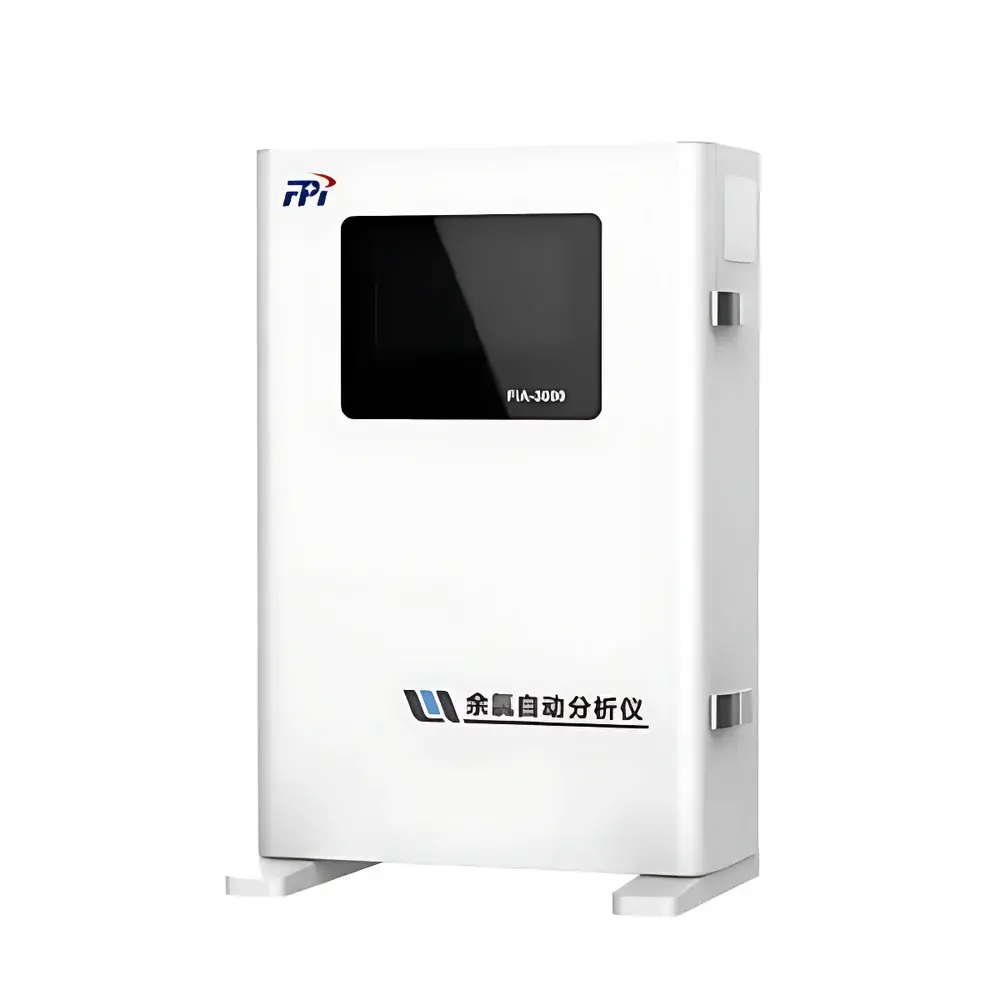
FIA-3000 EXPEC Automated Free Chlorine & Total Chlorine Analyzer
| Brand | EXPEC (Hangzhou Puyu Technology Co., Ltd.) |
|---|---|
| Model | FIA-3000 |
| Measurement Principle | DPD Colorimetric Method (ASTM D1253, ISO 7393-2, EPA 330.5) |
| Wavelength | 510 nm |
| Detection Range | Free Chlorine: 0.01–5.00 mg/L Cl₂ |
| Total Chlorine | 0.02–5.00 mg/L Cl₂ |
| Detection Limit | ≤0.01 mg/L (Free Cl₂), ≤0.02 mg/L (Total Cl₂) |
| Sample pH Adjustment | Automatic buffering to pH 6.2–6.5 |
| Catalyst | Iodide-mediated oxidation for total chlorine conversion |
| Optical System | LED-based photometer with dual-beam compensation |
| Enclosure Rating | IP65 |
| Installation Options | Wall-mounted or benchtop configuration |
| Reagent Consumption | <1.2 mL per analysis cycle |
| Waste Separation | Integrated reagent/waste fluid segregation |
| Compliance | Designed for GLP/GMP-aligned operation |
Overview
The EXPEC FIA-3000 Automated Free Chlorine & Total Chlorine Analyzer is a fully integrated flow-injection analysis (FIA) system engineered for continuous, unattended monitoring of residual disinfectant levels in potable water, wastewater effluent, and industrial process streams. It implements the standardized N,N-diethyl-p-phenylenediamine (DPD) colorimetric method—recognized under ASTM D1253, ISO 7393-2, and U.S. EPA Method 330.5—to quantitatively determine both free chlorine (hypochlorous acid/hypochlorite) and total chlorine (free + combined chloramines) in aqueous matrices. The instrument dynamically adjusts sample pH to 6.2–6.5 using an on-board buffer reagent delivery module, enabling stoichiometric reaction between free chlorine and DPD to form a stable magenta-colored quinoid compound. For total chlorine determination, iodide catalyst is introduced post-buffering to oxidize chloramine species, ensuring complete chromogenic conversion. Absorbance is measured at 510 nm via a temperature-stabilized LED photometer with dual-beam optical path compensation, minimizing drift from lamp aging or ambient light interference.
Key Features
- Simultaneous dual-parameter capability: seamless switching between free chlorine and total chlorine measurement modes without hardware reconfiguration
- Automated pH conditioning and catalytic iodide injection—no manual reagent addition or timing intervention required
- Low reagent consumption (<1.2 mL per analysis cycle) and segregated waste handling, reducing hazardous waste generation and disposal frequency
- Integrated turbidity and color compensation algorithm that corrects for non-specific absorbance contributions from suspended solids or natural organic matter
- IP65-rated enclosure suitable for indoor utility rooms, outdoor kiosks, or wet-process environments with high humidity or occasional splashing
- Modular mechanical design supporting either wall-mount installation (space-constrained sites) or benchtop deployment (lab validation or mobile calibration stations)
- No routine calibration curve maintenance: factory-characterized photometric response with periodic verification using NIST-traceable standard solutions
Sample Compatibility & Compliance
The FIA-3000 accepts raw, filtered, or clarified liquid samples with turbidity up to 100 NTU and color intensity up to 500 Pt-Co units—common in municipal distribution systems, cooling tower blowdown, and pharmaceutical rinse water. It complies with operational requirements for regulated water monitoring under national drinking water standards (e.g., China’s GB 5749-2022, U.S. EPA Safe Drinking Water Act), and supports quality assurance frameworks including ISO/IEC 17025-accredited laboratories and GxP-regulated facilities. Data integrity features include electronic signatures, time-stamped audit trails, and encrypted local storage—fully aligned with FDA 21 CFR Part 11 for computerized system validation. All reagents meet ACS grade specifications and are supplied in sealed, light-protected cartridges to ensure stability over shelf life.
Software & Data Management
The embedded control software provides real-time concentration trending, alarm threshold configuration (e.g., low-dose alerts, breakpoint detection), and automated report generation in PDF/CSV formats. Remote access is enabled via secure HTTPS interface with role-based user permissions (operator, supervisor, administrator). Historical data is stored locally for ≥180 days and can be exported to LIMS or SCADA platforms via Modbus TCP or OPC UA protocols. Firmware updates are delivered over-the-air with cryptographic signature verification. All measurement events—including reagent lot tracking, maintenance logs, and diagnostic codes—are recorded with immutable timestamps to support regulatory audits and root-cause analysis.
Applications
- Real-time monitoring of chlorine residual at water treatment plant final effluent points and distribution system entry nodes
- Chlorine demand profiling in cooling water circuits across power generation and petrochemical facilities
- Validation of disinfection efficacy in pharmaceutical purified water (PW) and water-for-injection (WFI) loops
- Compliance tracking for food processing facility sanitizing rinse lines and CIP system return streams
- Long-term unattended operation in remote pumping stations or reservoir telemetry nodes with cellular or LoRaWAN backhaul
- Method verification and reference analysis in environmental testing laboratories conducting third-party certification
FAQ
What is the difference between free chlorine and total chlorine measurements?
Free chlorine refers to hypochlorous acid (HOCl) and hypochlorite ion (OCl⁻), the primary disinfecting species. Total chlorine includes both free chlorine and combined chlorine (e.g., monochloramine), which forms when chlorine reacts with ammonia.
Does the FIA-3000 require daily calibration?
No. It operates on a fixed photometric baseline validated during manufacturing. Periodic verification with certified standards (e.g., every 7–30 days depending on application criticality) satisfies QA requirements.
Can it operate in high-turbidity wastewater without filtration?
Yes—the built-in optical compensation algorithm mitigates scattering effects up to 100 NTU; however, particulate fouling of the flow cell may require quarterly cleaning in untreated sewage applications.
Is remote firmware update supported?
Yes, via authenticated HTTPS connection with SHA-256 signed package verification to ensure system integrity.
How is data security ensured for regulatory submissions?
All raw absorbance values, calculated concentrations, operator actions, and system diagnostics are cryptographically timestamped and stored in a write-once, read-many (WORM) archive compliant with 21 CFR Part 11 electronic record requirements.
Related Products







