
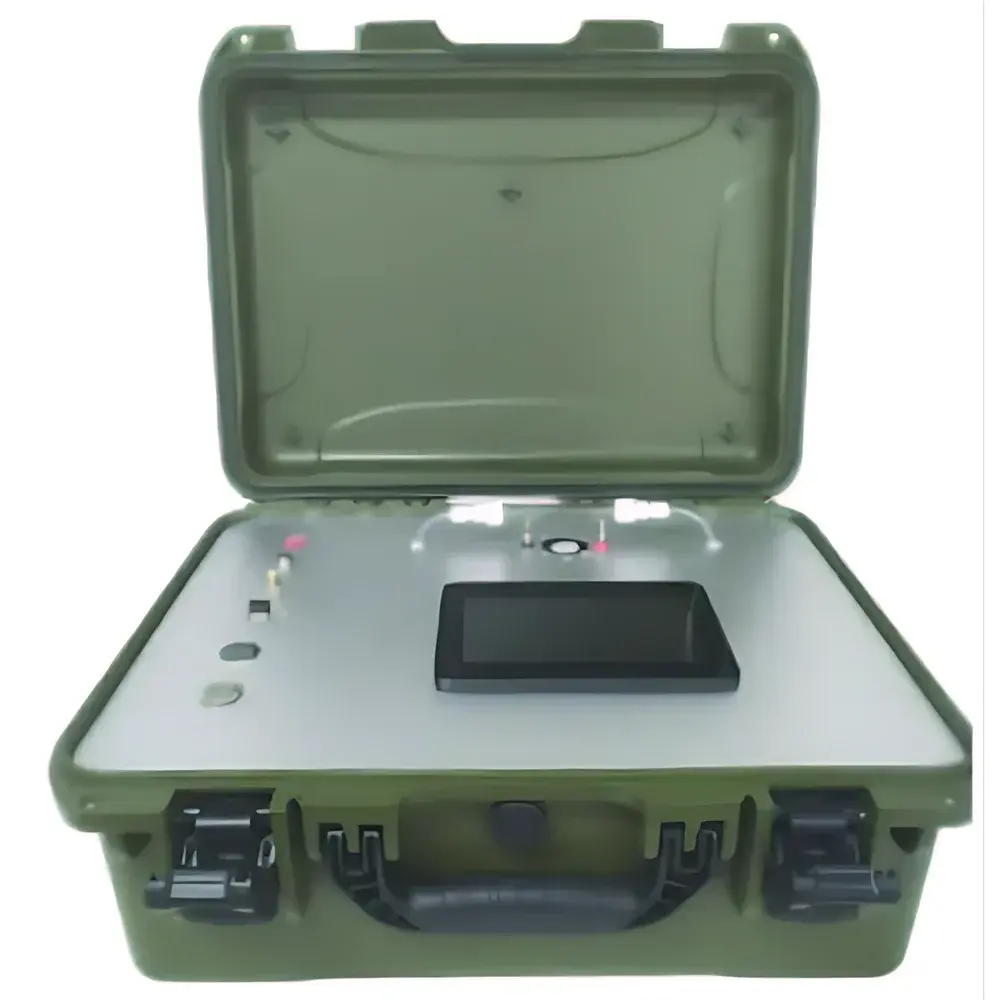
Great Tech ME-510 Portable Gaseous Mercury Analyzer
| Brand | Great Tech |
|---|---|
| Origin | Beijing, China |
| Model | ME-510 |
| Measurement Principle | Cold Vapor Atomic Fluorescence Spectrometry (CVAFS) |
| Detection Limit | <0.1 ng/m³ (for 5 L sample) |
| Measurement Range | 0.1–1000 ng/m³ |
| Linear Error | <3% (0–100 ng/m³) |
| Repeatability | <3% RSD |
| Sampling Flow Rate | 0.3–2.0 L/min |
| Sampling Time | 1–58 min |
| Preheating Time | 15 min |
| Carrier Gas | Argon or Nitrogen |
| Carrier Gas Consumption | <25 mL/min |
| Data Update Interval | 3–60 min |
| Operating Temperature | 15–35 °C |
| Operating Humidity | 10–95% RH (non-condensing) |
| Altitude Limit | 0–2000 m |
| Power Supply | 100–240 VAC, 50/60 Hz |
| Max Power Consumption | <150 W |
| Built-in Li-ion Battery | 8 h continuous operation (standard), 80 h with external power management |
| Dimensions | ≤507 × 412 × 215 mm |
| Weight | 18 kg |
| Filter Replacement Interval | 4 weeks |
| Touchscreen | 7-inch capacitive display |
| Data Output | CSV via USB and Wi-Fi |
| GPS Option | Integrated module for geotagged logging |
| Soil Gas Probe Option | Includes temperature (−40 to +80 °C, ±0.3 °C accuracy) and RH (0–100% RH, ±3% RH accuracy) sensors |
| Calibration Source | Programmable low-temperature mercury vapor generator (0–30 °C, ±0.005 °C stability, 0.0001 °C resolution), 25 μL digital syringe (0.01 μL precision) |
Overview
The Great Tech ME-510 Portable Gaseous Mercury Analyzer is a field-deployable, laboratory-grade instrument engineered for high-sensitivity, real-time quantification of elemental mercury (Hg⁰) in ambient air, stack emissions, and soil gas matrices. It employs Cold Vapor Atomic Fluorescence Spectrometry (CVAFS)—a reference-grade optical detection technique endorsed by U.S. EPA Method 1631E and ISO 6978-2—where gaseous mercury is thermally desorbed from a gold-coated quartz trap, reduced to atomic vapor, and excited by a 253.7 nm UV source. The resulting fluorescence intensity is linearly proportional to Hg⁰ concentration, enabling sub-picogram-level detection with exceptional selectivity and minimal interferences from other metals or volatile compounds. Unlike fixed-station analyzers, the ME-510 integrates ruggedized mechanical architecture, thermal stabilization, and autonomous power management to support unattended operation across remote monitoring sites, mobile survey platforms, and emergency response deployments.
Key Features
- Field-optimized CVAFS detection with ultra-low detection limit (<0.1 ng/m³ for 5 L sampling volume) and wide dynamic range (0.1–1000 ng/m³)
- Integrated 7-inch capacitive touchscreen interface for local configuration, real-time signal visualization, and diagnostic feedback—no external PC required
- Self-contained power system: rechargeable Li-ion battery supports ≥8 hours of continuous operation; optional extended runtime (up to 80 h) with intelligent power cycling
- Precision mass-flow-controlled sampling (0.3–2.0 L/min), adjustable via GUI, with active humidity and temperature compensation algorithms
- Modular probe compatibility: optional soil gas sampling head equipped with co-located Pt100 temperature sensor (±0.3 °C) and capacitive RH sensor (±3% RH), enabling concurrent measurement of soil gas Hg⁰, soil temperature, and interstitial moisture
- Onboard GPS module (optional) provides automated georeferencing of all measurement events, supporting spatial trend mapping and regulatory compliance reporting
- Low-carrier-gas consumption design (<25 mL/min Ar/N₂); standard 4 L cylinder sustains >7 days of continuous operation
- Pre-calibrated, PID-controlled low-temperature mercury vapor source (0–30 °C, ±0.005 °C stability) with 25 μL digital syringe (0.01 μL resolution) for traceable, matrix-matched calibration
Sample Compatibility & Compliance
The ME-510 is validated for direct analysis of gaseous samples containing elemental mercury without chemical derivatization. It meets performance criteria outlined in U.S. EPA Method 1631E (Mercury in Water by Oxidation, Purge and Trap, and CVAFS), ASTM D6784-22 (Standard Test Method for Elemental, Oxidized, Particle-Bound, and Total Mercury in Flue Gas), and ISO 6978-2 (Natural gas — Determination of mercury — Part 2: Method using atomic absorption spectrometry after amalgamation). Its hardware architecture complies with IEC 61326-1 (EMC requirements for laboratory equipment) and IEC 61010-1 (safety requirements for electrical equipment). All data acquisition, storage, and export functions adhere to ALCOA+ principles (Attributable, Legible, Contemporaneous, Original, Accurate, Complete, Consistent, Enduring, Available), supporting GLP/GMP audit readiness. Firmware enforces electronic signature workflows and full audit trails per FDA 21 CFR Part 11 when configured for regulated environments.
Software & Data Management
The ME-510 runs embedded Linux-based firmware with dual-mode data handling: local mode enables standalone logging to internal flash memory (≥32 GB), while network mode supports secure Wi-Fi or Ethernet connectivity for remote telemetry via Modbus TCP or HTTP REST API. Raw spectral data, calibrated concentrations, environmental metadata (T, RH, GPS, flow rate), and system diagnostics are exported as timestamped CSV files—compatible with LIMS integration and third-party analytics platforms (e.g., Python Pandas, MATLAB, Tableau). The included desktop software suite performs automatic baseline correction, peak deconvolution, and multi-point calibration curve fitting using NIST-traceable standards. All calculations—including Hg⁰ mass loading, volumetric concentration normalization, and temperature/pressure correction—are performed in accordance with ISO 5167 and EPA 40 CFR Part 60 Appendix A-3 conventions.
Applications
- Ambient air quality monitoring networks (urban, rural, background stations)
- Coal-fired power plant stack emission verification and continuous emission monitoring system (CEMS) backup validation
- Artisanal and small-scale gold mining (ASGM) site characterization and remediation progress tracking
- Landfill and contaminated site vapor intrusion assessment
- Volcanic and geothermal Hg⁰ flux studies requiring portable, high-temporal-resolution sampling
- Indoor air quality surveys in chlor-alkali facilities, dental clinics, and laboratories handling mercury-containing materials
- Research-grade soil gas mercury profiling for biogeochemical cycle modeling
FAQ
What carrier gases are compatible with the ME-510?
Argon and nitrogen are both supported; argon delivers optimal sensitivity due to higher fluorescence quantum yield, while nitrogen offers cost-effective operation with <5% signal reduction.
Does the instrument require daily calibration?
No—daily calibration is not required. The integrated low-temperature mercury source enables on-demand multipoint calibration at user-defined intervals (e.g., pre- and post-campaign, or every 24 h for critical applications).
Can the ME-510 operate unattended for extended periods?
Yes. With external AC power and climate-controlled housing, it supports fully autonomous operation for >30 days. Battery-only mode provides ≥8 h runtime; optional solar-charging kits extend field deployment indefinitely.
Is method validation documentation available?
Yes. Great Tech provides a comprehensive Method Validation Report compliant with ISO/IEC 17025, including precision, accuracy, linearity, LOD/LOQ, and interference testing data against certified reference materials (CRM) such as NIST SRM 2783.
How is data integrity ensured during wireless transmission?
All Wi-Fi transmissions use TLS 1.2 encryption; data packets include SHA-256 checksums and sequence numbering to prevent corruption or replay attacks. Local storage retains primary records even during network outages.
Related Products







