
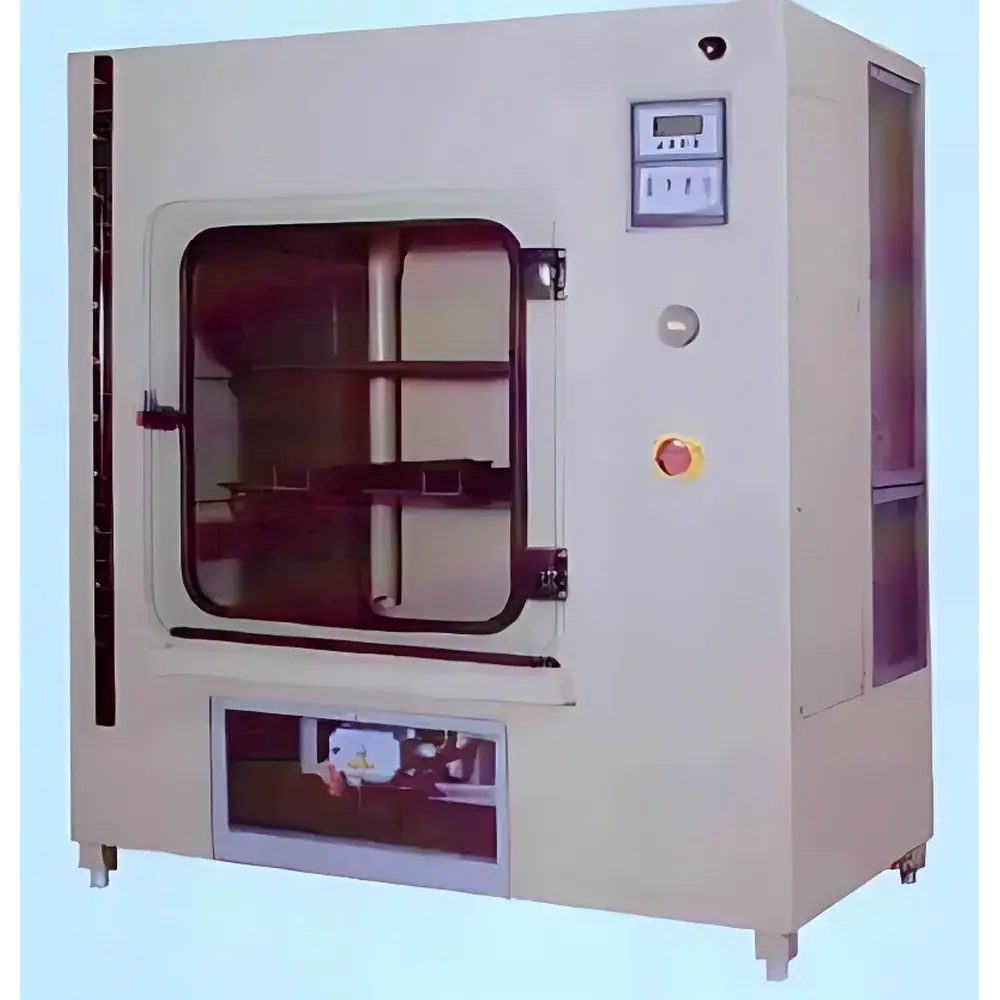
COFOMEGRA CORROSIONBOX Series Salt Spray Test Chamber
| Brand | COFOMEGRA |
|---|---|
| Origin | Italy |
| Model | CORROSIONBOX |
| Chamber Capacity | 450 L / 1000 L |
| Internal Dimensions (W×D×H) | 800×700×800 mm / 1100×800×1100 mm |
| External Dimensions (W×D×H) | 1320×720×1450 mm / 1640×820×1750 mm |
| Weight | 260 kg / 465 kg |
| Salt Solution Reservoir Capacity | 110 L / 260 L |
| Construction Material | 10 mm thick polypropylene (PP) |
| Chamber Insulation | Double-wall insulated |
| Temperature Range (Salt Fog Mode) | 35°C ± 2°C (standard) |
| Temperature Range (Condensation Mode) | 40°C ± 1°C |
| 雾化方� | �: Compressed air-driven saturated mist generation via central nozzle and diffusion tower |
| Heating System | Immersed heating elements with PID-controlled uniformity |
| Drainage | Integrated floor-level sump with gravity drainage |
| Compliance | Designed to meet ASTM B117, ISO 9227, JIS Z2201, DIN 50021 requirements |
Overview
The COFOMEGRA CORROSIONBOX Series is a precision-engineered horizontal salt spray test chamber designed for accelerated corrosion evaluation of metallic materials, coated substrates, and protective surface treatments. Based on the standardized principles of continuous and cyclic corrosion testing, the system employs controlled salt fog generation, condensation, and optional drying phases to simulate aggressive environmental exposure—such as marine atmospheres, industrial pollutants, and automotive under-hood conditions. Constructed entirely from 10 mm thick polypropylene (PP), the chamber resists chemical degradation from chloride-rich aerosols and acidic condensates, ensuring long-term structural integrity and measurement stability. Its double-wall insulated enclosure minimizes thermal loss and improves temperature uniformity across the test volume, while the hinged transparent lid enables real-time visual monitoring without interrupting test cycles.
Key Features
- Horizontal configuration with front-access hinged transparent lid for unobstructed sample observation and ergonomic loading/unloading
- Central high-efficiency nozzle and conical diffusion tower ensure homogeneous salt mist distribution across the entire test volume
- Compressed air pre-saturation system: air is heated and humidified prior to nozzle entry, enabling stable, reproducible fog generation per ASTM B117 specifications
- Dual-mode operation: independent salt spray mode (35°C ± 2°C) and condensation mode (40°C ± 1°C using deionized water reservoir and submerged heaters)
- Enhanced models support fully programmable cyclic corrosion testing—including sequential salt fog, condensation, and ambient-air drying phases—with configurable dwell times and transition logic
- Modular electronics compartment: sealed control panel housing PID controllers, solenoid valves, humidification modules, and peristaltic salt solution dosing pumps—all accessible for rapid maintenance
- Integrated bottom sump with gravity-fed drainage system; compatible with external neutralization or recirculation setups
Sample Compatibility & Compliance
The CORROSIONBOX accommodates specimens up to 700 mm in depth and 800 mm in height (Basic 450 L model) or 800 mm × 1100 mm (Enhanced 1000 L model), supporting standard test panels, fasteners, electronic enclosures, and automotive components. All models comply with core international standards for corrosion resistance validation, including ASTM B117 (neutral salt spray), ISO 9227 (corrosion tests in artificial atmospheres), JIS Z2201 (salt spray testing methods), and DIN 50021 (salt mist climate testing). Optional accessories—such as humidity sensors, data loggers with timestamped event tracking, and programmable cycle sequencers—enable alignment with extended protocols like ISO 14993 (cyclic corrosion testing) and SAE J2334 (automotive cyclic corrosion). The PP construction ensures full compatibility with chloride-based, acetic-acid modified (AASS), and copper-accelerated (CASS) test solutions.
Software & Data Management
While the Basic models feature standalone microprocessor-based controllers with LED interface and manual parameter setting, Enhanced variants integrate a programmable logic controller (PLC) with RS-485/Modbus RTU communication capability. This architecture supports integration into centralized laboratory management systems (LIMS) and enables remote monitoring via industrial Ethernet (optional). All cycle logs—including start/stop timestamps, temperature setpoints, fog duration, condensation duration, and fault events—are stored internally with non-volatile memory retention. Audit-trail functionality meets GLP and GMP documentation requirements, and optional software packages provide CSV export, graphical trend analysis, and automated report generation compliant with FDA 21 CFR Part 11 (when paired with qualified electronic signature modules).
Applications
The CORROSIONBOX Series serves quality assurance laboratories in automotive OEMs and Tier-1 suppliers for evaluating primer/topcoat durability, galvanized steel passivation, and aluminum anodizing performance. It is widely deployed in aerospace component certification (e.g., fastener corrosion resistance per AMS 2700), marine hardware qualification (ISO 12944 C5-M), and electronics enclosure validation (IEC 60068-2-11). Research institutions utilize its cyclic capability to correlate accelerated test results with field exposure data, particularly for developing predictive corrosion models. The modular design also supports method development for emerging standards involving SO₂, NOₓ, or combined pollutant exposure when integrated with auxiliary gas dosing systems.
FAQ
What standards does the CORROSIONBOX comply with?
It is engineered to meet ASTM B117, ISO 9227, JIS Z2201, and DIN 50021 for neutral salt spray testing; enhanced models support ISO 14993 and SAE J2334 with optional cycle programming.
Can the chamber operate with AASS or CASS solutions?
Yes—the PP construction and corrosion-resistant fluid path components are fully compatible with acetic-acid salt spray (AASS) and copper-accelerated salt spray (CASS) formulations.
Is remote monitoring supported?
Enhanced models offer Modbus RTU and optional Ethernet connectivity for integration with SCADA or LIMS platforms.
How is temperature uniformity maintained during condensation mode?
Submerged heating elements with PID feedback control maintain ±1°C uniformity at 40°C across the test volume, verified per ISO 9227 Annex B.
What maintenance intervals are recommended for the salt solution pump and humidification system?
Daily visual inspection of nozzle and diffusion tower; monthly cleaning of peristaltic pump tubing and deionized water reservoir; annual calibration of temperature and pressure sensors.



