
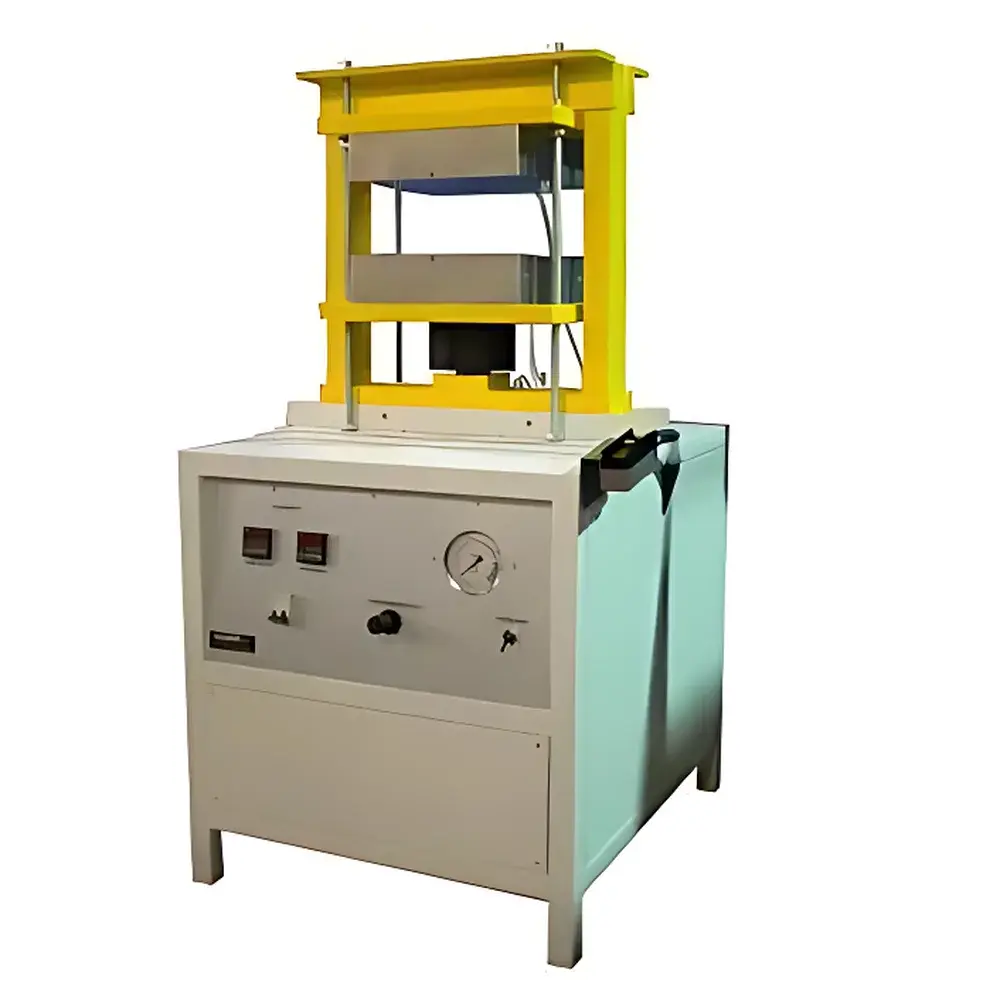
ATSFAAR 10T Hydraulic Hot Press
| Brand | ATSFAAR |
|---|---|
| Origin | Italy |
| Model | 10026120 |
| Max Operating Force | 100 kN (10 tonf) |
| Recommended Max Working Force | 70–80 kN |
| Platen Spacing Range | 0–200 mm |
| Bottom Platen Stroke | 180 mm (pneumatically adjustable) |
| Heating Plate Dimensions | 300 × 300 mm |
| Temperature Range | Ambient to 300 °C |
| Inlet Pressure | Compressed Air 5 bar, Cooling Water 3 bar |
| Electrical Supply | 230 V, 50 Hz, 6.4 kVA |
| Overall Dimensions (W × D × H) | 900 × 750 × 1450 mm |
| Net Weight | ~250 kg |
| Pressure Gauge | 150 mm dial, full scale 630 kg/cm² (≈61.8 MPa) |
Overview
The ATSFAAR 10T Hydraulic Hot Press (Model 10026120) is a precision-engineered laboratory-scale hot pressing system designed for controlled thermal and mechanical consolidation of advanced materials. It operates on the principle of simultaneous uniaxial pressure application and uniform conductive heating across parallel platens—enabling reproducible fabrication of dense pellets, sintered ceramics, polymer composites, metal powders, and battery electrode sheets. Its robust all-metal frame ensures structural rigidity under high compressive loads, while independent thermal control of top and bottom platens—each equipped with dedicated heating elements (4 × 0.8 kVA), embedded cooling channels, and isolated digital temperature regulation—supports precise thermal profiling during ramp-hold-cool cycles. The system integrates pneumatic actuation for platen positioning and hydraulic force generation, delivering stable, calibrated pressure up to 100 kN (equivalent to 10 metric tons-force) with recommended operational limits between 70–80 kN to ensure long-term mechanical integrity and measurement repeatability.
Key Features
- Stainless-steel reinforced structural frame with vibration-damped base mounting for stable operation under dynamic load conditions.
- Dual-zone digital temperature controller with independent PID tuning per platen; resolution ±0.1 °C, accuracy ±1.0 °C over 25–300 °C range.
- Top platen incorporates a redundant safety thermostat (mechanical cut-off at 300 °C), compliant with IEC 61000-6-2/6-4 electromagnetic compatibility standards.
- Hydraulic force generation with calibrated load cell feedback (optional upgrade available); pressure displayed via analog 150 mm dial gauge (0–630 kg/cm²) and optionally via digital interface.
- Integrated cooling circuit per platen—configurable for air or water circulation—with inlet pressure rating of 3 bar and quick-connect fittings for closed-loop chiller integration.
- Front-panel operator interface featuring master power switch, manual pressure regulator, pressure relief valve, and status indicators for heating, cooling, and safety interlocks.
- Modular platen design accommodates custom inserts (e.g., graphite, molybdenum, or ceramic dies) and supports optional vacuum or inert-gas purging via rear-mounted gas inlets (not included).
Sample Compatibility & Compliance
The ATSFAAR 10T Hot Press is routinely deployed in ISO/IEC 17025-accredited laboratories for sample preparation prior to XRD, SEM-EDS, BET surface area analysis, and mechanical testing. It accommodates disk-shaped specimens up to Ø150 mm and thicknesses from 0.5 mm to 150 mm, with standard tooling supporting stainless-steel, tungsten carbide, and borosilicate glass dies. The system meets CE marking requirements under Machinery Directive 2006/42/EC and Low Voltage Directive 2014/35/EU. Its thermal and pressure control architecture supports GLP-compliant documentation when paired with validated data acquisition software (see Software & Data Management). All electrical components conform to IP54 ingress protection; cooling circuits comply with EN 13445-3 for non-pressurized heat exchangers.
Software & Data Management
While the base configuration features standalone analog/digital controls, the system is compatible with ATSFAAR’s optional PC-based control suite (HotPress Control v3.2), which provides time-stamped logging of temperature, pressure, and platen displacement at user-defined intervals (1–60 s). The software exports CSV-formatted datasets compliant with ASTM E29–23 rounding conventions and supports audit trail generation per FDA 21 CFR Part 11 requirements—including electronic signatures, user role management, and immutable log archiving. Optional Ethernet/IP or RS-485 interfaces enable integration into centralized lab automation systems (LIMS or MES) for traceable sample batch tracking.
Applications
- Consolidation of ceramic green bodies (Al₂O₃, ZrO₂, SiC) under controlled dwell-time/temperature profiles for densification studies.
- Preparation of standardized polymer composite test coupons (ASTM D3039, ISO 527-4) with minimized void content and interfacial delamination.
- Electrode lamination for solid-state battery R&D, including LiCoO₂/NMC cathodes and sulfide-based electrolytes requiring low-oxygen, low-temperature pressing.
- Metallurgical sample mounting for metallographic analysis—particularly for soft alloys (e.g., Mg, Al) where conventional cold mounting induces deformation artifacts.
- Thermoplastic matrix impregnation of carbon fiber preforms (e.g., PEEK/CF), leveraging programmable ramp rates and hold stability within ±0.5 °C.
FAQ
What is the maximum recommended operating temperature, and how is thermal runaway prevented?
The system is rated for continuous operation up to 300 °C. A fail-safe bimetallic thermostat on the upper platen interrupts power to the heating elements if this threshold is exceeded—providing hardware-level redundancy beyond the primary digital controller.
Can the press accommodate vacuum or inert-atmosphere processing?
Yes—the rear panel includes threaded ports (G1/4″) for optional vacuum line or inert gas (Ar/N₂) purge connections. Custom sealed platen kits and O-ring grooved dies are available as accessories.
Is calibration certification included with delivery?
A factory-issued calibration report (traceable to NIST and EUROMET standards) is provided for temperature sensors and pressure transducers; annual recalibration services are supported through ATSFAAR’s European service network.
What maintenance intervals are recommended for hydraulic and cooling subsystems?
Hydraulic oil inspection every 500 operating hours; cooling circuit descaling annually or per local water hardness guidelines; pneumatic filter replacement every 12 months.
Does the system meet requirements for GMP-regulated pharmaceutical excipient compaction studies?
When configured with validated software, audit trail, and electronic signature modules, it complies with Annex 11 and USP guidelines for equipment used in quality-critical material preparation.



