
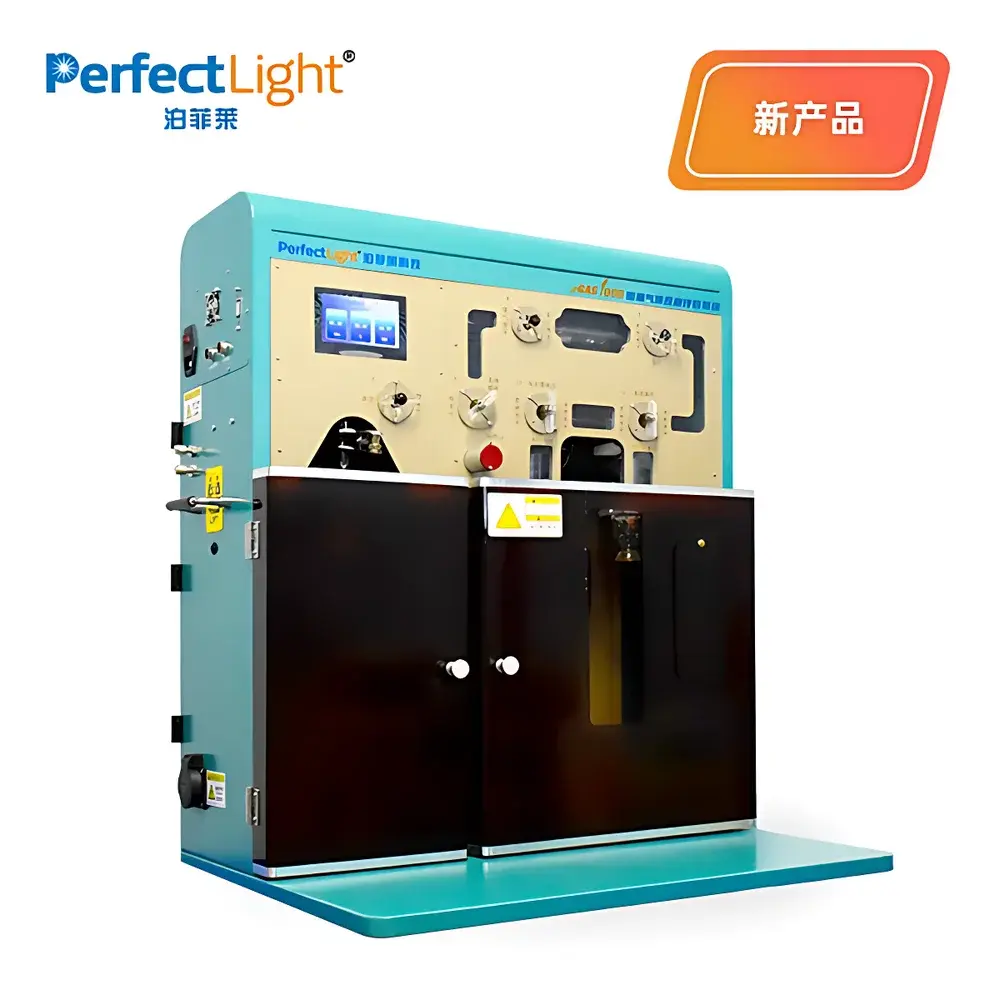
μGAS1000 Micro-Gas Reaction Evaluation System
| Brand | PerfectLight |
|---|---|
| Origin | Beijing, China |
| Model | μGAS1000 |
| Vacuum Integrity | ≤0.5 kPa (absolute) |
| System Volume | 440 mL |
| Reactor Volume | 210 mL (recommended working volume: 40–80 mL) |
| Gas Loop Volume | 230 mL |
| Tubing Material | Borosilicate glass (3 mm ID narrow sections) |
| Valve Count | 6 |
| Vacuum Grease | Apiezon H (−10 °C to +200 °C) |
| Gas Mixing Time (H₂/O₂/CO₂) | <10 min |
| Linearity (R²) | >0.999 |
| Repeatability (RSD, n=4) | <3% |
| Pressure Resolution | 1 Pa |
| Temperature Resolution | 0.01 °C |
| Max Carrier Gas Pressure | >0.5 MPa |
| Heating Capability | Up to 120 °C (loop & sampling lines) |
| Sampling Quantitation Options | 0.5 / 1 / 2 / 3 / 5 mL loops |
| Detection Compatibility | GC-integrated, software-controlled auto-sampling and background gas injection |
| Software | PC-based control with real-time logging, ASTM/ISO-compliant data export (.xlsx), GLP-ready audit trail, automated dynamic leak testing, preheat function to prevent valve seizure |
Overview
The μGAS1000 Micro-Gas Reaction Evaluation System is a fully integrated, vacuum-tight benchtop platform engineered for quantitative kinetic analysis of low-yield gaseous products in heterogeneous catalytic reactions—particularly photocatalytic, photoelectrocatalytic, and thermocatalytic processes involving H₂, O₂, CO, CH₄, CO₂, and other trace gases. Built upon PerfectLight’s proprietary borosilicate glass modular architecture, the system employs a closed-loop gas recirculation principle combined with precision volumetric sampling and GC-coupled detection. Its core measurement methodology relies on repeated, automated extraction of representative gas-phase aliquots from a thermally stabilized, chemically inert reaction headspace, followed by chromatographic quantification and software-driven stoichiometric conversion to molar production rates (µmol·h⁻¹) and apparent quantum yields (AQY). Designed explicitly for research-grade reproducibility under ambient or controlled-temperature conditions, the μGAS1000 meets the stringent requirements of catalysis laboratories engaged in DOE-, ERC-, or Horizon Europe-funded clean energy projects—where trace-gas fidelity, long-term system integrity, and regulatory-compliant data provenance are non-negotiable.
Key Features
- Integrated PC-Based Control Architecture: Unified software interface manages vacuum pump activation, GC trigger signals, heating module setpoints, valve sequencing, and real-time acquisition of pressure (±1 Pa), temperature (±0.01 °C), humidity, and ambient conditions. All experimental metadata—including operator ID, catalyst mass, solvent volume, light source model, filter specification, and irradiance calibration—is embedded into each dataset.
- High-Fidelity Gas Recirculation Loop: A 230 mL borosilicate glass loop with 3 mm internal diameter tubing minimizes dead volume and adsorption artifacts. Driven by a passive magnetic-coupled impeller pump (no electrical spark risk, zero electrolytic interference), the loop achieves uniform mixing of H₂, O₂, and CO₂ within ≤10 minutes at ≥3 kPa absolute pressure. Linear calibration curves (R² > 0.999) are validated across 40–400 µL H₂, 20–200 µL O₂, and 100–1500 µL CO/CH₄ ranges.
- Patented On-System Sampling Valve Island (CN2022219141302): Eliminates external syringe-based injection and associated air ingress. Features six independently actuated glass-on-glass valves with Apiezon H lubrication, enabling fully automated background gas dosing, zero-gas purging, and quantitative loop filling. Configurable sampling loops (0.5–5 mL) support dynamic sensitivity adjustment without hardware modification.
- Modular Photoreactor Platform: Interchangeable reactor bodies include gas-solid, gas-liquid-solid, photoelectrochemical, and electrocatalytic configurations. Each integrates a calibrated K-type thermocouple at the reaction zone, a one-piece heated jacket for ±0.3 °C thermal stability, and an O-ring–sealed conical flange joint ensuring leak rates <1×10⁻⁹ mbar·L·s⁻¹. Quick-release design allows user-level replacement of pressure sensors and seals without service dispatch.
- GC-Ready Interface & Data Traceability: Supports direct TTL-level triggering of commercial GC systems (Agilent, Shimadzu, Thermo Fisher). Software enforces 21 CFR Part 11–compliant electronic signatures, immutable timestamps, and versioned method files. Exported .xlsx reports contain raw peak areas, calculated molar yields, turnover frequencies (TOF), and AQY values per ISO 25037:2021 Annex B protocols.
Sample Compatibility & Compliance
The μGAS1000 accommodates powdered, immobilized, or electrode-supported catalysts (0.1–100 mg loading), aqueous or organic liquid phases (40–80 mL), and inert or reactive carrier gases (Ar, N₂, CO₂, synthetic air). Its all-glass fluidic path eliminates metal ion leaching and surface adsorption—critical for low-concentration CO and CH₄ detection. The system complies with ASTM E2934-22 (standard practice for reporting photocatalytic activity), ISO 25037:2021 (gas-phase photocatalytic hydrogen evolution), and USP analytical instrument qualification guidelines. Vacuum integrity is verified per ISO 2859-1 sampling plans, and long-term drift is monitored via automated daily leak checks embedded in the firmware.
Software & Data Management
The μGAS1000 Control Suite runs on Windows 10/11 and provides full audit-trail functionality: every parameter change, valve actuation, GC injection event, and calibration update is timestamped and logged with user credentials. Raw sensor streams (pressure, temperature, humidity) are sampled at 10 Hz and archived alongside GC chromatograms. Built-in calculation modules apply ideal gas law corrections for temperature/pressure deviations and normalize gas yields to incident photon flux (measured separately via calibrated photodiode). Data exports include both unprocessed time-series logs and summary reports compliant with journal submission standards (e.g., ACS Catalysis, Applied Catalysis B: Environmental). Optional integration with LabArchives ELN enables direct dataset ingestion with DOIs.
Applications
- Quantitative determination of apparent quantum yield (AQY) in UV–vis photocatalytic water splitting (H₂/O₂ co-evolution)
- Kinetic profiling of CO₂ photoreduction pathways (CO, CH₄, C₂H₄ selectivity under controlled pCO₂)
- Photoelectrocatalytic hydrogen evolution reaction (HER) rate analysis under potentiostatic control
- Thermocatalytic dehydrogenation or reforming studies requiring sub-ppm gas detection limits
- Stability assessment of MOF- or perovskite-based catalysts via 100+ hour continuous gas evolution monitoring
- Method validation for ISO/IEC 17025-accredited catalysis testing laboratories
FAQ
Does the μGAS1000 require external vacuum pumps or GC instruments to operate?
No—the system includes integrated vacuum control logic and communicates directly with third-party GCs via digital I/O; however, a compatible GC and roughing pump (≥6 L/min) must be provided by the user.
Can the system quantify multiple gases simultaneously in a single run?
Yes—when paired with a multi-channel GC detector (e.g., TCD/FID dual setup), the software schedules sequential injections and assigns peaks using retention time windows and internal standard normalization.
How is system leak integrity validated during routine use?
The onboard “Dynamic Leak Test” function pressurizes the loop to 50 kPa, monitors decay over 30 minutes, and calculates leakage rate using the ideal gas law—results are saved with pass/fail thresholds aligned to ISO 10110-7.
Is remote monitoring supported?
Yes—via optional VPN-configured Ethernet port; live pressure/temperature dashboards and alarm notifications (email/SMS) are configurable through the admin panel.
What maintenance intervals are recommended for Apiezon H grease and O-rings?
Grease reapplication is advised every 12 months under continuous operation; O-rings should be inspected quarterly and replaced if compression set exceeds 20%, per manufacturer torque specifications.



