
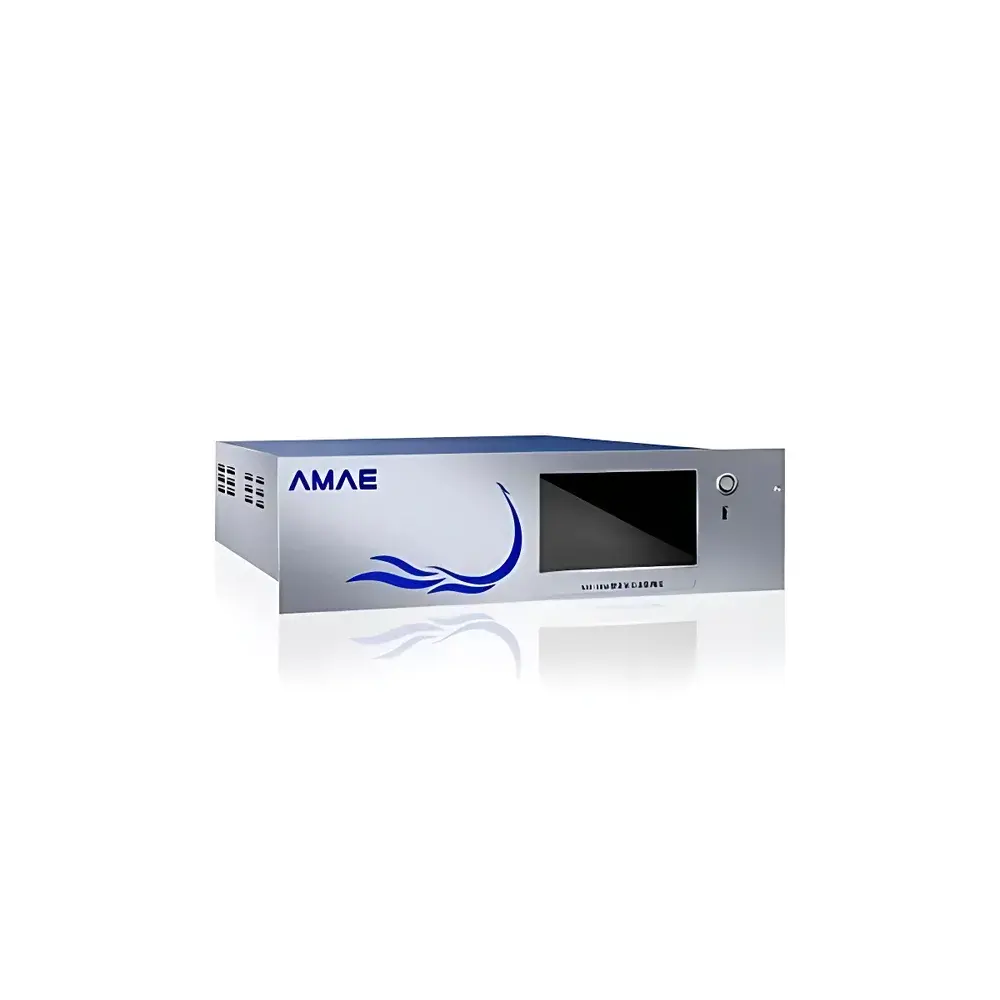
AM-1066 Ozone Automatic Monitor by Guoji Instruments (AMAE)
| Brand | Guoji Instruments (AMAE) |
|---|---|
| Origin | Jiangsu, China |
| Manufacturer Type | Authorized Distributor |
| Country of Manufacture | China |
| Model | AM-1066 |
| Pricing | Upon Request |
| Measurement Principle | Non-Dispersive Ultraviolet (NDUV) Absorption at 253.7 nm |
| Range | 0–0.1 / 0.2 / 0.5 / 1.0 ppm (field-selectable, expandable) |
| Detection Limit | 0.1 ppb (2σ, for ranges ≤0.2 ppm) or 0.5% F.S. (2σ, for ranges >0.2 ppm) |
| Accuracy | ±1.0% F.S. |
| Linearity | ±1.0% F.S. |
| Zero Drift | ±1.0% F.S./day, ±2.0% F.S./week |
| Span Drift | ±1.0% F.S./day, ±2.0% F.S./week |
| Response Time (T90) | ≤80 s |
| Sample Flow Rate | ~0.7 L/min |
| Dimensions | 483 mm × 545 mm × 133 mm (L×W×H) |
| Power Consumption | 30 W |
| Light Source | Patented UV LED at 253.7 nm |
| Connectivity | Embedded Web Server (Ethernet/Wi-Fi) |
| Calibration | Scheduled Auto-Calibration Support |
Overview
The AM-1066 Ozone Automatic Monitor is a precision-grade ambient and stack ozone analyzer engineered for continuous, unattended measurement in regulatory, industrial, and research environments. It operates on the well-established principle of non-dispersive ultraviolet (NDUV) absorption spectroscopy, specifically targeting the strong, characteristic absorption band of ozone (O₃) at 253.7 nm. By employing a stable, patented ultraviolet light-emitting diode (UV LED) as the excitation source and a high-sensitivity photodetector to quantify transmitted intensity, the instrument applies the Lambert–Beer law to derive real-time ozone concentration with trace-level accuracy. Unlike traditional mercury-lamp-based systems, the solid-state UV LED offers superior long-term spectral stability, reduced warm-up time, and extended operational lifetime—critical attributes for fixed-site monitoring networks and mobile deployment platforms requiring minimal maintenance intervals.
Key Features
- Patented UV LED Source: Integrated 253.7 nm UV LED ensures narrow spectral bandwidth, low thermal drift, and immunity to mechanical shock—eliminating lamp aging artifacts common in conventional Hg-vapor sources.
- Embedded Web Server Architecture: Full HTTP/HTTPS interface enables remote configuration, real-time status monitoring, historical data retrieval, diagnostic logging, and over-the-air firmware updates via standard Ethernet or IEEE 802.11 Wi-Fi connectivity.
- Dynamic Visualization Interface: On-device LCD and web-accessible dashboard provide live process flow diagrams, real-time calibration curve plotting, trend overlays, and alarm-triggered event annotation.
- Compact Modular Design: Optimized mechanical layout conforms to 19-inch rack-mount standards (483 mm width) while maintaining full analytical functionality within a depth of only 133 mm—ideal for space-constrained urban monitoring stations or mobile laboratory enclosures.
- Low-Power Operational Profile: Total system power draw remains consistently below 30 W under nominal sampling conditions, supporting solar-battery hybrid deployments and reducing thermal load in temperature-sensitive installations.
- Automated Calibration Management: Programmable calibration scheduler supports zero/span verification using certified ozone generators or permeation devices; all calibration events are timestamped and logged with audit-trail metadata compliant with ISO/IEC 17025 documentation requirements.
Sample Compatibility & Compliance
The AM-1066 accepts ambient air, ducted stack effluent, and diluted emission streams without preconditioning for most applications. Optional heated sample lines (up to 60 °C) and particulate filtration (0.3 µm PTFE membrane) are available for high-humidity or aerosol-rich environments. The analyzer meets performance criteria specified in EPA Method TO-11A and EN 14625 for ambient ozone monitoring. Its digital output and internal logging support integration into SCADA systems adhering to IEC 61850-7-420 and Modbus TCP protocols. Data integrity safeguards—including write-protected internal memory, cyclic redundancy checksums per record, and configurable retention policies—align with GLP/GMP data governance expectations. While not pre-certified for US EPA EQOA designation, its documented linearity, drift stability, and detection limits satisfy technical prerequisites for candidate evaluation under 40 CFR Part 53 Subpart C.
Software & Data Management
Firmware v3.2+ delivers native CSV export, configurable polling intervals (1 s to 1 h), and dual-channel analog outputs (0–1 V / 4–20 mA) with NIST-traceable scaling. The embedded database stores ≥30 days of second-resolution measurements (concentration, flow, temperature, pressure, lamp intensity, detector gain) with automatic rollover. All user actions—including parameter changes, calibration initiations, and reboot events—are recorded in an immutable system log with UTC timestamps and operator ID fields. Remote API access supports RESTful GET/POST endpoints for integration with cloud-based environmental data platforms (e.g., ThingSpeak, AWS IoT Core) and custom dashboards built on Grafana or Kibana. Audit logs comply with FDA 21 CFR Part 11 requirements when deployed with external identity management and electronic signature workflows.
Applications
- Ambient air quality monitoring networks (urban, suburban, background sites)
- Industrial fence-line and workplace exposure assessment (OSHA PEL/ACGIH TLV verification)
- CEMS-compliant dilution-based emission monitoring for thermal oxidizers and semiconductor fab exhaust stacks
- Mobile monitoring platforms (vehicle-mounted, drone-deployable with auxiliary power)
- Research-grade ozone kinetics studies requiring high temporal resolution and low baseline noise
- Calibration transfer standards for field-portable electrochemical and metal oxide sensors
FAQ
What ozone concentration ranges are factory-configured, and can they be changed in the field?
The AM-1066 ships with user-selectable full-scale ranges of 0–0.1, 0–0.2, 0–0.5, or 0–1.0 ppm. Range switching is performed via software configuration—no hardware modification required.
Does the instrument require periodic lamp replacement like traditional UV photometers?
No. The patented 253.7 nm UV LED has a rated lifetime exceeding 20,000 hours (>2 years of continuous operation) with negligible spectral shift, eliminating scheduled lamp replacement.
How is zero and span calibration validated during automated cycles?
Zero calibration uses synthetic nitrogen (or purified air); span calibration employs a traceable ozone generator calibrated against NIST SRM 2690b. All calibration results—including slope, offset, R², and residual error—are stored and exportable.
Is the device suitable for outdoor installation without climate-controlled housing?
It is rated for indoor use (IP20). For outdoor deployment, it must be installed in an environmentally controlled enclosure meeting ASTM D509-22 specifications for temperature (15–30 °C) and relative humidity (<80% RH, non-condensing).
Can raw absorbance data be accessed for method validation or third-party algorithm development?
Yes. The firmware exposes raw photodetector voltage, reference channel intensity, and calculated absorbance values via the REST API and local serial interface (RS-232).
Related Products







