
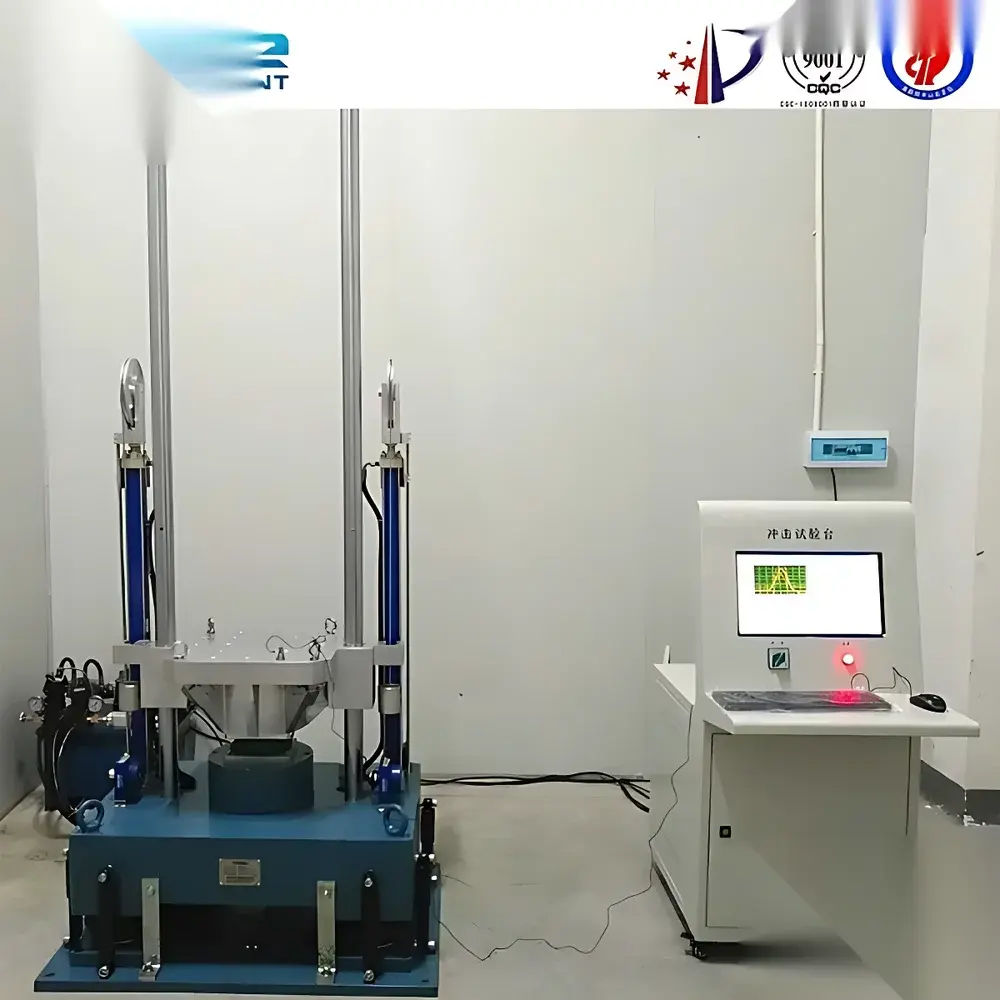
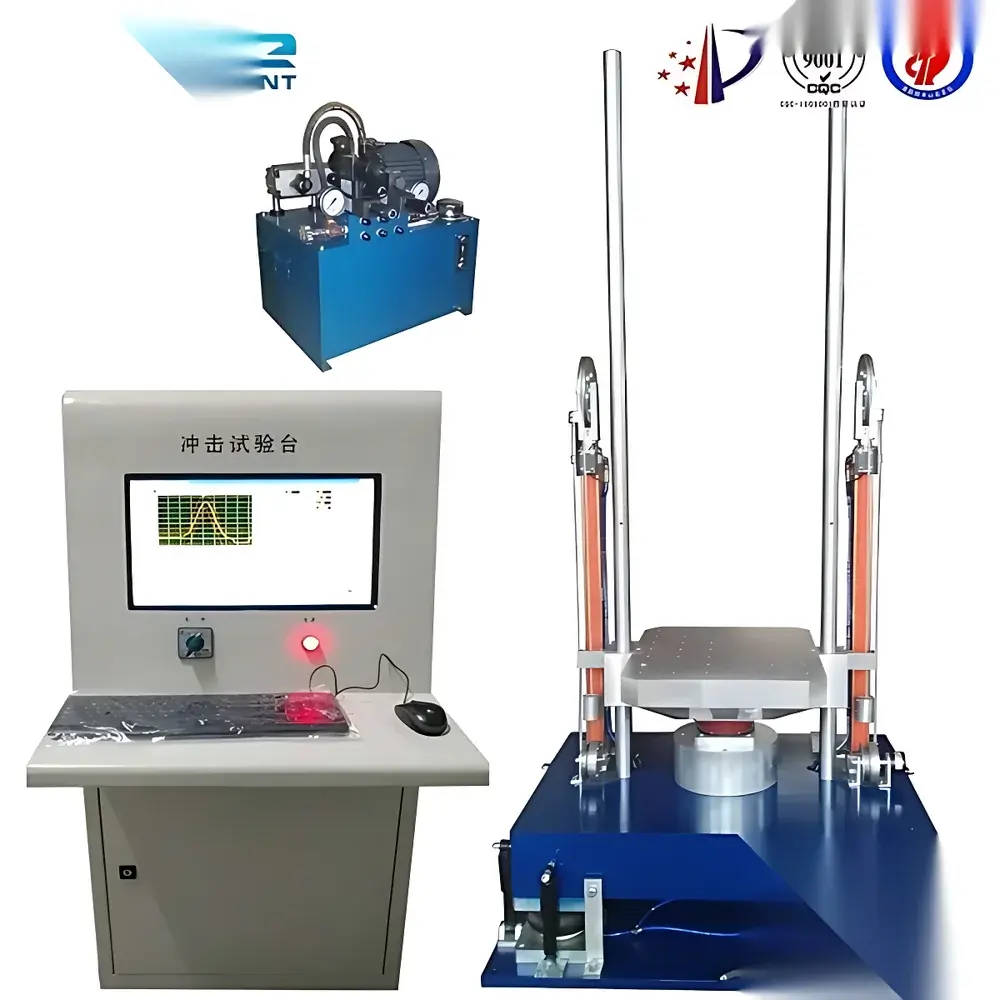
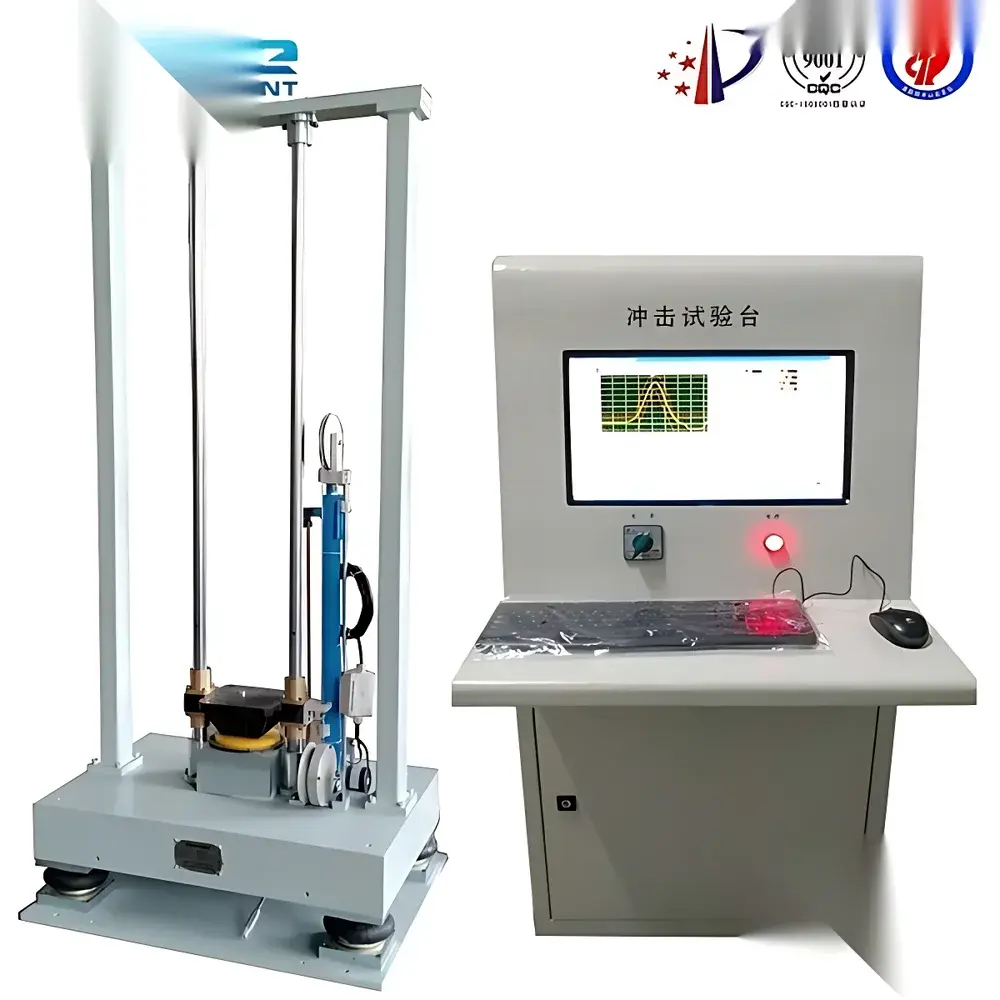
OK-S-20 Electromechanical Shock Testing Machine
| Brand | OEM |
|---|---|
| Origin | Imported |
| Manufacturer Type | Authorized Distributor |
| Model | OK-S-20 |
| Price | USD 14,000 (FOB) |
| Power Supply | AC 380 V ±5%, 50/60 Hz ±0.5 Hz, 3-phase 5-wire |
| Load Capacity | 25 kg |
| Table Dimensions | 35 cm × 30 cm |
| Shock Pulse Waveforms | Half-sine, Trapezoidal, Post-peak Sawtooth (optional) |
| Acceleration Range | 150–15,000 m/s² |
| Pulse Duration | 0.5–11 ms |
| Overall Dimensions (W×H×D) | 110 × 220 × 85 cm |
| Net Weight | 900 kg |
| Compliance | IEC 60068-2-27, MIL-STD-810H, GJB 150.18A, JIS C 0041, ASTM D999 |
Overview
The OK-S-20 Electromechanical Shock Testing Machine is a precision-engineered system designed to replicate controlled mechanical shock environments for reliability validation of electronic components, aerospace subsystems, automotive ECUs, and industrial control modules. It operates on the principle of electromechanically driven free-fall impact: a DC motor coupled with a gear-reduction lifting mechanism elevates the test table and impact mass to a programmable height; upon release, the mass strikes a calibrated elastomeric buffer, generating a repeatable, high-fidelity shock pulse—primarily half-sine, with optional trapezoidal or post-peak sawtooth profiles. Unlike pneumatic or hydraulic shock testers, the OK-S-20 delivers superior waveform reproducibility and pulse-to-pulse stability due to its rigid frame architecture, integrated damping base, and closed-loop speed regulation of the lifting motor. Its acceleration range (150–15,000 m/s²) and adjustable pulse duration (0.5–11 ms) enable compliance testing across multiple international standards without hardware reconfiguration.
Key Features
- Electromechanical actuation with brushless DC motor and precision planetary gearbox ensures consistent lift velocity and minimal mechanical backlash.
- Adjustable impact height and interchangeable buffer materials (e.g., polyurethane, silicone rubber, neoprene) allow fine-tuning of peak acceleration and pulse width independently.
- Dual-mode waveform generation: standard half-sine pulse optimized for IEC 60068-2-27 Method Ea; optional trapezoidal and post-peak sawtooth waveforms support MIL-STD-810H Method 516.8 Tailored Shock and JIS C 0041 Class II requirements.
- Integrated anti-rebound mechanism eliminates secondary impact, ensuring single-event fidelity critical for qualification-grade testing.
- Passive vibration isolation base with tuned mass dampers reduces floor-transmitted energy to <0.5 g RMS at 10–200 Hz—meeting ISO 2041 Class B ambient vibration criteria for adjacent lab equipment.
- Full safety interlock suite: emergency stop circuitry, door position sensing, overtravel limit switches, and uninterruptible power monitoring prevent hazardous operation during power loss or misalignment.
Sample Compatibility & Compliance
The OK-S-20 accommodates test specimens up to 25 kg mounted on its 35 cm × 30 cm aluminum honeycomb table (flatness tolerance: ±0.05 mm). Fixture adaptability supports standard ¼”-20 and M6 threaded inserts, as well as custom fixture mounting via T-slots. The system is pre-validated against key shock test standards including IEC 60068-2-27 (Ea, Ec), MIL-STD-810H Method 516.8 (Shock), GJB 150.18A (China MIL), JIS C 0041 (Japanese Industrial Standard), and ASTM D999 (Transportation Shock). Calibration traceability follows ISO/IEC 17025 requirements, with annual verification supported by NIST-traceable accelerometers and digital oscilloscopes. For regulated industries, the machine’s operational log—including timestamped test parameters, pulse waveform captures, and operator ID—is exportable in CSV format to support GLP/GMP audit trails per FDA 21 CFR Part 11 Annex 11 requirements.
Software & Data Management
The OK-S-20 is operated via a dedicated Windows-based control interface with real-time waveform preview, parameter locking, and multi-step test sequence programming. All shock events are captured using a built-in 16-bit, 1 MS/s data acquisition module synchronized to the impact trigger. Raw acceleration time-history data (±500 g full scale) is stored in IEEE-compliant .tdms format and can be exported directly to MATLAB, Python (via PyTDMS), or commercial analysis tools such as nCode DesignLife. The software enforces user role-based access control (Operator, Technician, Administrator), maintains an immutable audit trail of all parameter changes and test executions, and supports automated report generation compliant with ISO 17025 documentation structure. Optional integration with LabVIEW or SCADA systems is available via Modbus TCP or OPC UA protocols.
Applications
- Qualification testing of avionics enclosures per DO-160 Section 8 Shock.
- Drop simulation for handheld medical devices (e.g., infusion pumps, portable ultrasound units) aligned with IEC 60601-1 Clause 9.4.2.
- Component-level shock survivability assessment for automotive ADAS sensors under ISO 16750-3.
- Package integrity validation of lithium-ion battery modules subjected to transportation shock per UN Manual of Tests and Criteria Part III Subsection 38.3.4.
- Research into shock-induced solder joint fatigue mechanisms using accelerated life testing protocols.
- Verification of structural damping solutions in precision optical mounts and semiconductor wafer handling systems.
FAQ
What shock waveforms does the OK-S-20 generate natively, and how are optional waveforms implemented?
The system generates half-sine pulses as standard. Trapezoidal and post-peak sawtooth waveforms require installation of dedicated buffer assemblies and corresponding firmware calibration files—both supplied as factory-configured options.
Is the OK-S-20 suitable for continuous production-line testing?
Yes—it is rated for ≥50,000 shock cycles at ≤500 m/s² and features maintenance-free linear guides, sealed bearings, and predictive diagnostics accessible via the control software.
Does the system support remote monitoring and diagnostics?
Standard Ethernet connectivity enables SNMP-based network health reporting, live waveform streaming via HTTP API, and secure remote desktop access for technical support under customer-defined firewall policies.
Can test data be integrated into an enterprise quality management system (QMS)?
Yes—CSV and TDMS exports are compatible with major QMS platforms (e.g., MasterControl, TrackWise, ETQ Reliance); custom REST API connectors are available upon request.
What is the recommended calibration interval and traceability basis?
Annual calibration is recommended, performed using NIST-traceable reference accelerometers and certified shakers per ISO 16063-21; calibration certificates include measurement uncertainty budgets and as-found/as-left data.



