
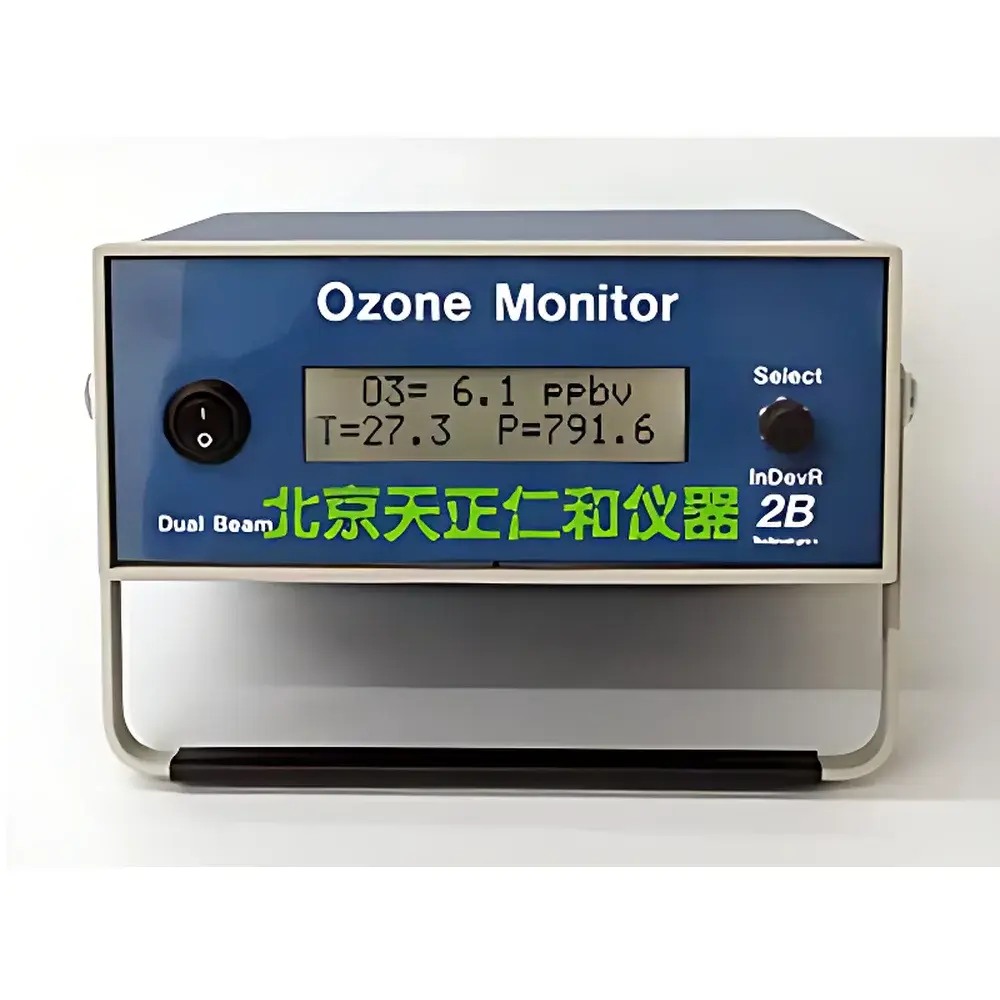
205 Model Ozone Analyzer by 2B Technologies
| [Origin | USA |
|---|---|
| Manufacturer Type | Authorized Distributor |
| Origin Category | Imported |
| Model | 205 |
| Price | Upon Request] |
Overview
The 205 Model Ozone Analyzer is a high-performance, dual-beam ultraviolet (UV) absorption ozone monitor engineered for precision atmospheric ozone measurement in demanding environmental and atmospheric research applications. It operates on the well-established Beer–Lambert principle, utilizing UV light at 254 nm to quantify ozone concentration via differential absorption between a sample beam (ozone-containing air) and a reference beam (ozone-scrubbed air). This dual-beam architecture eliminates drift associated with lamp intensity fluctuations and photodetector aging—critical for long-term unattended operation aboard aircraft, balloons, unmanned aerial systems (UAS), and ground-based monitoring stations. With a native measurement interval of 2 seconds and full 0.5 Hz data acquisition capability, the 205 delivers the fastest real-time ozone response among commercially available UV photometric analyzers while maintaining compact form factor (10 × 21 × 29 cm), low mass (2.1 kg), and power efficiency (5.0 W nominal). It is EPA Federal Equivalent Method (FEM) certified under EQOA-0812-193, building upon the validated platform of the 202 Model with enhanced baseline stability, reduced sensitivity drift, and improved signal-to-noise performance.
Key Features
- Dual-beam UV photometry at 254 nm with simultaneous I0 (reference) and I (sample) detection for intrinsic compensation of optical source and detector variability
- Measurement interval of 2 seconds; configurable averaging intervals: 2 s, 10 s, 1 min, 5 min, or 1 hr (user-defined)
- DewLine™ proprietary moisture compensation system—eliminates water vapor interference without chemical scrubbers or Nafion dryers
- Redundant sampling pump and integrated flowmeter: backup pump automatically engages if main flow falls below 1.2 L/min, with visual alert on LCD
- Onboard EEPROM data logger storing up to 14,336 records (e.g., 10-second averages yield ~1.4 days; 1-hour averages support >1.6 years of continuous logging)
- Real-time clock (RTC) with battery-backed memory for timestamped data integrity
- Three 0–2.5 V DC analog inputs for concurrent recording of auxiliary parameters (e.g., temperature, pressure, relative humidity)
- User-configurable analog output (0–2.5 V) with optional 4–20 mA current loop output
- Microprocessor-controlled interface supporting field calibration (gain/zero adjustment), unit selection (ppb, ppm, pphm, µg/m³, mg/m³), and T/P correction
- NIST-traceable calibration certificate included; instrument-specific calibration data provided on CD-ROM
Sample Compatibility & Compliance
The 205 Model is designed for ambient air, stratospheric balloon payloads, and aircraft cabin/external probe integration. Its operational altitude range spans 0–30 km (corresponding to 1000–10 mbar), with optional low-temperature configuration (-20 to 50 °C) featuring heated UV lamp and rotary vane pump. The analyzer complies with U.S. EPA Federal Equivalent Method (FEM) EQOA-0812-193 for ambient ozone monitoring and meets essential requirements for GLP-compliant field studies. All firmware and data handling protocols support audit-ready operation: time-stamped records, non-volatile storage, and user-accessible calibration history satisfy foundational elements of 21 CFR Part 11 readiness when deployed with secure external logging systems. While not FDA-certified as a medical device, its metrological traceability and documented uncertainty budget align with ISO/IEC 17025 principles for environmental testing laboratories.
Software & Data Management
Data export is supported via RS-232 serial interface (configurable baud rates: 1200, 2400, 4800, 19200) and analog voltage output. Optional USB-to-serial adapter enables direct PC connectivity for real-time telemetry using 2B Technologies’ free Windows-compatible software suite. Internal EEPROM logging retains timestamps, ozone values, auxiliary sensor inputs, flow rate, and system diagnostics. Optional Secure Digital (SD) flash memory card expands storage capacity to effectively unlimited duration—ideal for multi-week balloon flights or remote station deployments. GPS option provides synchronized georeferenced metadata (latitude, longitude, altitude) embedded directly into logged records. All data files are ASCII-delimited (.csv), ensuring compatibility with MATLAB, Python (pandas), R, and commercial environmental data management platforms.
Applications
- Tropospheric and stratospheric ozone profiling from manned/unmanned aircraft and high-altitude balloons
- Urban and regional air quality monitoring networks requiring FEM-compliant instrumentation
- Mobile laboratory platforms and vehicle-mounted emission studies
- Calibration transfer standards and intercomparison campaigns (e.g., NOAA’s Global Monitoring Laboratory protocols)
- Indoor air quality assessment in controlled environments (e.g., cleanrooms, laboratories)
- Validation of satellite-based ozone retrievals (e.g., OMI, TROPOMI, OMPS)
- Long-term trend analysis in background monitoring sites (e.g., GAW stations)
FAQ
Is the 205 Model EPA-certified?
Yes—the 205 Model is designated as an EPA Federal Equivalent Method (FEM) under EQOA-0812-193, confirming its equivalence to the reference method for ambient ozone monitoring.
What is the detection limit and dynamic range?
The instrument achieves a 2σ detection limit of 2.0 ppb and a linear dynamic range spanning 1.0 ppb to 250 ppm ozone concentration.
Does it support temperature and pressure correction?
Yes—real-time T/P correction is enabled via internal sensors or user-supplied analog inputs; units include °C/K, mbar/torr, and ozone in ppb/ppm/µg/m³.
Can it operate unattended for extended periods?
Yes—its low power draw (5.0 W), onboard RTC, EEPROM logger, and optional GPS + SD card make it suitable for autonomous deployment exceeding one year at 1-hour averaging resolution.
What maintenance is required?
Routine maintenance includes periodic zero checks using supplied zero cartridges, annual lamp replacement (typical lifetime >12 months), and filter replacement per manufacturer guidelines—no consumables beyond these items.







