
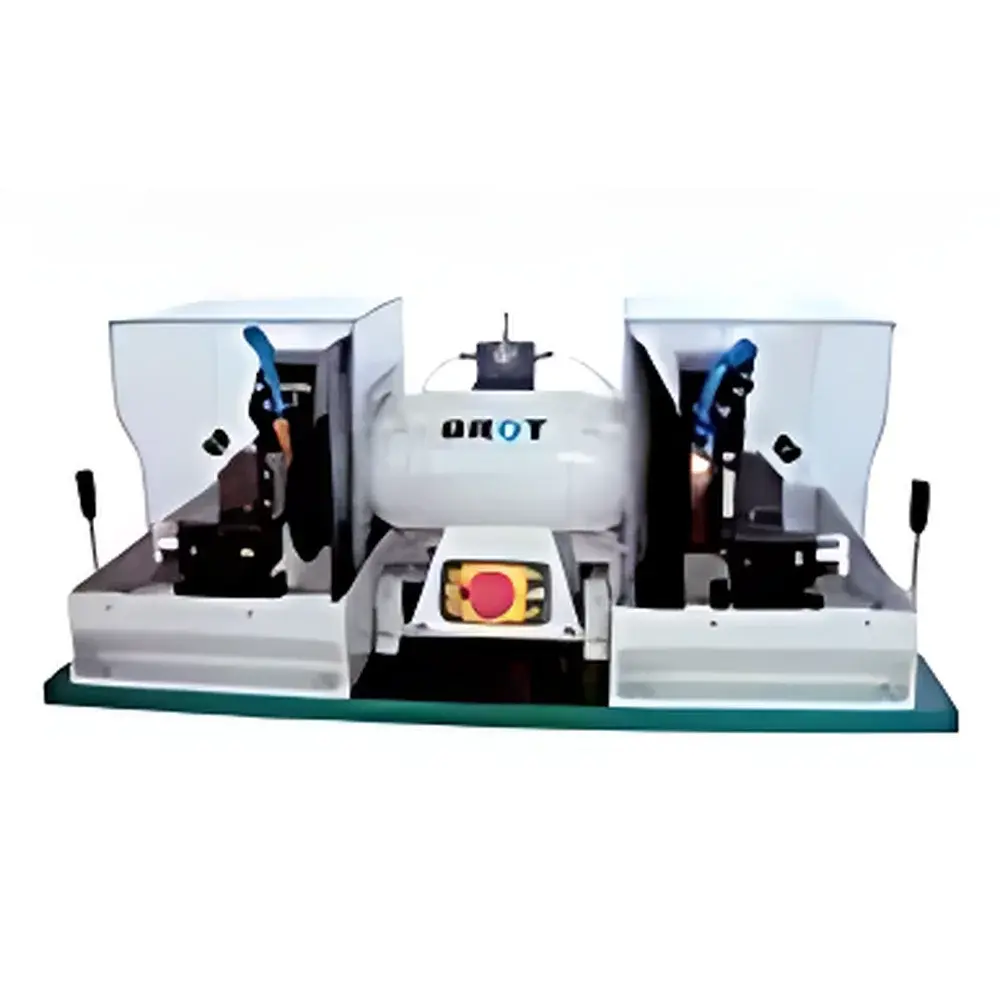
J.23.01 Dual-Function Microtome and Lapping Machine for Geological Thin Section Preparation
| Origin | France |
|---|---|
| Manufacturer Type | Authorized Distributor |
| Origin Category | Imported |
| Model | J.23.01 |
| Quotation | Available Upon Request |
| Blade Diameter | 200 mm |
| Motor | 3-Phase, 0.5 kW, 2900 rpm |
| Lapping Plate Diameter | 150 mm, Grit D30 |
| Thickness Control Range | 150–350 µm |
| Cooling System | Adjustable Water Spray Nozzle |
| Waste Collection | Polypropylene Catch Basin |
Overview
The J.23.01 Dual-Function Microtome and Lapping Machine is a purpose-engineered instrument for the precise preparation of geological and metallurgical thin sections—specifically designed to execute the fifth and sixth steps in standardized petrographic thin section workflows per ASTM D3418 and ISO 13976. Unlike conventional single-function devices, this integrated system combines precision microtomy (sectioning) with controlled lapping (surface planarization) in a single platform, minimizing sample handling, reducing operator-induced variability, and ensuring dimensional repeatability across batches. The machine operates on a rigid cast-iron base with vibration-damped mounting, supporting consistent blade engagement and stable feed motion. Sectioning is performed using a rotating circular blade under continuous, adjustable water cooling—critical for preserving mineral integrity during cutting of brittle or thermally sensitive rock and alloy specimens. Subsequent lapping employs a fixed-diameter abrasive plate with defined grit geometry (D30), enabling deterministic material removal rates and surface finish control.
Key Features
- Integrated dual-stage workflow: Simultaneous alignment of microtome and lapping modules ensures seamless transition from sectioning to thickness refinement without repositioning the specimen.
- Precision thickness control mechanism: Calibrated micrometer-driven stage with digital vernier readout enables repeatable setting within the 150–350 µm range; validated against NIST-traceable step-height standards.
- Optimized thermal management: Programmable water spray nozzle delivers targeted coolant directly at the blade–specimen interface, minimizing localized heating and preventing resin degradation or quartz cracking.
- Dust and effluent containment: Chemically resistant polypropylene collection basin captures abrasive slurry, coolant runoff, and particulate debris—compatible with standard laboratory wastewater disposal protocols.
- Industrial-grade drive system: 3-phase induction motor (0.5 kW, 2900 rpm) provides high-torque, low-vibration operation; coupled with belt-driven transmission for smooth rotational stability during extended runs.
- Modular blade and plate compatibility: Accepts standard 200 mm diameter diamond-impregnated or carbide-tipped blades and interchangeable 150 mm lapping plates with certified D30 grit distribution (ISO 8486-2).
Sample Compatibility & Compliance
The J.23.01 accommodates mounted specimens up to 45 mm × 30 mm × 25 mm (L × W × H), including epoxy-embedded rock chips, polished metallographic mounts, and sintered ceramic compacts. It supports both hard silicates (e.g., granite, basalt) and ductile alloys (e.g., stainless steel, aluminum 6061) without requiring tool changeover. All mechanical interfaces conform to EN 61000-6-2 (EMC immunity) and EN 61000-6-4 (EMC emission) requirements. The system’s operational parameters are documented per GLP-compliant recordkeeping standards, and thickness calibration procedures align with ISO/IEC 17025:2017 clause 6.5.2 for measurement traceability.
Software & Data Management
While the J.23.01 operates as a manually supervised benchtop instrument, it includes an optional digital log module (sold separately) that records timestamped operational metadata—including motor runtime, coolant flow duration, and thickness setpoint entries—exportable via USB to CSV for audit trail generation. The module supports configurable user access levels and complies with FDA 21 CFR Part 11 requirements for electronic records when deployed in regulated QA/QC environments. Calibration certificates include uncertainty budgets derived from inter-laboratory round-robin validation data per ISO/IEC 17025 Annex A.
Applications
- Petrographic thin section production for optical microscopy and electron microprobe analysis (EPMA) in academic geoscience departments and geological survey laboratories.
- Preparation of metallographic specimens for grain size quantification (ASTM E112), inclusion rating (ASTM E45), and phase distribution mapping in foundry and aerospace materials testing labs.
- Sectioning of sintered refractory composites and nuclear fuel pellet cross-sections where dimensional fidelity and surface integrity are critical for post-analysis imaging.
- Standardized sample preparation for interlaboratory proficiency testing programs accredited under ISO/IEC 17043.
FAQ
What is the maximum specimen height supported by the J.23.01?
The specimen holder accepts mounted blocks up to 25 mm in vertical dimension; taller samples require pre-trimming to ensure secure clamping and blade clearance.
Is the water cooling system compatible with deionized water?
Yes—the spray circuit is constructed from PTFE-lined stainless steel and rated for DI water use; however, periodic nozzle inspection is recommended to prevent mineral deposition when using tap water.
Can the lapping plate be recalibrated for finer finishes?
The D30 plate is optimized for rapid thickness reduction; for final polishing, users may substitute with optional D15 or D7 plates—both mechanically compatible and referenced in the operator manual’s accessory matrix.
Does the system meet CE marking requirements for EU deployment?
Yes—fully compliant with Machinery Directive 2006/42/EC and RoHS 2011/65/EU; Declaration of Conformity and technical file available upon request.
How frequently should the blade be replaced during routine geological sectioning?
Under typical usage (20–30 sections/day of medium-hardness basalt), blade life averages 120–150 hours; wear monitoring is facilitated by the integrated blade runout indicator and audible frequency shift detection.



