
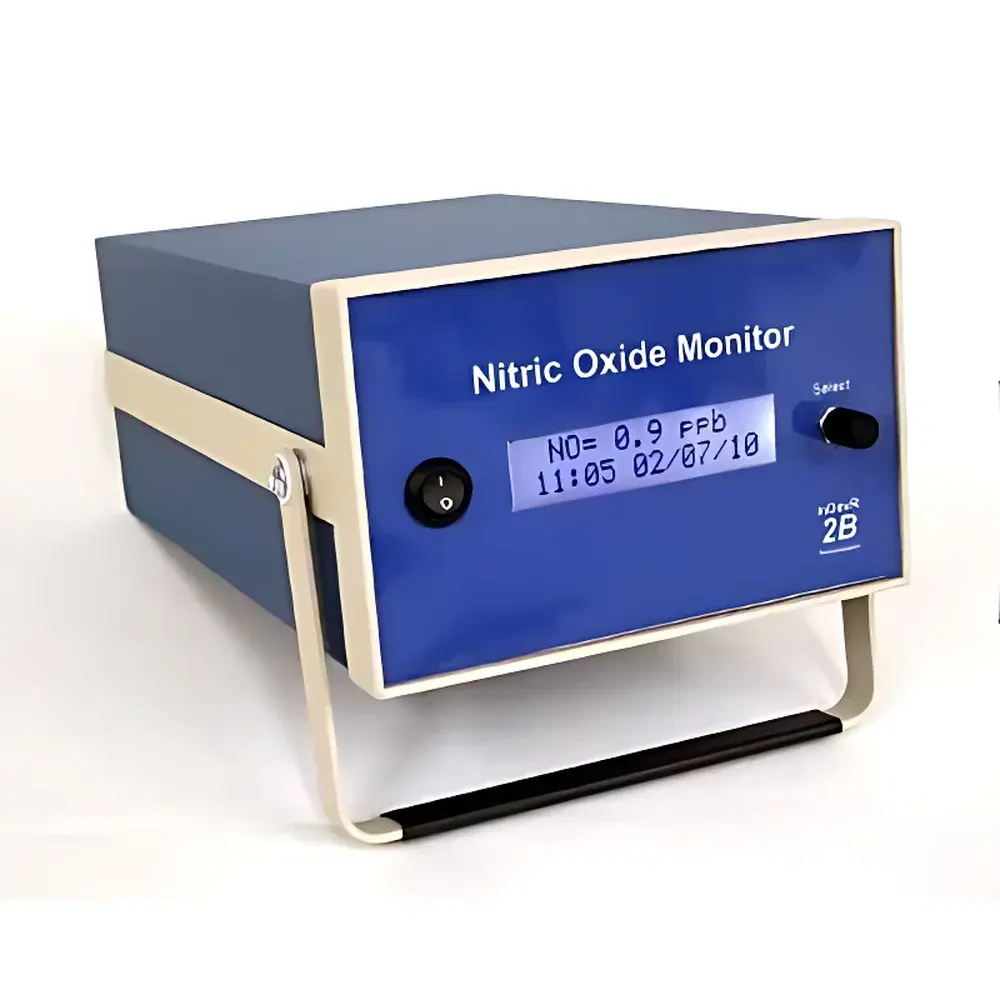
2B Technologies Model 410 Nitric Oxide Analyzer
| Brand | 2B Technologies |
|---|---|
| Origin | USA |
| Model | 410 |
| Measurement Principle | Chemiluminescence-free ozone titration with UV absorption at 254 nm (NOzone™ Technology) |
| Range | 0–2 ppm NO |
| Detection Limit | <1.5 ppb or ±2% of reading, whichever is greater |
| Data Storage | 14,336 rows (e.g., 10-sec averages for ~1.4 days |
| Sampling Flow Rate | 1.0 L/min |
| Measurement Interval | Configurable (10 s, 1 min, 5 min, 1 hr) |
| Output Interfaces | RS-232 serial, 0–2.5 V analog, LCD display, optional microSD card logging |
| Dimensions | 33.7 × 20.0 × 13.3 cm |
| Weight | 8.3 kg (3.7 kg without portable case) |
| Optional Accessory | 401 NO₂ Converter for NOₓ and NO₂ measurement |
| Compliance | Designed for ambient air quality monitoring per EPA TO-15 and ISO 8573-1 referencing traceable gas standards |
Overview
The 2B Technologies Model 410 Nitric Oxide (NO) Analyzer is a field-deployable, chemiluminescence-free instrument engineered for high-precision, long-term monitoring of ambient NO concentrations in the range of 0–2 ppm. Unlike conventional chemiluminescence analyzers—which rely on ozone generation, reaction chambers, photomultiplier tubes, and frequent calibration—it employs 2B’s proprietary NOzone™ technology: a quantitative, stoichiometric reaction between ambient NO and precisely metered ozone (O₃), followed by highly stable UV absorption measurement at 254 nm to determine residual O₃ depletion. This differential ozone titration method eliminates interference from NO₂, hydrocarbons, and particulate matter, delivering intrinsic selectivity and metrological robustness. The analyzer meets the performance criteria outlined in U.S. EPA Method TO-15 for trace-level reactive nitrogen species and supports compliance with ISO 8573-1 for compressed air purity verification where NO is a critical contaminant. Its compact footprint, low power consumption (<12 W), and passive thermal stabilization make it suitable for unattended operation in remote stations, mobile platforms, and indoor air quality laboratories.
Key Features
- NOzone™ technology: Eliminates need for ozone generators, PMT detectors, and high-voltage components—reducing maintenance, drift, and calibration frequency.
- Sub-ppb detection limit: <1.5 ppb absolute or ±2% of reading (whichever is greater), validated against NIST-traceable standard gases.
- Integrated temperature- and pressure-compensated flow control ensures consistent 1.0 L/min sampling across ambient conditions (−20°C to +40°C, 70–106 kPa).
- Configurable averaging intervals (10 s, 1 min, 5 min, 1 hr) support both real-time event capture and regulatory reporting requirements (e.g., 1-hr max, 8-hr average).
- Onboard non-volatile memory stores up to 14,336 data points with timestamps; optional microSD card enables extended archival without external PC connection.
- RS-232 serial interface and 0–2.5 V analog output allow seamless integration into SCADA systems, data loggers (e.g., Campbell Scientific CR1000), and centralized environmental monitoring networks.
Sample Compatibility & Compliance
The Model 410 is optimized for clean, dry ambient air samples. It accepts inlet gases with dew point ≤ −20°C and particulate loading <10 µg/m³ (recommended pre-filtration with 2.5 µm PTFE membrane). When paired with the optional 401 NO₂ Converter (heated molybdenum catalyst, 325°C), the system measures total reactive nitrogen oxides (NOₓ = NO + NO₂) and calculates NO₂ by difference (NO₂ = NOₓ − NO). This configuration satisfies U.S. EPA equivalency criteria for NO₂ monitoring under 40 CFR Part 53. The analyzer’s firmware implements audit trails, user-access levels, and timestamped calibration logs—supporting GLP/GMP-aligned data integrity frameworks and FDA 21 CFR Part 11 readiness when used with compliant data management software.
Software & Data Management
Data acquisition and instrument control are managed via 2B’s free, cross-platform EnviroSoft™ application (Windows/macOS/Linux), which provides real-time plotting, remote configuration, automated zero/span validation scheduling, and CSV export with metadata (flow rate, internal temperature, lamp intensity, O₃ generator status). All stored records include embedded diagnostic flags (e.g., “low lamp signal”, “flow out-of-spec”) to facilitate QA/QC review. For enterprise deployment, the RS-232 protocol supports Modbus RTU mapping, enabling interoperability with industrial IoT gateways and cloud-based environmental dashboards (e.g., AWS IoT Core, Azure IoT Hub) using standardized JSON payloads.
Applications
- Ambient air quality monitoring networks (AQS, EEA, national reference stations)
- Indoor air quality assessment in healthcare facilities, cleanrooms, and semiconductor fabrication environments
- Mobile emission testing (e.g., on-road vehicle plume chasing, aircraft ground support equipment exhaust)
- Atmospheric chemistry research—particularly NO/NO₂ interconversion kinetics and ozone production efficiency studies
- Calibration transfer and field validation of lower-cost metal oxide sensor arrays
- Compliance verification for ISO 8573-1 Class 1–3 compressed breathing air systems
FAQ
Does the Model 410 require ozone calibration gas?
No. The instrument generates ozone internally via a mercury-free UV lamp and quantifies NO through stoichiometric O₃ consumption—no external O₃ standard is needed.
Can the 401 NO₂ Converter be installed in-field?
Yes. The 401 is a plug-and-play module with integrated thermocouple and heater control; installation requires only mechanical coupling and firmware update via EnviroSoft™.
What is the recommended calibration interval?
Under stable field conditions, annual zero/span verification using certified NO-in-N₂ standards (e.g., Scott-Marrin, Air Liquide) is sufficient; drift remains typically <±0.5 ppb/month.
Is the analog output isolated and ratiometric?
The 0–2.5 V output is optically isolated and referenced to instrument ground; output scaling is fully programmable (e.g., 0–2 ppm = 0–2.5 V) and linear within ±0.1% FS.
How does humidity affect measurement accuracy?
Relative humidity up to 90% RH has negligible impact due to the dry-gas design and UV absorption path geometry; however, condensation must be prevented upstream using Nafion™ dryers or chilled mirrors.
Related Products







