
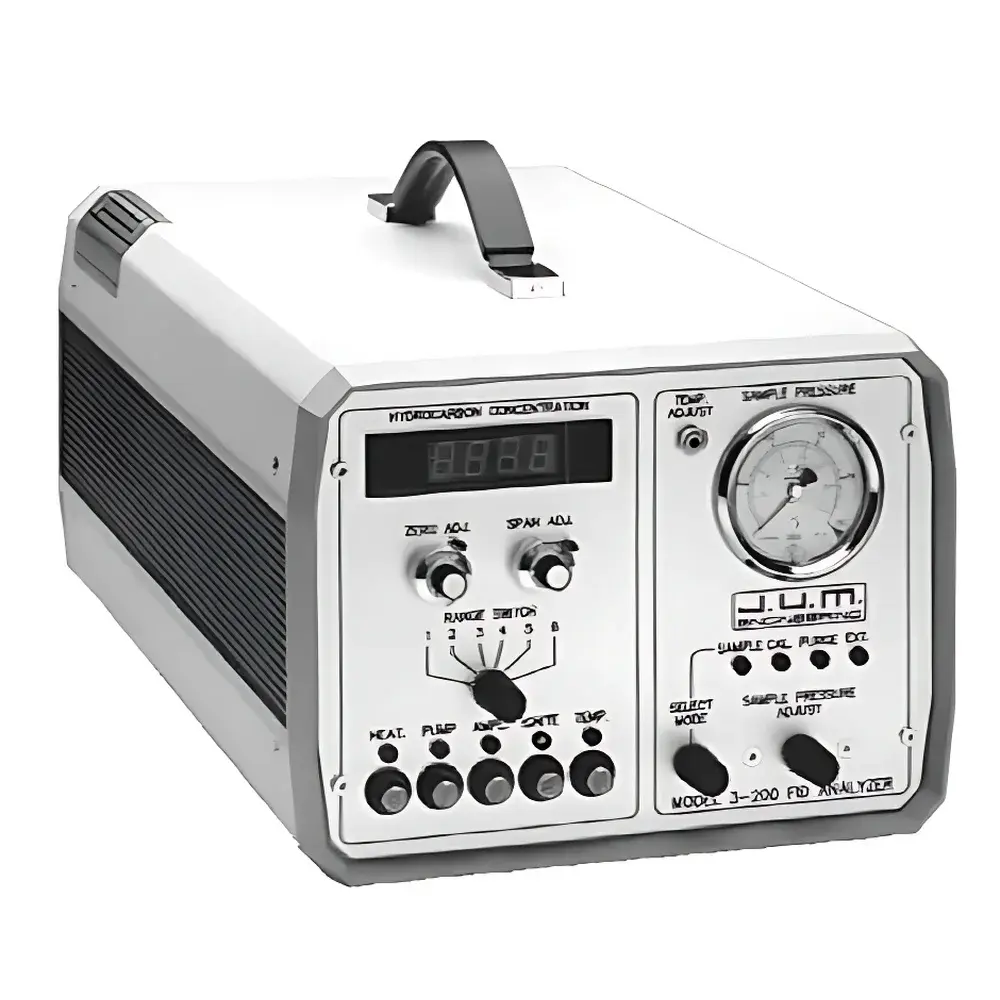
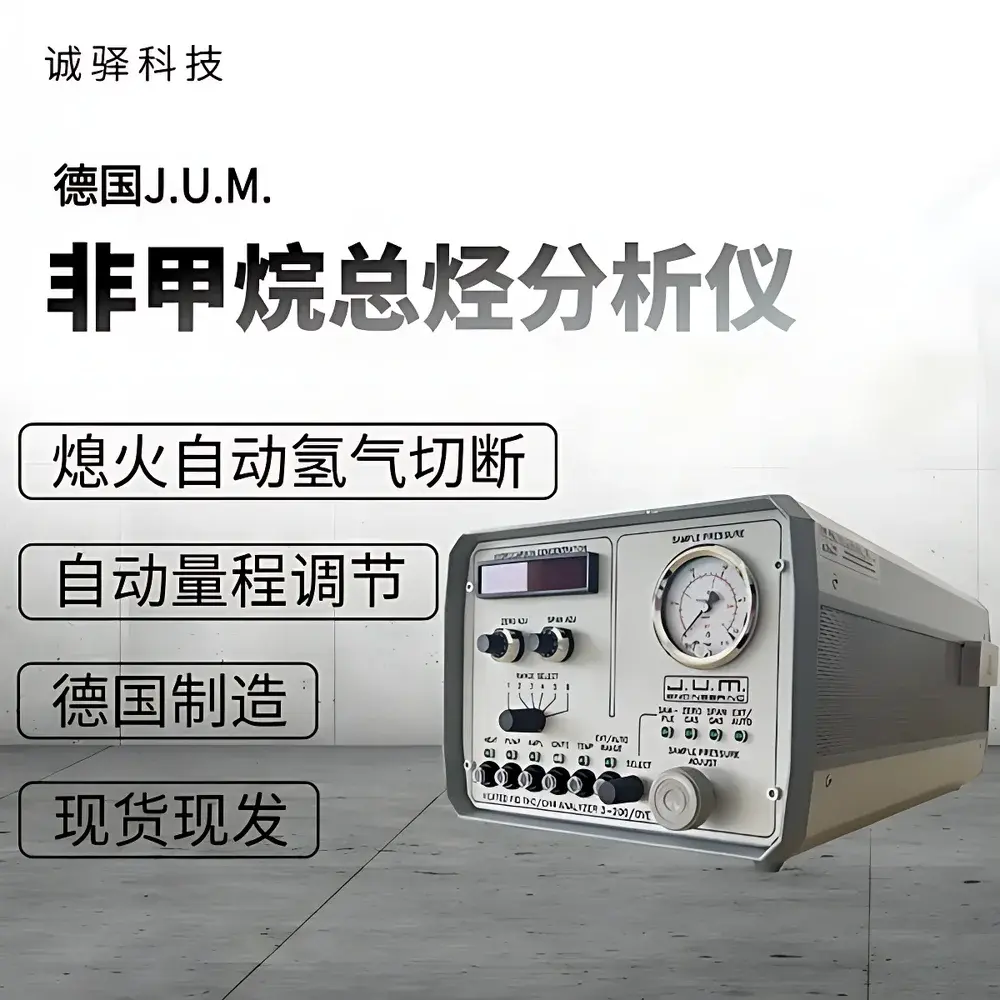
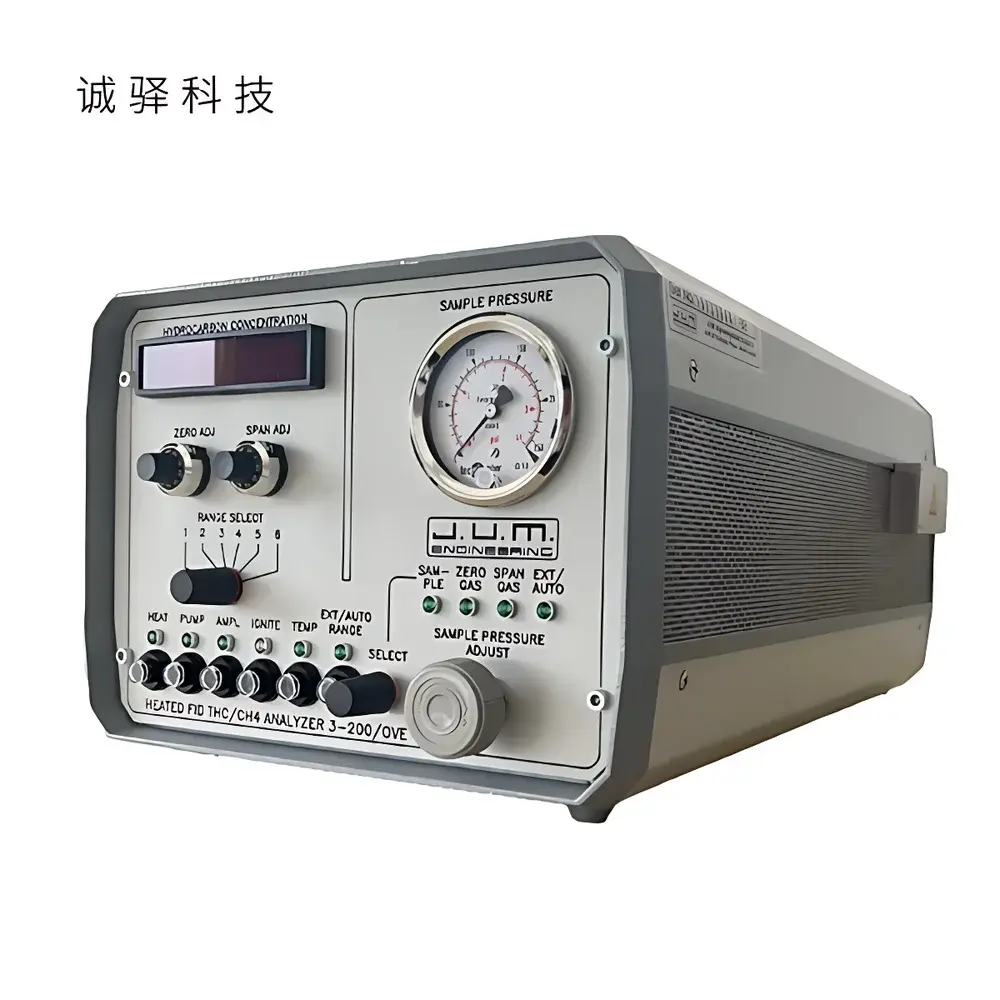
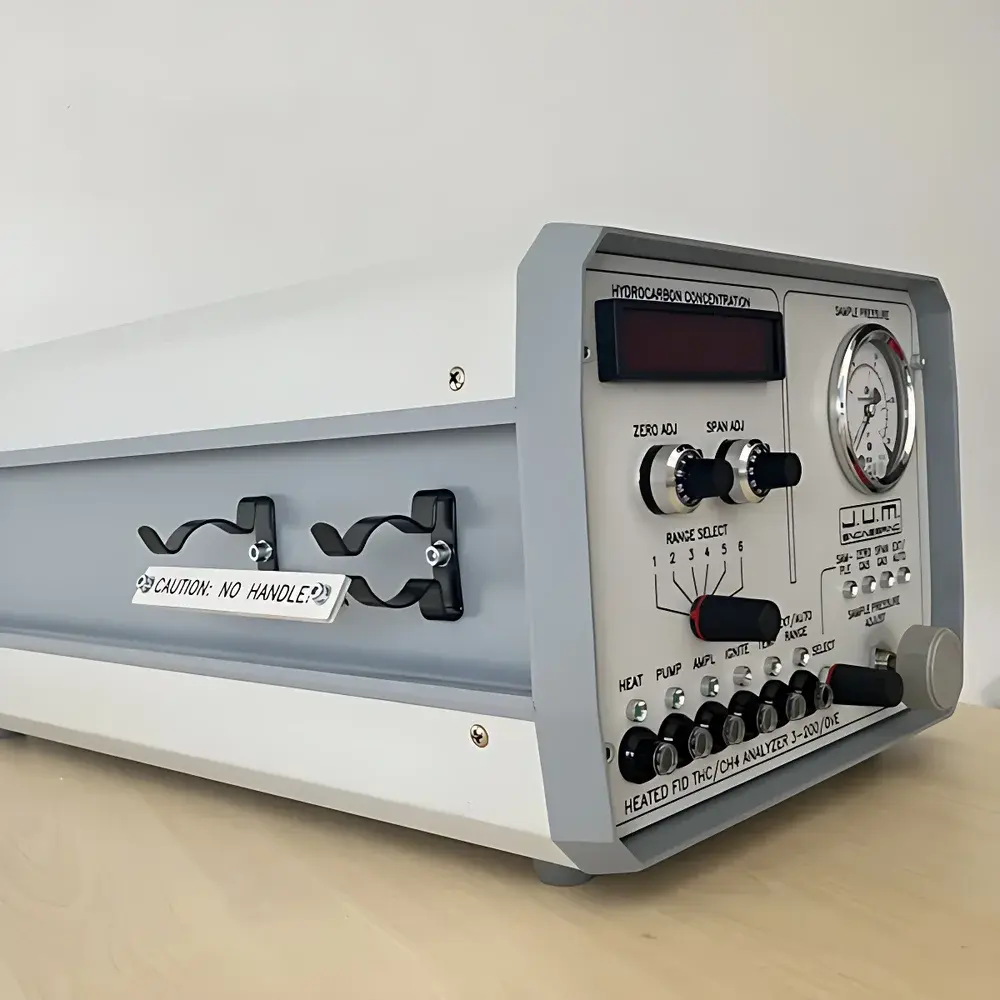
J.U.M. 3-200-1 Portable Total Hydrocarbons Analyzer with FID
| Brand | J.U.M. |
|---|---|
| Origin | Germany |
| Model | 3-200-1 |
| Detection Principle | Flame Ionization Detection (FID) |
| Instrument Type | Portable Online Analyzer |
| Detection Range | 0–1000 ppm |
| Resolution | 0.1 ppm |
| Accuracy | ±5% of reading |
| Response Time | <60 s |
| Operating Heater Temperature | 190 °C |
| Sensitivity (CH₄) | ≤1 ppm full-scale |
| Carrier/Combustion Air | Integrated zero-air generator |
Overview
The J.U.M. 3-200-1 Portable Total Hydrocarbons Analyzer is a field-deployable, FID-based gas analyzer engineered for quantitative measurement of total hydrocarbons (THC) in ambient air, stack emissions, and process streams. It operates on the well-established flame ionization detection principle: organic compounds eluting from the sample stream are pyrolyzed in a hydrogen–air flame, generating ions proportional to carbon mass flow. These ions are collected at a biased electrode, producing a current signal linearly correlated with hydrocarbon concentration. Designed for regulatory compliance and industrial process control, the 3-200-1 delivers laboratory-grade performance in a rugged, battery-operable chassis weighing under 12 kg. Its integrated air generation system eliminates dependency on external compressed air cylinders, while the heated detector chamber (maintained at 190 °C) prevents condensation and adsorption of higher-molecular-weight VOCs—ensuring representative quantification across C₁–C₁₂ hydrocarbon species.
Key Features
- True portable FID architecture with built-in zero-air generator—no external air supply required
- Heated detector compartment (190 °C) minimizes wall losses and ensures stable response to heavy hydrocarbons (e.g., xylene, naphthalene)
- Proprietary high-stability back-pressure regulator enabling consistent sample flow (±0.5% over 8 h) and reduced calibration drift
- Multi-range auto-scaling capability: selectable full-scale ranges include 0–10, 0–100, 0–1,000, 0–10,000, and 0–100,000 ppm (as CH₄-equivalent)
- Real-time digital output (RS-232/RS-485, optional Ethernet) compliant with Modbus RTU/TCP for SCADA integration
- Battery-powered operation (>4 h continuous use) with AC adapter and vehicle DC input options
- Robust IP54-rated enclosure suitable for outdoor deployment in industrial and municipal environments
Sample Compatibility & Compliance
The 3-200-1 is validated for direct analysis of undiluted gas samples containing moisture, particulates (with optional heated filter), and variable oxygen content. It meets the technical requirements of multiple international regulatory frameworks, including German BImSchV Ordinances No. 2, 13, and 17; European Standards EN 12619 (stack emission monitoring) and EN 13526 (performance testing of VOC analyzers); and U.S. EPA Methods 25A (total gaseous organic concentration) and Method 503 (calibration and verification procedures). Its measurement traceability aligns with ISO/IEC 17025-accredited calibration practices using NIST-traceable methane standards. The analyzer supports GLP-compliant data logging with time-stamped events, operator ID fields, and audit trail capabilities when paired with optional firmware modules.
Software & Data Management
The embedded firmware provides real-time concentration display, peak hold, and user-configurable alarm thresholds (high/low, rate-of-change). Optional J.U.M. AnalyzeLink™ PC software enables remote configuration, trend visualization, report generation (PDF/CSV), and automated compliance reporting per EN 14181 QAL2/QAL3 protocols. All raw analog and digital outputs are timestamped with microsecond resolution. Data integrity is preserved via cyclic redundancy check (CRC) validation and non-volatile memory storage (≥30 days of 1-second interval data). For regulated environments, optional 21 CFR Part 11-compliant firmware adds electronic signatures, role-based access control, and immutable audit logs.
Applications
- Stack emission monitoring at combustion sources (boilers, incinerators, thermal oxidizers)
- Boundary line and fence-line monitoring for fugitive VOC emissions
- In-service testing of catalytic converters and aftertreatment systems
- Engine exhaust characterization during R&D and homologation cycles
- Carbon adsorption bed breakthrough detection and regeneration endpoint control
- Trace hydrocarbon verification in high-purity nitrogen, argon, or hydrogen used in semiconductor fabrication
- LEL (Lower Explosive Limit) assessment during solvent recovery operations
- Field verification of ambient air quality near petrochemical facilities or landfills
FAQ
What calibration gases are required for routine operation?
Certified methane-in-air standards (e.g., 10 ppm, 100 ppm, 500 ppm) traceable to NIST or PTB are recommended for daily zero/span checks. Multi-point calibration is performed using at least three concentrations covering the intended measurement range.
Can the 3-200-1 measure individual VOCs or only total hydrocarbons?
It is configured exclusively for total hydrocarbon quantification (as CH₄-equivalent). For speciated VOC analysis, a GC-FID or GC-MS system is required.
Is the instrument certified for use in hazardous areas (ATEX/IECEx)?
The standard 3-200-1 is rated for Zone 2/Class I Div 2 environments. ATEX-certified variants (II 2G Ex db IIB T3 Gb) are available upon request with modified housing and ignition protection.
How often does the FID require maintenance?
Under typical field use, the burner nozzle and collector electrode require cleaning every 200–300 operating hours; the hydrogen supply (small cylinder or generator) should be inspected weekly for pressure stability and leak integrity.
Does the analyzer support automatic zero correction during sampling?
Yes—optional automatic zeroing can be scheduled at user-defined intervals (e.g., every 2 or 4 hours) using an internal zero-air purge cycle, minimizing manual intervention while maintaining long-term baseline stability.







