
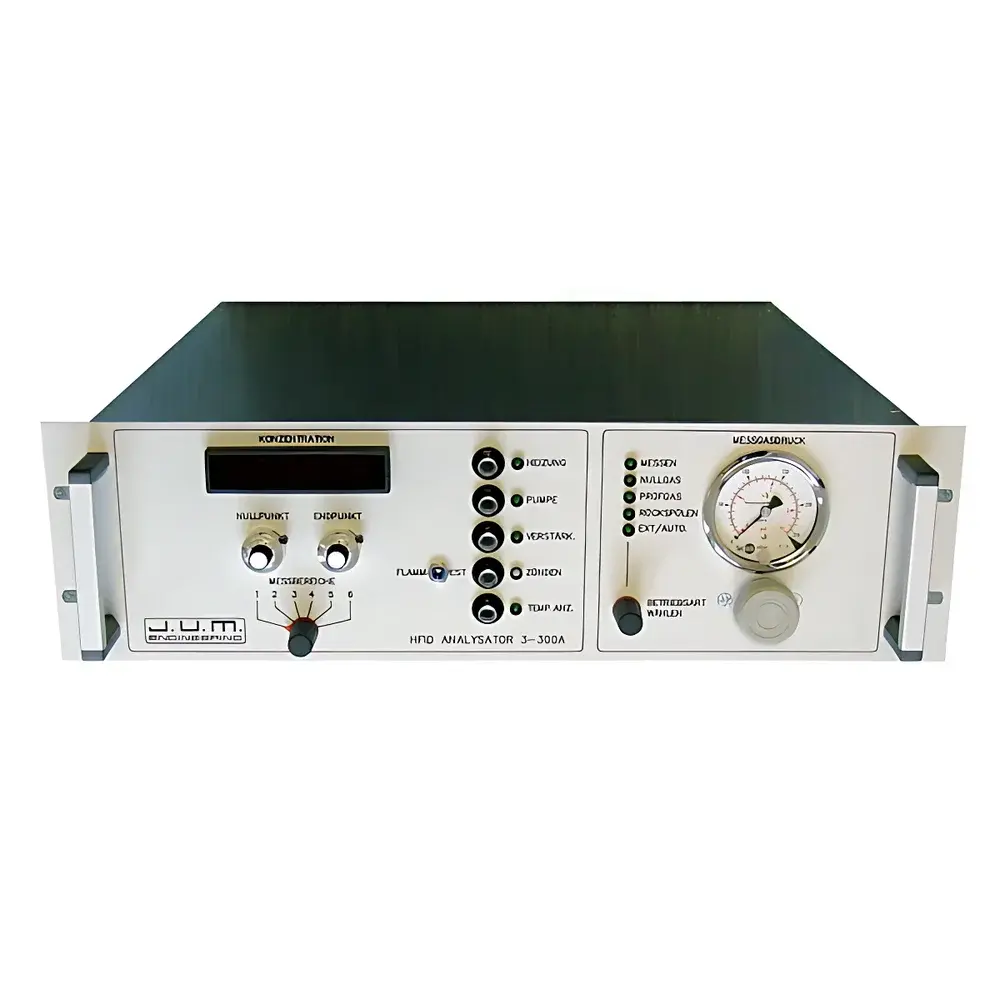
J.U.M. 3-300A Online Total Hydrocarbon Analyzer with FID Detection
| Brand | J.U.M. |
|---|---|
| Origin | Germany |
| Model | 3-300A |
| Detection Principle | Flame Ionization Detection (FID) |
| Instrument Type | Online Continuous Analyzer |
| Detection Range | 0–1000 ppm (expandable to 100,000 ppm) |
| Resolution | 0.1 ppm |
| Accuracy | ±5% of reading |
| Response Time (T90) | <60 s |
| Operating Heater Temperature | 190 °C |
| Carrier/Combustion Air | Integrated compressed air supply |
| Filter Design | Pneumatically actuated reverse-pulse backflush system |
Overview
The J.U.M. 3-300A Online Total Hydrocarbon Analyzer is a high-stability, continuously operating gas analyzer engineered for real-time quantification of total hydrocarbons (THC) in industrial exhaust streams, ambient air, and process gases. It employs flame ionization detection (FID), a well-established, linear, and highly sensitive measurement principle compliant with international regulatory frameworks for hydrocarbon emission monitoring. Unlike catalytic or photoionization-based alternatives, FID delivers robust, compound-independent response across saturated and unsaturated aliphatic and aromatic hydrocarbons—making it the reference method for regulatory compliance in continuous emission monitoring systems (CEMS). The instrument operates with full sample path heating at 190 °C to prevent condensation and adsorption losses of higher-boiling VOCs, ensuring representative measurement of true total hydrocarbon mass concentration. Its design conforms to the fundamental metrological requirements of EN 12619 (stationary source emissions — automated measuring systems), EN 13526 (performance criteria for VOC analyzers), and U.S. EPA Methods 25A and 503—enabling direct integration into legally mandated CEMS architectures.
Key Features
- Integrated high-temperature sample conditioning: Entire gas path—including sampling probe, heated line, filter, and detector chamber—maintained at 190 °C to eliminate cold spots and preserve volatile organic compound integrity.
- Self-contained combustion air generation: Onboard air compressor and filtration system eliminates dependency on external compressed air sources, reducing installation complexity and operational failure points.
- Automated reverse-pulse backflush filtration: Programmable pneumatic cleaning cycle extends filter service life and maintains consistent flow dynamics without manual intervention.
- Multi-range measurement capability: Factory-configurable full-scale ranges including 0–10, 0–100, 0–1,000, 0–10,000, and 0–100,000 ppm (as methane equivalent), selectable via software or hardware jumpers.
- Fast dynamic response: T90 <60 seconds under standard conditions, enabling reliable capture of transient emission events during start-up, load changes, or process upsets.
- Rugged industrial enclosure: IP65-rated housing with redundant power input options (110/230 VAC, 50/60 Hz) and integrated surge protection suitable for outdoor or harsh plant environments.
Sample Compatibility & Compliance
The 3-300A is validated for use with flue gases, stack emissions, ambient air, inert carrier gases (N₂, Ar), and synthetic air matrices. It accommodates sample dew points up to 100 °C and particulate loading ≤1 mg/m³ (with active filtration). Calibration traceability follows ISO/IEC 17025 requirements using certified NIST-traceable methane standards. Regulatory alignment includes German BImSchV Ordinances 2, 13, and 17; European Standards EN 12619 and EN 13526; and U.S. EPA Methods 25A (for THC in stationary sources) and Method 503 (for calibration and performance verification of FID analyzers). The system supports QAL2 (Quality Assurance Level 2) testing per EN 14181 and meets data integrity requirements for GLP/GMP-aligned environmental reporting.
Software & Data Management
The analyzer interfaces via Modbus RTU/TCP and analog 4–20 mA outputs (isolated, HART-enabled optional). Configuration, diagnostics, and trend logging are managed through J.U.M.’s web-based iControl software, accessible via secure HTTPS. Data logging supports time-stamped raw FID current, temperature readings, pressure compensation values, and maintenance event timestamps. Audit trails comply with FDA 21 CFR Part 11 requirements when deployed in regulated manufacturing environments (e.g., semiconductor cleanroom purge gas monitoring or pharmaceutical solvent recovery units). Optional cloud integration enables remote calibration validation, alarm forwarding (SNMP/email/SMS), and long-term emission trend analysis aligned with EU IED reporting cycles.
Applications
- Continuous monitoring of THC in thermal oxidizers, catalytic converters, and incinerators per TA Luft and IED Annex VI.
- Real-time exhaust gas analysis for internal combustion engines and vehicle test benches (RDE, WLTP).
- Trace hydrocarbon monitoring in ultra-high-purity nitrogen, argon, and hydrogen used in semiconductor fabrication.
- Leak detection and lower explosive limit (LEL) assessment in solvent recovery systems and paint booths.
- Activated carbon bed breakthrough monitoring in air pollution control installations.
- Background THC screening in ambient air quality networks and landfill gas collection systems.
FAQ
What calibration gases are required for routine operation?
Certified methane-in-air standards at two points (e.g., zero air and 50% FS) are recommended weekly; full multi-point calibration per EN 14181 QAL2 every 3 months.
Can the 3-300A measure individual VOCs?
No—it reports total hydrocarbon concentration as methane-equivalent (ppm C₁H₄); compound-specific identification requires GC-FID or GC-MS coupling.
Is external sample conditioning required?
Not typically—the integrated heated sample path and backflush filter accommodate most industrial gas streams; however, high-moisture or corrosive applications may require optional acid-gas scrubbers or chiller-based moisture removal upstream.
How is data integrity ensured during power interruption?
Non-volatile memory retains configuration, calibration history, and last 72 hours of 1-second resolution data; UPS-ready input supports seamless failover in critical CEMS deployments.
Does the system support automatic zero/span checks?
Yes—programmable automated zero (synthetic air) and span (CH₄ standard) sequences can be scheduled daily or per operational cycle, with full audit trail logging.







