
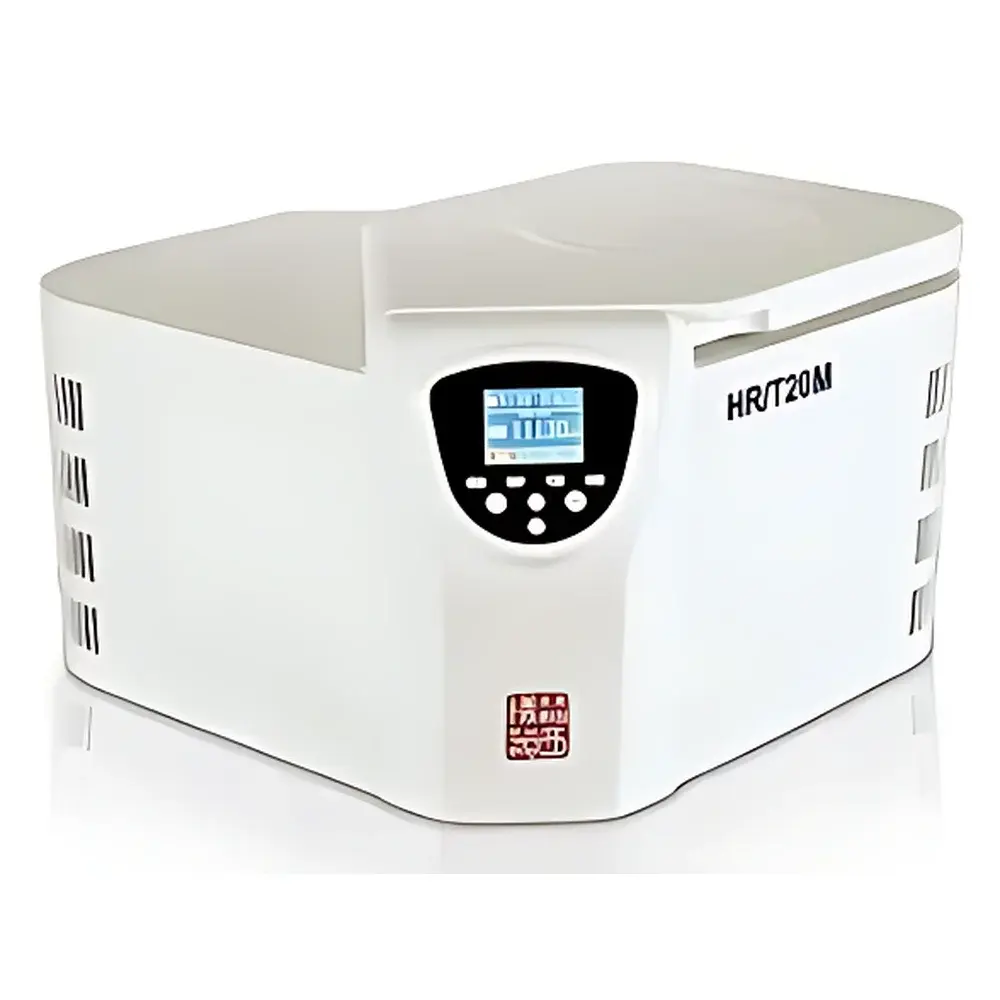
3H20RI High-Speed Refrigerated Centrifuge
| Origin | Hunan, China |
|---|---|
| Manufacturer Type | Authorized Distributor |
| Product Origin | Domestic (China) |
| Model | 3H20RI |
| Price | USD 3,700 (FOB) |
| Category | High-Speed Refrigerated Centrifuge (10,000–30,000 rpm) |
| Target Applications | Biomolecular Separation |
| Maximum Capacity | 4 × 100 mL |
| Maximum Speed | 20,800 rpm |
| Dimensions (L×W×H) | 710 × 630 × 350 mm |
| Refrigeration Range | −20 °C to +40 °C |
| Temperature Accuracy | ±1 °C |
| Acceleration/Deceleration Control | 10-step programmable |
| Rotor Options | Titanium angle rotors (e.g., 12 × 1.5/2.0 mL, 24 × 1.5/2.0 mL), horizontal buckets (4 × 100 mL), enzyme plate carriers (2 × 96-well), and custom configurations |
| Safety Compliance | Triple-layer steel rotor containment, imbalance detection, overspeed protection, overtemperature cutoff, automatic door lock with brushless motor actuation |
| Display | 7-inch TFT true-color touchscreen with real-time display of speed (rpm), RCF (×g), time, temperature, and acceleration profile |
| Programmability | Up to 100 user-defined protocols with parameter recall, quick-start “pulse” mode, standby cooling function |
| Noise Level | ≤65 dB(A) |
| Power Supply | 220 V AC, 50 Hz |
| Total Power Consumption | 1.5 kW |
| Net Weight | 75 kg |
| Refrigerant | R404a (non-CFC, compliant with international environmental standards) |
Overview
The 3H20RI High-Speed Refrigerated Centrifuge is an engineered solution for high-resolution separation of biomolecules—including nucleic acids, proteins, subcellular organelles, and viral particles—under precisely controlled thermal conditions. Based on the principle of sedimentation velocity centrifugation, it applies controlled centrifugal force (RCF up to 30,000 × g) to accelerate differential migration of particles through liquid media according to size, shape, and density. Its refrigerated architecture maintains sample integrity during prolonged high-speed runs, making it suitable for applications where thermal denaturation or enzymatic degradation must be minimized—such as plasmid purification, mitochondrial isolation, exosome enrichment, and cryopreserved cell processing. Designed for routine use in GLP-compliant laboratories, clinical diagnostics centers, biopharmaceutical QC labs, and academic core facilities, the 3H20RI meets fundamental mechanical and thermal stability requirements aligned with ISO 13485 design controls and supports audit-ready operation under FDA 21 CFR Part 11 when integrated with validated LIMS environments.
Key Features
- Brushless DC frequency-controlled motor delivering high torque and extended service life with minimal maintenance
- dsPIC30F microcontroller-based digital control system (Microchip Technology) ensuring precise speed regulation (±50 rpm accuracy) and stable RCF output
- FAIRCHILD FSBB30CH intelligent power drive module for low-noise, high-efficiency motor actuation and dynamic braking
- Triple-layer steel rotor housing with dynamic imbalance compensation and real-time vibration monitoring
- Standby pre-cooling functionality: chamber cools to setpoint while rotor remains stationary, reducing thermal shock upon sample loading
- 7-inch capacitive TFT touchscreen interface with multilingual support (English, Spanish, German, French), intuitive icon-driven navigation, and simultaneous display of all operational parameters
- Programmable acceleration/deceleration profiles (10 selectable ramps) to minimize pellet disruption and optimize recovery of fragile complexes
- Integrated brushless motor door lock with position feedback and emergency release mechanism compliant with IEC 61000-6-2 EMC immunity standards
Sample Compatibility & Compliance
The 3H20RI accommodates a broad range of tube formats and vessel types via interchangeable rotor systems, including titanium angle rotors (12 × 1.5/2.0 mL, 24 × 1.5/2.0 mL, 10 × 5 mL), high-capacity horizontal buckets (4 × 100 mL), and specialized carriers for 96-well microplates. All rotors are certified to ISO 15512:2018 for maximum rated speed and cyclic fatigue endurance. The instrument conforms to IEC 61010-1:2010 for laboratory equipment safety, EN 61326-1:2013 for electromagnetic compatibility, and GB/T 19001–2016 (equivalent to ISO 9001:2015) for quality management. Refrigeration uses R404a—a non-ozone-depleting, low-GWP alternative meeting current EU F-Gas Regulation (EU No 517/2014) thresholds—and operates reliably across ambient temperatures from +10 °C to +35 °C.
Software & Data Management
While the 3H20RI operates as a standalone instrument, its embedded firmware supports full protocol export/import via USB 2.0 port in CSV format. Each run logs timestamped metadata—including start/stop time, final speed, achieved RCF, chamber temperature history, and fault codes—to internal flash memory (retention ≥10,000 cycles). Optional RS-485 serial interface enables integration into centralized lab automation platforms using Modbus RTU protocol. For regulated environments, optional audit trail software (sold separately) provides electronic signature capability, user access levels (admin/operator), and immutable record generation compliant with ALCOA+ principles and 21 CFR Part 11 Annex 11 requirements.
Applications
- Purification of plasmid DNA, genomic DNA, and RNA from bacterial lysates and mammalian cells
- Isolation of mitochondria, lysosomes, and nuclei via differential centrifugation protocols
- Concentration and size-based fractionation of extracellular vesicles (exosomes, microvesicles)
- Clarification of cell culture supernatants and fermentation broths in upstream bioprocessing
- Preparation of antigen-antibody complexes for immunoassay development
- Routine hematological separations in blood banks and transfusion medicine labs (e.g., platelet-rich plasma, buffy coat isolation)
- Food safety testing workflows requiring pathogen concentration from large-volume samples (e.g., 100 mL milk or juice matrices)
FAQ
What is the maximum relative centrifugal force (RCF) achievable with the 3H20RI using the 4 × 100 mL horizontal rotor?
The maximum RCF is 11,720 × g at 11,000 rpm.
Does the 3H20RI support validation documentation (IQ/OQ/PQ) for GMP environments?
Yes—factory-issued qualification templates and calibration certificates traceable to NIST standards are available upon request.
Can the centrifuge maintain −20 °C during continuous operation at maximum speed?
Yes, the dual-stage refrigeration system with independent condenser fan control ensures stable temperature maintenance across the full speed range.
Are rotor autoclaving and chemical resistance specifications provided?
Titanium rotors are compatible with standard autoclaving (121 °C, 20 min) and resistant to common decontaminants including 70% ethanol, 0.5% sodium hypochlorite, and 1 M NaOH.
Is remote monitoring or network connectivity supported?
Standard configuration includes USB and RS-485; Ethernet or Wi-Fi modules are available as field-installable options with secure TLS 1.2 communication.



