
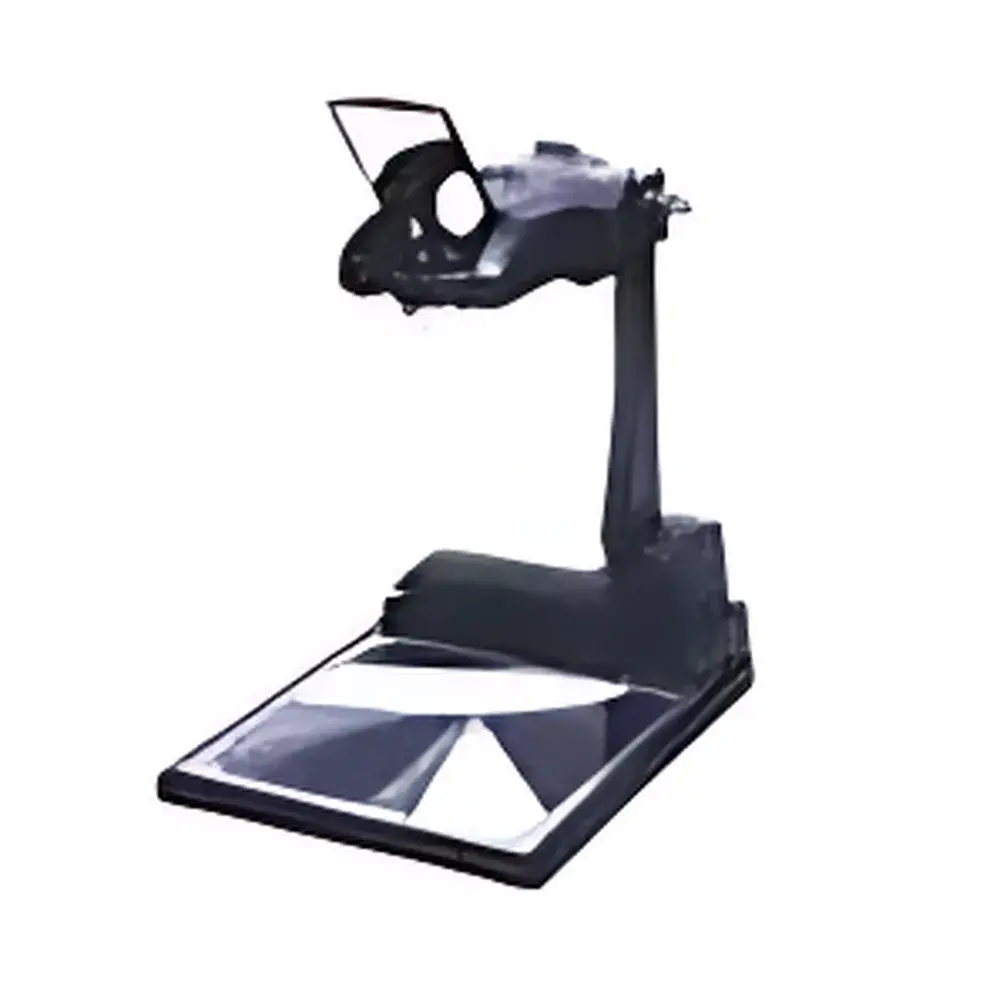
3M 2770 Fish Eye Analyzer
| Origin | USA |
|---|---|
| Manufacturer Type | Authorized Distributor |
| Origin Category | Imported |
| Model | 3M 2770 |
| Pricing | Upon Request |
| Lens | Single-element optical lens |
| Projection Stage Area | 285 × 285 mm |
| Brightness Control | Dual-level (high/low) toggle switch |
| Chromatic Dispersion | Adjustable rotational dispersion filter for white light |
| Thermal Protection | Integrated thermal cutoff switch |
| Light Source | 24 V / 150 W halogen-tungsten lamp (dual-lamp configuration) |
| Weight | 5.7 kg |
| Dimensions (L × W × H) | 418 × 317.5 × 419 mm |
| Projector Luminance | 2000 lm |
| Focal Length | 270–298.2 mm |
| Image Distortion | <1% |
| Power Supply | 220–240 V AC, 50/60 Hz |
| Power Consumption | 360 W |
| Acoustic Noise | ≤50 dB(A) |
| Operating Temperature | 15–40 °C |
| Storage Temperature | 5–60 °C |
| Included Accessories | Two FNT replacement lamps, 2.13 m × 2.13 m projection screen (requires ≥2.5 m clear width), acrylic standard aperture plate (230 × 230 × 3 mm) with three precision-drilled circular apertures (Ø0.2 mm, Ø0.4 mm, Ø0.8 mm |
| Calibration | NIST-traceable metrology certificate provided with each unit |
Overview
The 3M 2770 Fish Eye Analyzer is a purpose-built optical projection instrument engineered for quantitative assessment of gel-like imperfections—commonly referred to as “fish eyes”—in polyolefin films, particularly isotactic polypropylene (iPP) and related thermoplastic olefinic materials. Unlike generic visual inspection tools, the 3M 2770 operates on standardized optical magnification and controlled illumination principles: it projects a uniformly enlarged image of a film specimen onto a calibrated screen using a single-element high-fidelity lens and a stabilized 24 V / 150 W halogen-tungsten light source. The system leverages geometric projection physics—where linear magnification is determined by the ratio of projection distance to focal length—to enable reproducible detection of sub-millimeter undissolved polymer agglomerates. Its design complies with ASTM D2761 and ISO 1874-2 guidelines for polyolefin film quality evaluation, supporting QC laboratories in extrusion, film casting, and converting operations where gel content directly correlates with downstream processing defects (e.g., die line streaks, surface haze, or web breakage).
Key Features
- Single-element optical lens system delivering <1% geometric distortion across the full 285 × 285 mm projection stage, ensuring dimensional fidelity during fish eye sizing.
- Dual-brightness mode (high/low) toggle switch enables adaptation to ambient lighting conditions and operator fatigue reduction during extended shift-based inspections.
- Adjustable rotational chromatic dispersion filter compensates for spectral non-uniformity in white-light illumination, improving contrast resolution for translucent gel boundaries.
- Integrated thermal cutoff switch automatically de-energizes the lamp circuit if internal temperature exceeds safe operational limits (≥65 °C), extending lamp service life and preventing thermal degradation of film samples.
- NIST-traceable metrology certificate supplied with each unit—verifying optical alignment, luminance output (2000 lm ±5%), and aperture plate dimensional accuracy per ASME B89.1.10M.
- Compact benchtop footprint (418 × 317.5 × 419 mm) and low acoustic signature (≤50 dB[A]) support integration into ISO Class 7 cleanroom-adjacent QC labs without HVAC interference.
Sample Compatibility & Compliance
The 3M 2770 is optimized for flat, transparent to semi-transparent polyolefin films with thicknesses ranging from 12 µm to 150 µm. It accepts specimens up to 285 × 285 mm, accommodating standard ASTM D2761 test coupons and industrial roll-edge strips. The included acrylic aperture plate (230 × 230 × 3 mm) features three certified-diameter through-holes (Ø0.2 mm, Ø0.4 mm, Ø0.8 mm), each machined to ±0.005 mm tolerance and verified via coordinate measuring machine (CMM). This plate serves as both a sizing reference and a pass/fail gauge per ASTM D2761 Annex A1. The instrument meets IEC 61000-4-2 (ESD immunity) and UL 61010-1 safety requirements. Its optical calibration protocol aligns with GLP documentation standards, including audit trails for lamp replacement cycles, screen cleaning logs, and aperture plate verification records.
Software & Data Management
The 3M 2770 is a hardware-only optical platform—no embedded firmware or proprietary software is required. All measurement interpretation follows documented visual counting procedures defined in ASTM D2761 Section 7 and ISO 1874-2 Clause 6.3. Users record raw counts per aperture size manually or via LIMS-integrated spreadsheets. For digital traceability, laboratories commonly pair the analyzer with calibrated USB microscopes (e.g., Dino-Lite AM4113X) for secondary verification imaging. Audit-ready documentation—including the NIST-traceable calibration certificate, lamp lot traceability, and aperture plate CMM report—is archived per FDA 21 CFR Part 11 compliant electronic record systems when deployed in regulated GMP environments.
Applications
- Quantitative fish eye enumeration in cast or blown iPP films prior to metallization or coating processes.
- Root-cause analysis of gel formation in Ziegler–Natta or metallocene-catalyzed polyolefin resins.
- Supplier qualification testing against contractual gel limits (e.g., ≤3 fish eyes per 100 cm² at Ø0.4 mm threshold).
- Process validation of melt filtration efficiency in extrusion lines handling recycled polyolefin feedstocks.
- Stability monitoring of polymer additives (e.g., nucleating agents, clarifiers) under thermal shear stress.
FAQ
Is the 3M 2770 compliant with ASTM D2761?
Yes—the optical geometry, illumination uniformity, and aperture plate specifications meet all mandatory requirements of ASTM D2761-22, including projection magnification ratio, screen luminance stability, and aperture tolerance limits.
Can the instrument be used for non-polyolefin films such as PET or PA?
While physically compatible, the 3M 2770’s calibration and acceptance criteria are validated exclusively for polyolefins per ISO 1874-2. Use with other polymers requires method verification per ICH Q2(R2) guidelines.
What is the expected lamp lifetime under continuous operation?
Rated at 50 hours at full brightness; recommended replacement after 40 hours to maintain luminance stability within ±5% of nominal 2000 lm output.
Does the system include automated counting or image analysis?
No—it is a manual visual counting instrument. Automation requires third-party machine vision integration, which falls outside the scope of ASTM D2761 compliance.
How often must the aperture plate be recertified?
Annually—or after any mechanical impact—using a certified CMM lab, with re-certification traceable to ISO/IEC 17025 accredited providers.






