
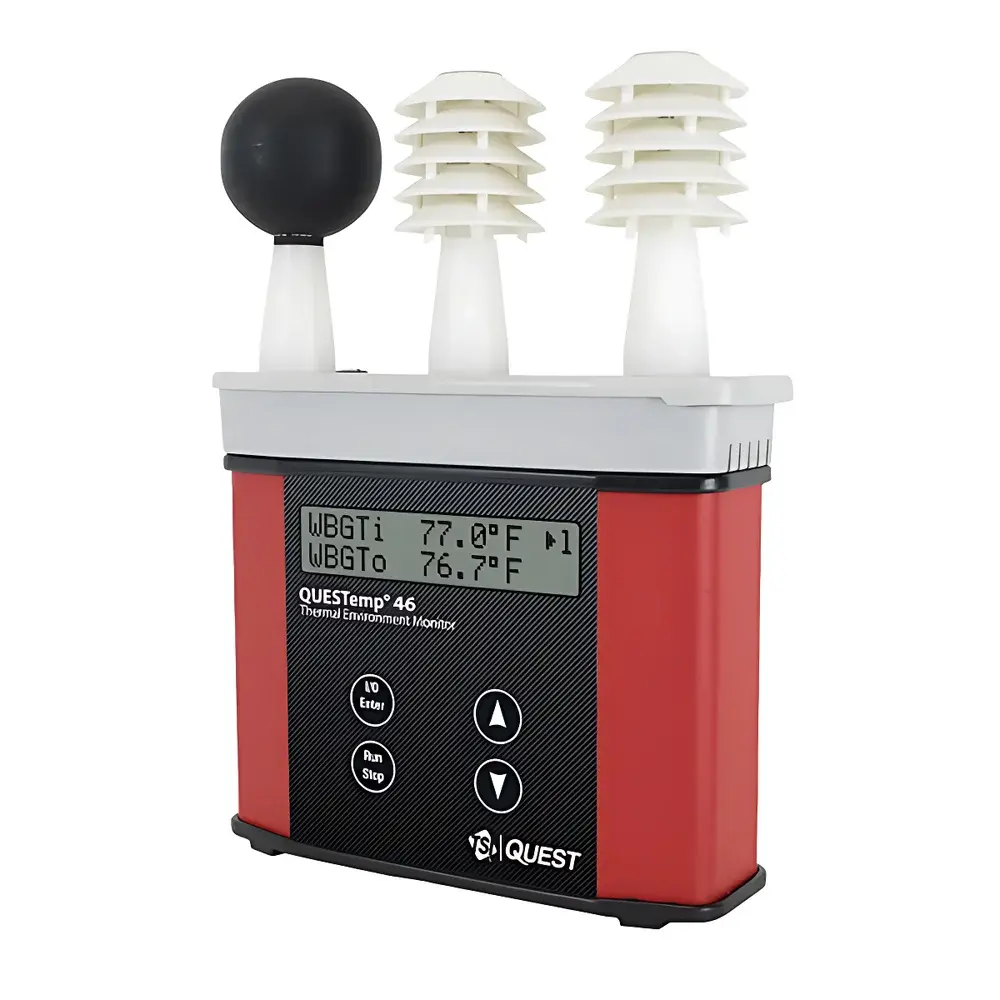
3M Quest QT-32 WBGT Heat Stress Monitor
| Brand | 3M |
|---|---|
| Origin | USA |
| Model | Quest QT-32 |
| Sensor Separation Distance | Up to 200 ft |
| Power Options | 9V Alkaline or NiMH Rechargeable Battery / AC Adapter |
| Operating Temperature | –5°C to +60°C (Electronics & Sensors) |
| IP Rating | IP54 |
| Dimensions (Carrying Case) | 23.4 × 18.3 × 7.6 cm |
| Weight | 1.2 kg |
| Compliance | UL/CSA Class I Groups A–D, Class II Groups E–G, Class III, Temp Code T3 |
| Optional Configurations | Tri-sensor (head–torso–ankle) weighted WBGT averaging |
Overview
The 3M Quest QT-32 WBGT Heat Stress Monitor is an industrial-grade, portable environmental monitoring instrument engineered for quantitative assessment of heat stress exposure in occupational settings. It operates on the Wet Bulb Globe Temperature (WBGT) index—a composite thermal metric defined by ISO 7243 and widely adopted in occupational health standards including OSHA technical guidelines, ACGIH TLVs®, and China’s GB/Z T189.7–2007. The QT-32 simultaneously acquires dry-bulb temperature (Tdb), natural wet-bulb temperature (Tnwb), and black-globe temperature (Tg) using calibrated, thermally isolated sensors—enabling real-time calculation of both indoor and outdoor WBGT values per ANSI/ASHRAE Standard 55 and ISO methodology. Its modular architecture supports up to three spatially distributed sensor assemblies (e.g., head, torso, ankle), allowing stratified thermal profiling and weighted WBGT computation that reflects human physiological response across body zones. Designed for field deployment in foundries, power plants, construction sites, and emergency response operations, the QT-32 delivers traceable, reproducible measurements under demanding thermal and particulate conditions.
Key Features
- Tri-parameter thermal sensing: Integrated dry-bulb, natural wet-bulb, and black-globe temperature measurement with ±0.5°C accuracy across 0–120°C range for each channel
- Dual-mode WBGT calculation: Automatic switching between indoor (0.7×Tnwb + 0.2×Tg + 0.1×Tdb) and outdoor (0.7×Tnwb + 0.2×Tg + 0.1×Tdb) algorithms per ISO 7243
- Extended sensor reach: Detachable sensor modules connected via shielded cable up to 200 ft (61 m), minimizing operator exposure during high-temperature surveys
- Multi-height monitoring: Expandable to three independent sensor nodes for vertical thermal gradient analysis and anatomically weighted WBGT synthesis
- Robust environmental rating: IP54 ingress protection ensures reliable operation in dusty, humid, or intermittently wet industrial environments
- Flexible power architecture: Operates on standard 9V alkaline cells or rechargeable NiMH batteries; optional AC adapter enables continuous logging during stationary assessments
- Multi-language UI: On-device display supports English, Chinese, German, Italian, Spanish, Portuguese, and Korean—configurable without software reflash
Sample Compatibility & Compliance
The QT-32 is validated for use with standard 2-inch and 6-inch black-globe assemblies (ASTM D3238-compliant), enabling precise radiant heat capture across low- and high-intensity exposure scenarios. Its sensor suite meets NIST-traceable calibration requirements and carries a People’s Republic of China Metrological Instrument Type Approval Certificate (CPA). Electrical safety certification includes UL/CSA recognition for Class I (flammable gases/vapors), Class II (combustible dusts), and Class III (ignitable fibers) hazardous locations—temperature code T3 (max surface temp ≤200°C). ATEX Directive 2014/34/EU compliance permits deployment in Zone 1 and Zone 21 classified areas. All WBGT computations adhere strictly to ISO 7243:2017 Annex B weighting coefficients and are compatible with regulatory reporting frameworks under OSHA 1910.132, EU Directive 89/391/EEC, and China’s Work Safety Law Article 39.
Software & Data Management
Data acquisition and post-processing are supported by the proprietary DMS (Data Management Software), which runs on Windows-based PCs. DMS enables time-stamped export of raw sensor readings (Tdb, Tnwb, Tg, RH, WBGTindoor, WBGToutdoor, HUMINDEX) in CSV and Excel formats. Audit trails include operator ID, calibration date stamps, sensor serial numbers, and configuration metadata—supporting GLP/GMP-aligned documentation for workplace safety audits. While the QT-32 itself does not implement FDA 21 CFR Part 11 electronic signature controls, DMS-generated reports may be integrated into validated laboratory information management systems (LIMS) when paired with institutional procedural controls.
Applications
- Ongoing heat stress surveillance in metallurgical facilities, glass manufacturing, and asphalt paving operations
- Regulatory compliance verification during OSHA or local labor inspectorate site visits
- Pre-shift and mid-shift exposure profiling for workers wearing PPE in confined spaces
- Thermal comfort validation in HVAC commissioning and building envelope performance testing
- Emergency response triage support—rapid WBGT screening during wildfire suppression or disaster recovery deployments
- Ergonomic risk assessment integration with NIOSH Lifting Equation and ACGIH Threshold Limit Values
FAQ
Does the QT-32 require annual recalibration?
Yes. 3M recommends annual NIST-traceable calibration of all thermal sensors and relative humidity transducers to maintain metrological integrity per ISO/IEC 17025 guidelines.
Can the QT-32 store data internally without a PC connection?
No. The QT-32 lacks onboard memory; real-time data streaming or logging requires active connection to DMS via USB or RS-232 interface.
Is the black-globe sensor interchangeable between 2” and 6” diameters?
Yes. Both globe sizes mount to the same thermal sensor housing and are auto-recognized by firmware upon attachment.
What is the maximum allowable ambient humidity for continuous operation?
The unit is rated for non-condensing relative humidity up to 95% RH at temperatures ≤40°C. Operation above 40°C requires adherence to IP54 derating curves specified in the user manual.
Can tri-sensor configurations be used for ISO 7243 Annex C “local heat stress” evaluation?
Yes. The weighted averaging algorithm aligns with ISO 7243:2017 Clause C.3.2 for multi-point thermal load estimation, provided sensor placement follows anatomical reference points defined in Annex D.







