
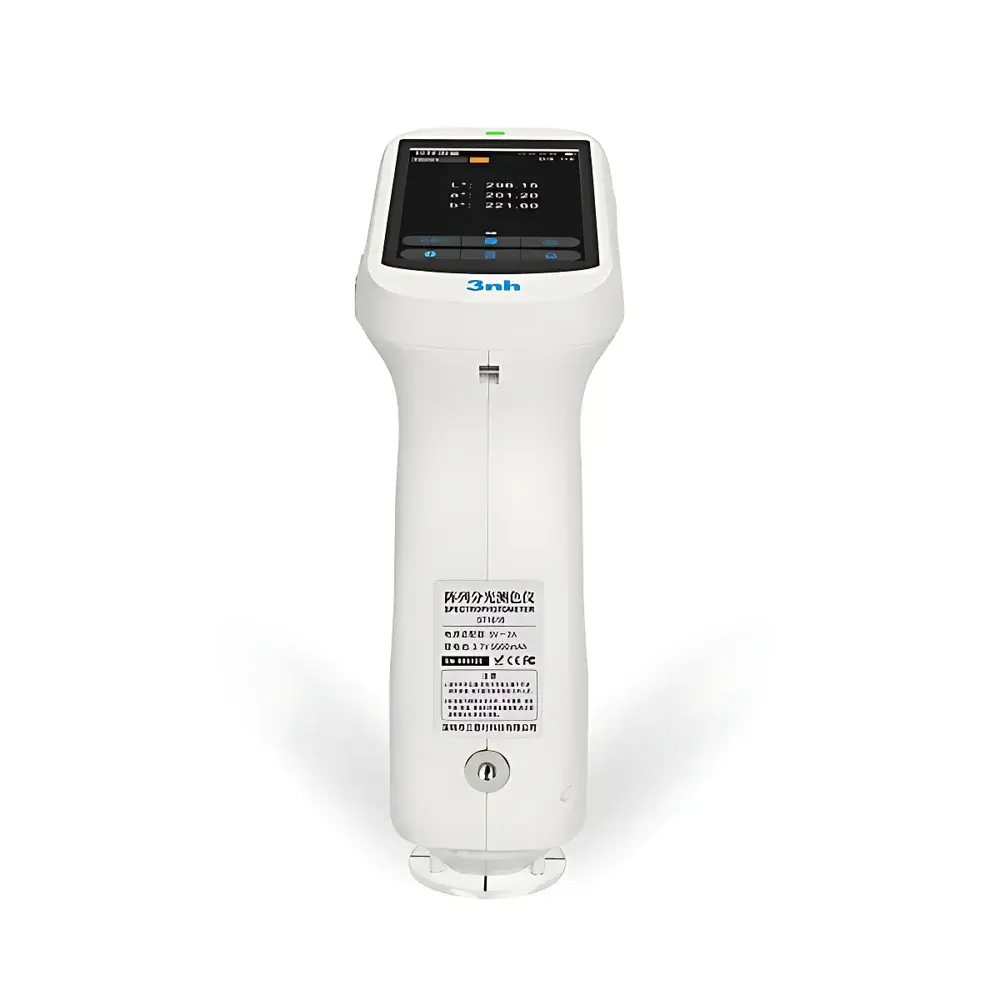
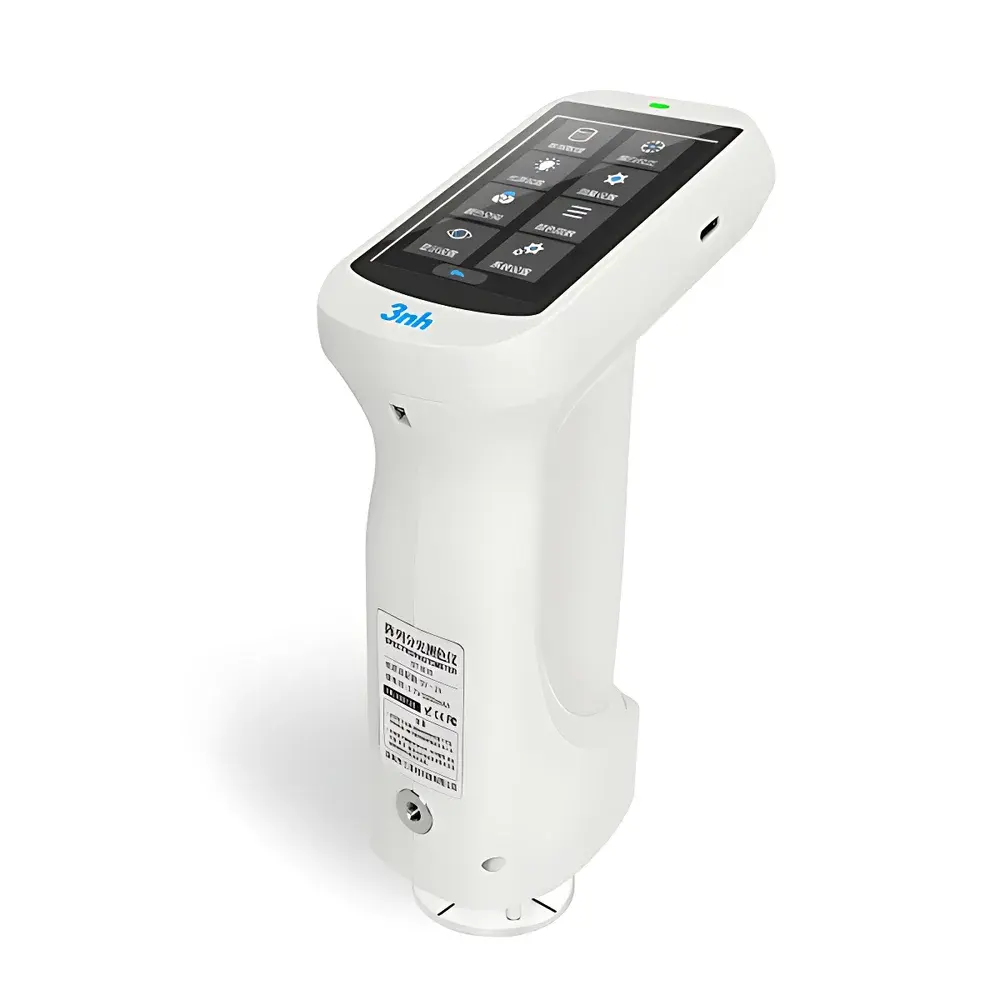
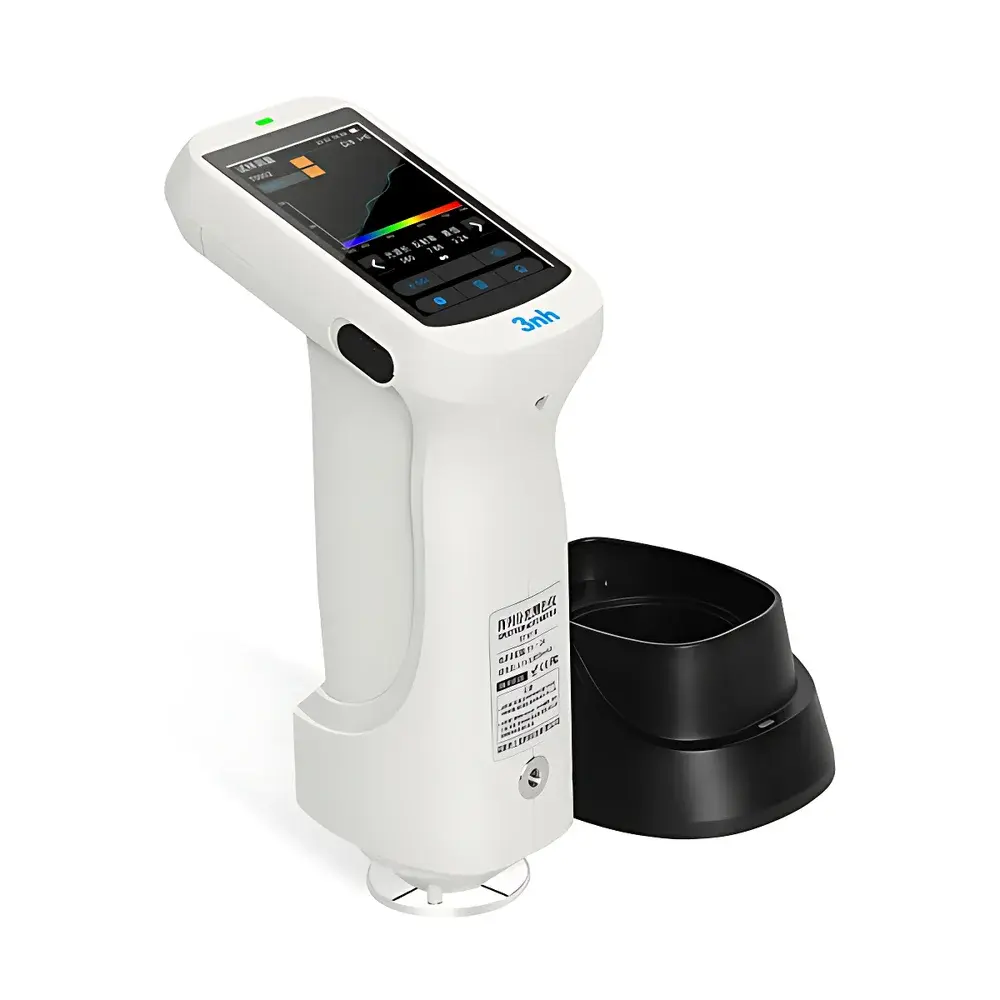
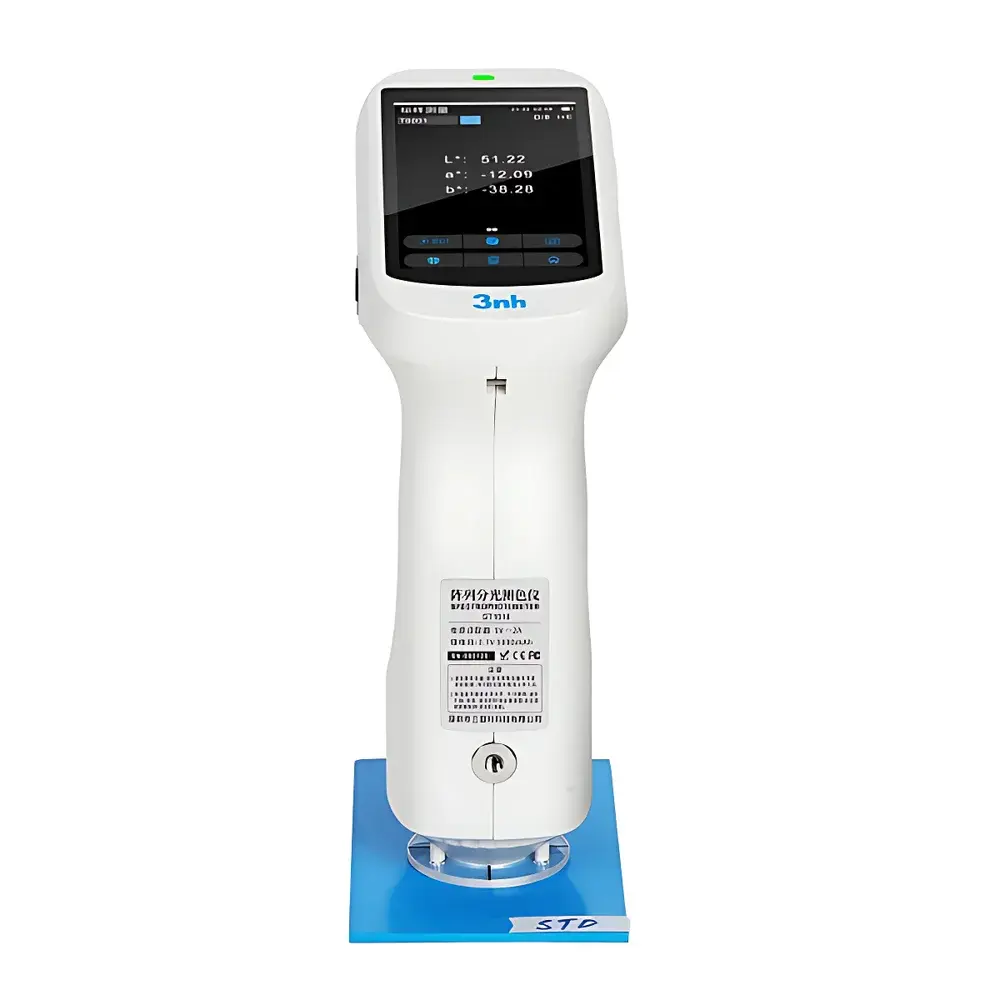
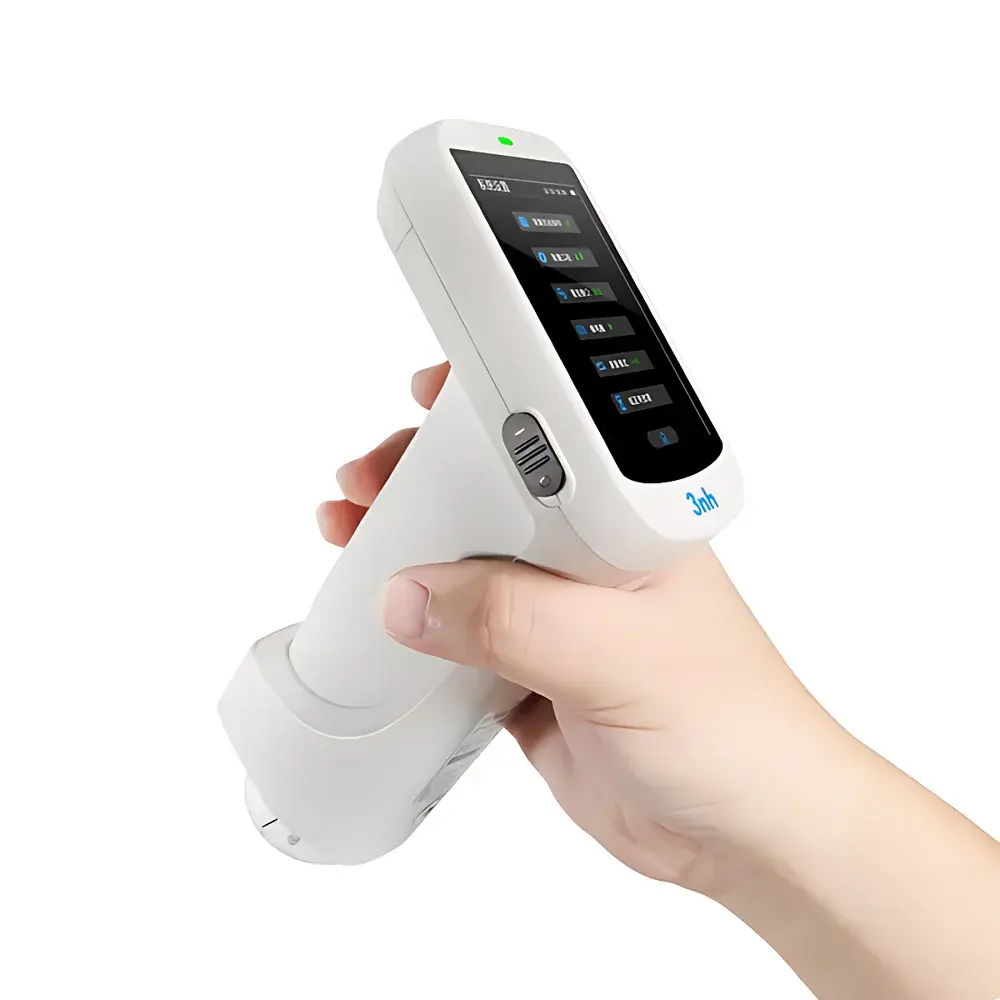
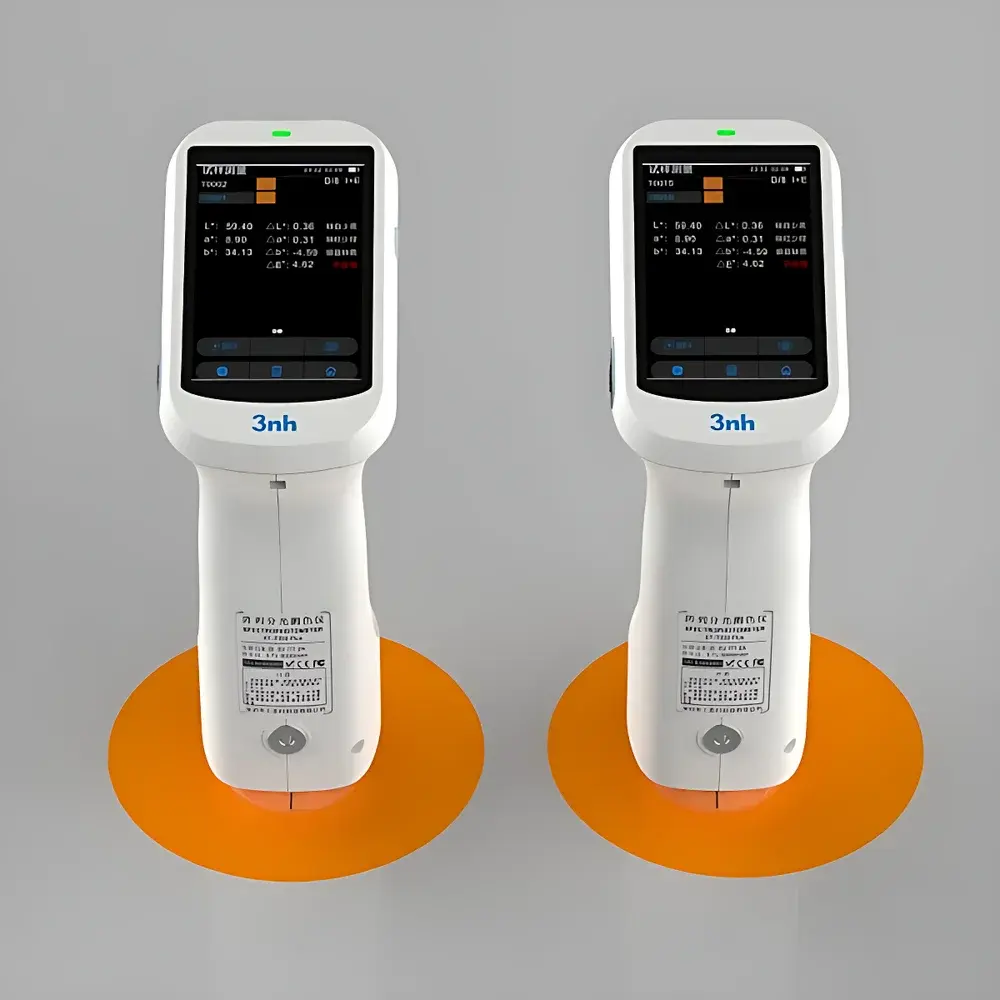
3nh ST1818 Array Spectrophotometric Colorimeter
| Brand | 3nh |
|---|---|
| Origin | Guangdong, China |
| Manufacturer Type | Direct Manufacturer |
| Product Category | Spectrophotometric Colorimeter |
| Instrument Type | Portable |
| Optical Geometry | d/8° integrating sphere |
| Light Source | Full-spectrum balanced LED array (400–700 nm) |
| Spectral Range | 400–700 nm |
| Repeatability | ΔE*ab ≤ 0.038 |
| Apertures | Φ8 mm / Φ10 mm flat port + Φ8 mm / Φ10 mm tip port |
| Inter-instrument Agreement | ΔE*ab ≤ 0.38 |
| Wavelength Interval | 10 nm |
| Integrating Sphere Diameter | 40 mm |
| Detector | Dual-row 18-element silicon photodiode array |
| Display | 3.5″ capacitive TFT touchscreen |
| Battery | 3.7 V / 5000 mAh Li-ion (≥8500 measurements per charge) |
| Dimensions | 114 × 70 × 208 mm |
| Weight | 435 g (without calibration base) |
Overview
The 3nh ST1818 Array Spectrophotometric Colorimeter is a precision portable instrument engineered for high-fidelity color measurement and spectral analysis in industrial quality control and R&D environments. It operates on the CIE-compliant d/8° geometry with specular component included (SCI), ensuring consistent measurement of both diffuse and mirror-reflected light—critical for accurate color evaluation of textured, glossy, or coated surfaces. At its core lies a dual-row 18-element silicon photodiode array detector coupled with planar grating-based spectrometry, delivering high-resolution spectral data across the visible spectrum (400–700 nm) at 10 nm intervals. Unlike filter-based tristimulus meters, the ST1818 captures full reflectance spectra, enabling rigorous color difference computation, metamerism assessment, and future-proof spectral data archiving. Its full-spectrum balanced LED illumination eliminates spectral gaps common in conventional white LEDs, providing uniform irradiance across all wavelengths—essential for compliance with ASTM E1164, ISO 7724-1, CIE No. 15, and GB/T 3978 standards.
Key Features
- High-Stability Dual-Optical Path Design: Independent reference and sample channels compensate for thermal drift and ambient fluctuations, maintaining measurement integrity under variable lab or production-floor conditions.
- Large-Area Silicon Photodiode Array: The dual-row 18-element sensor offers extended dynamic range—resisting saturation under high-reflectance conditions while retaining sensitivity below 1% reflectance—ensuring linearity from 0–200% reflectance.
- Intelligent Calibration Base: Integrated contact-type auto-calibration system with NIST-traceable standard white tile (R ≥ 95%) enables rapid, operator-independent recalibration—supporting GLP-compliant audit trails when paired with SQCX software.
- Dual-Aperture Flexibility: Interchangeable Φ8 mm / Φ10 mm flat port and conical tip port accommodate flat substrates, curved surfaces (e.g., automotive body panels), small parts (e.g., cosmetic caps), and irregular geometries without repositioning or masking.
- Ergonomic Industrial Design: Optimized grip contour, tactile measurement button placement, and scratch-resistant anodized aluminum housing ensure fatigue-free operation during high-volume sampling sessions.
- Long-Term Illumination Stability: LED light source rated for >1.5 million measurements and >10 years service life—eliminating lamp replacement costs and spectral drift associated with xenon or tungsten-halogen sources.
Sample Compatibility & Compliance
The ST1818 accommodates diverse material classes including opaque solids (plastics, painted metals), translucent films (packaging, medical tubing), textured textiles, printed media, and powdered samples (with optional accessory test box). Its d/8° SCI mode ensures metrological equivalence to benchtop spectrophotometers used in master-standard labs—enabling traceable color transfer across supply chains. The instrument conforms to international regulatory frameworks: ISO/IEC 17025 method validation requirements; ASTM D2244 (color difference), D1925 (yellowness index), and E313 (whiteness); GB/T 18833 (retroreflective sheeting); and DIN 5033-7 (colorimetric tolerances). Data integrity meets FDA 21 CFR Part 11 expectations when used with SQCX software’s electronic signature, audit trail, and role-based access controls.
Software & Data Management
The ST1818 is fully integrated with 3nh’s SQCX Quality Control Software—a Windows-native application supporting multi-user deployment, centralized database management, and automated reporting. SQCX stores up to 500 standard references and 10,000 sample records locally, with unlimited cloud or network-server scalability. It computes 12 color spaces (CIELAB, CIELCH, Hunter Lab, DIN99, Munsell C/2, sRGB, etc.), 8 color difference formulas (ΔE*ab, ΔE00, ΔE94, ΔECMC), whiteness/yellowness indices per ASTM/ISO methods, and metamerism indices (MI). All spectral data (31-point reflectance curves) are exportable as CSV or XML for third-party analysis (e.g., MATLAB, Python pandas). Version-controlled calibration logs, user activity timestamps, and electronic signatures satisfy GMP/GLP documentation requirements.
Applications
The ST1818 serves as a primary color verification tool in QC laboratories and production lines across regulated and non-regulated sectors. In automotive manufacturing, it validates paint batch consistency against OEM master standards. In pharmaceutical packaging, it verifies label ink hue compliance per USP . In food-grade plastic production, it monitors pigment dispersion stability across extrusion runs. Textile mills use it for shade matching across dye lots under multiple illuminants (D65, TL84, LED-B2). Cosmetic formulators rely on its repeatability (ΔE*ab ≤ 0.038) for precise tint adjustment in foundation and lipstick development. Academic researchers deploy it for pigment aging studies, spectral library construction, and cross-platform color model validation.
FAQ
What standards does the ST1818 comply with for color measurement?
It adheres to CIE No. 15:2018, ISO 7724-1:2019, ASTM E1164-22, GB/T 3978-2008, and DIN 5033-7—covering geometry, illuminant simulation, and color difference calculation protocols.
Can the ST1818 measure transparent or translucent materials?
Yes—when used with the optional transmission adapter (sold separately), it supports transmittance mode for films, bottles, and liquid samples per ASTM D1003.
Is spectral data export supported for external analysis?
Yes—full 31-point reflectance spectra (400–700 nm, 10 nm step) are exportable in CSV format for custom algorithm development or machine learning training.
How is inter-instrument agreement maintained across multiple ST1818 units?
With factory calibration using BCRA Series II tiles and routine verification using the supplied NIST-traceable white standard, inter-unit ΔE*ab remains ≤ 0.38—enabling reliable multi-site color harmonization.
Does the instrument support custom illuminant definitions?
Yes—SQCX software allows users to import spectral power distributions (SPDs) and define proprietary illuminants for specialized applications such as horticultural lighting or display calibration.





