
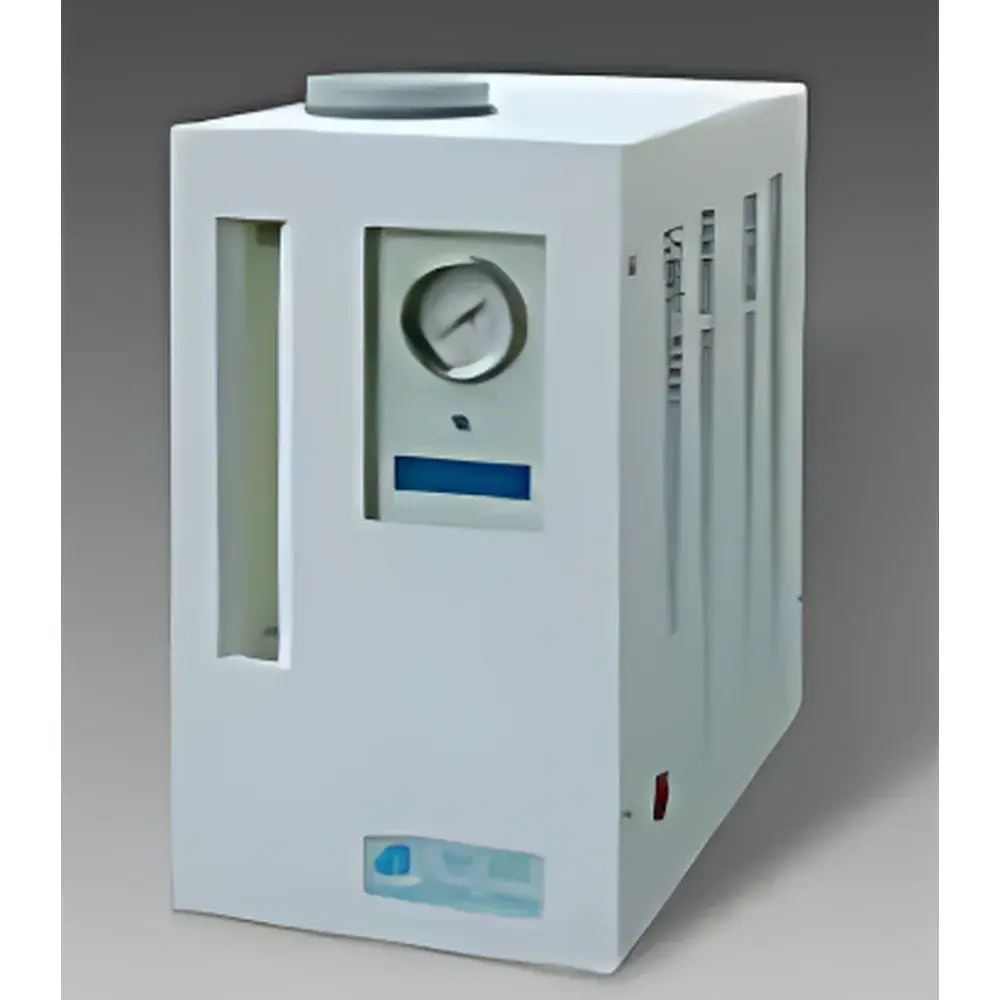
Brookfield DH-300 Ultra-High-Purity Hydrogen Generator
| Origin | Beijing, China |
|---|---|
| Manufacturer Type | Authorized Distributor |
| Origin Category | Domestic (China) |
| Model | DH-300 |
| Quotation | Available Upon Request |
| Hydrogen Purity | 99.99999% |
| Flow Rate | 0–300 mL/min |
| Output Pressure | 0–0.5 MPa |
| Pressure Stability | < 0.0001 MPa |
| Power Supply | 220 V ±10%, 50 Hz |
| Power Consumption | 300 W |
| Dimensions (W×D×H) | 380 × 200 × 370 mm |
| Net Weight | ~15 kg |
Overview
The Brookfield DH-300 Ultra-High-Purity Hydrogen Generator is an on-demand, electrolytic gas generation system engineered for laboratories requiring continuous, contamination-free hydrogen supply at analytical-grade purity levels. It employs a proton exchange membrane (PEM)-compatible alkaline electrolysis process coupled with integrated palladium alloy diffusion membrane purification — a dual-stage architecture that achieves and sustains ≥99.99999% (7N) hydrogen purity without reliance on external purification cartridges or consumable desiccants. Unlike conventional cylinder-based delivery or catalytic purifiers, the DH-300 eliminates risks associated with high-pressure storage, gas impurity drift, and periodic maintenance downtime. Its design targets applications where baseline stability, long-term reproducibility, and trace-level interference control are non-negotiable — particularly in capillary gas chromatography (GC), electrochemical analysis (e.g., polarography), semiconductor epitaxial growth, and nuclear physics instrumentation requiring ultra-low oxygen, moisture, and hydrocarbon content.
Key Features
- Palladium alloy diffusion membrane purification: Ensures consistent 7N (99.99999%) H₂ purity by selectively permeating atomic hydrogen while rejecting N₂, O₂, H₂O, CO, CO₂, and total hydrocarbons (THC) below detection limits of standard GC-TCD/FID systems.
- Low-sulfur silicone elastomer sealing system: All internal wetted seals utilize sulfur-free silicone gaskets and tubing to prevent sulfur-induced column degradation and baseline noise in sensitive GC detectors.
- Distilled water feed compatibility: Operates reliably with standard laboratory-grade distilled water (conductivity ≤ 5 µS/cm); no deionized water or ultrapure water (UPW) required, reducing operational overhead.
- Integrated pressure and flow regulation: Digital closed-loop control maintains setpoint accuracy within ±0.5% of full scale across the 0–300 mL/min range, with pressure stability better than ±0.0001 MPa under dynamic load conditions.
- Intelligent safety architecture: Features real-time monitoring of electrolyte level, diaphragm integrity, overpressure (mechanical + electronic dual cutoff), thermal runaway, and gas leak detection — compliant with IEC 61010-1:2010 for laboratory electrical equipment safety.
- Zero-consumable operation: No molecular sieves, activated carbon, or color-indicating silica gel; no scheduled replacement intervals or calibration drift from aging sorbents.
Sample Compatibility & Compliance
The DH-300 delivers hydrogen meeting ASTM D7606–22 specifications for “Ultra-High-Purity Gases Used in Analytical Instrumentation” and aligns with ISO 8573-1:2010 Class 0 requirements for particulate, water, and oil content in compressed gases. It satisfies critical purity thresholds for GC carrier gas per USP , EP 2.2.43, and JP 17 standards. The generator is compatible with all major benchtop and modular GC systems (Agilent, Thermo Fisher, Shimadzu, PerkinElmer), polarographic analyzers (Metrohm, ALS), and UHV-compatible deposition tools requiring <1 ppb O₂ and <0.1 ppm H₂O. CE marking and RoHS 2011/65/EU compliance are certified per manufacturer documentation.
Software & Data Management
The DH-300 operates in fully autonomous mode via embedded microcontroller firmware with local LED status interface. Optional RS-232/USB digital output enables integration into LabVantage, Empower, or custom LIMS environments for audit-trail-capable event logging (start/stop timestamps, pressure/flow deviations, fault codes). All operational parameters comply with FDA 21 CFR Part 11 requirements when deployed with validated software extensions, supporting electronic signatures, data integrity, and ALCOA+ principles in GLP/GMP-regulated labs.
Applications
- Carrier and fuel gas for flame ionization (FID), thermal conductivity (TCD), and pulsed discharge helium ionization (PDHID) detectors in high-resolution GC.
- Reducing atmosphere source in electrochemical cells, especially for low-noise polarographic determination of trace metals and organic redox species.
- Process gas in metalorganic chemical vapor deposition (MOCVD) and molecular beam epitaxy (MBE) systems requiring sub-ppb oxygen equivalence.
- Calibration and purge gas in residual gas analyzers (RGA), quadrupole mass spectrometers (QMS), and ultra-high vacuum (UHV) surface science chambers.
- Hydrogenation reagent in flow chemistry reactors and online catalytic screening platforms where stoichiometric consistency is essential.
FAQ
What is the maximum allowable inlet water conductivity for stable operation?
Distilled water with conductivity ≤ 5 µS/cm is recommended; conductivity > 10 µS/cm may accelerate electrode fouling and reduce membrane service life.
Does the DH-300 require periodic recalibration of flow or pressure sensors?
No — all sensors are factory-calibrated with NIST-traceable references and feature drift-compensated analog front-ends; zero recalibration is specified over the 5-year nominal service life.
Can the generator be mounted vertically or in enclosed cabinets?
Yes, provided minimum 50 mm clearance around all ventilation grilles and ambient temperature remains between 15–30 °C; forced-air cooling is not required.
Is hydrogen purity verified in real time during operation?
While the palladium membrane guarantees purity by physical separation principle, optional inline H₂ purity analyzers (e.g., MOCON Oxysense or INFICON Transpector) can be integrated via 1/8″ Swagelok ports for continuous verification.
How does the DH-300 handle transient demand spikes during GC oven ramping?
The built-in 1.2 L buffer volume and adaptive PID-controlled electrolyzer current ensure pressure deviation remains < ±0.00005 MPa during step-load changes up to 100 mL/min within 200 ms.



