
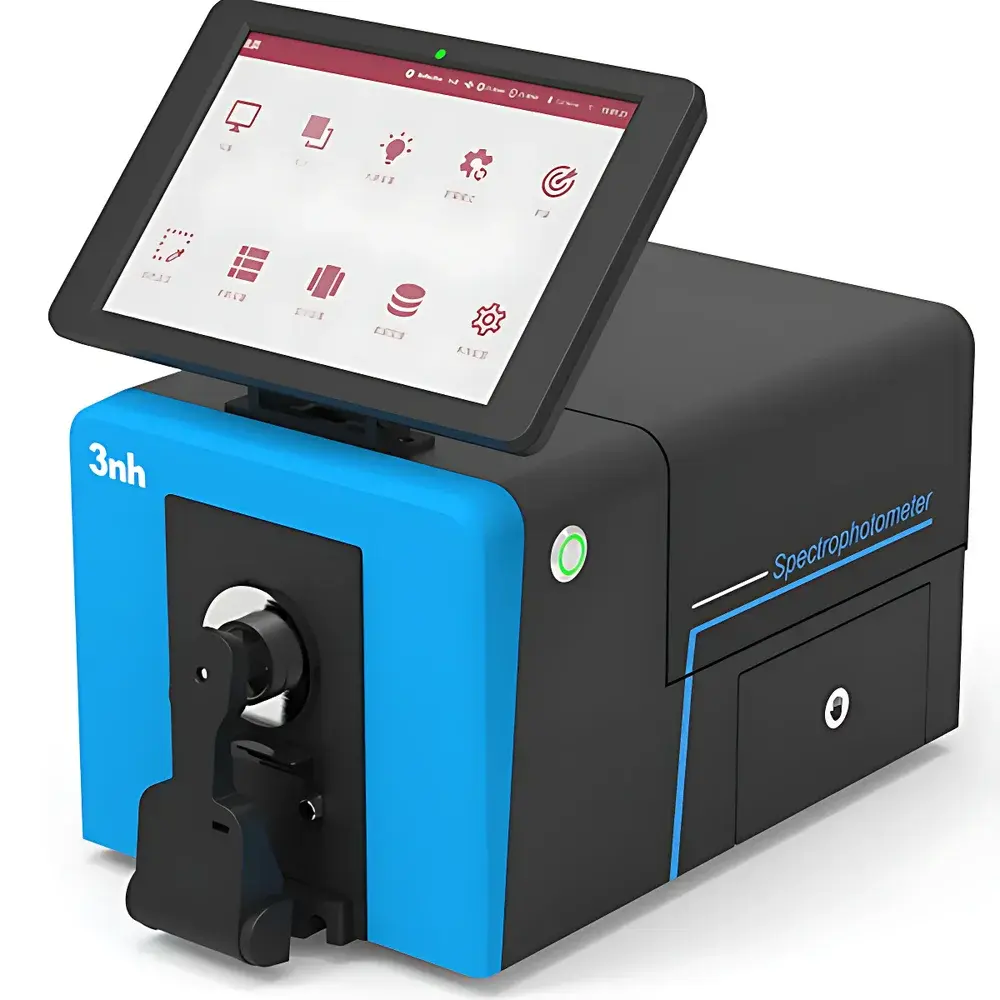
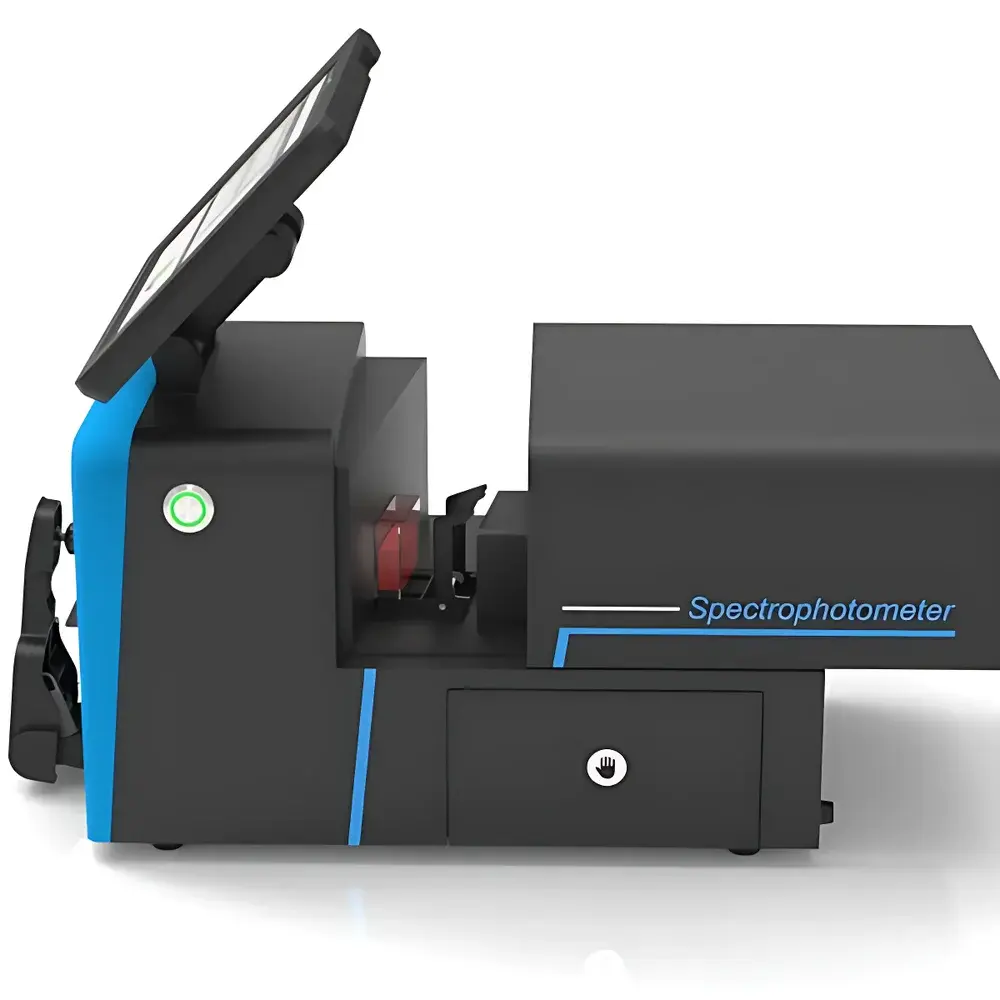
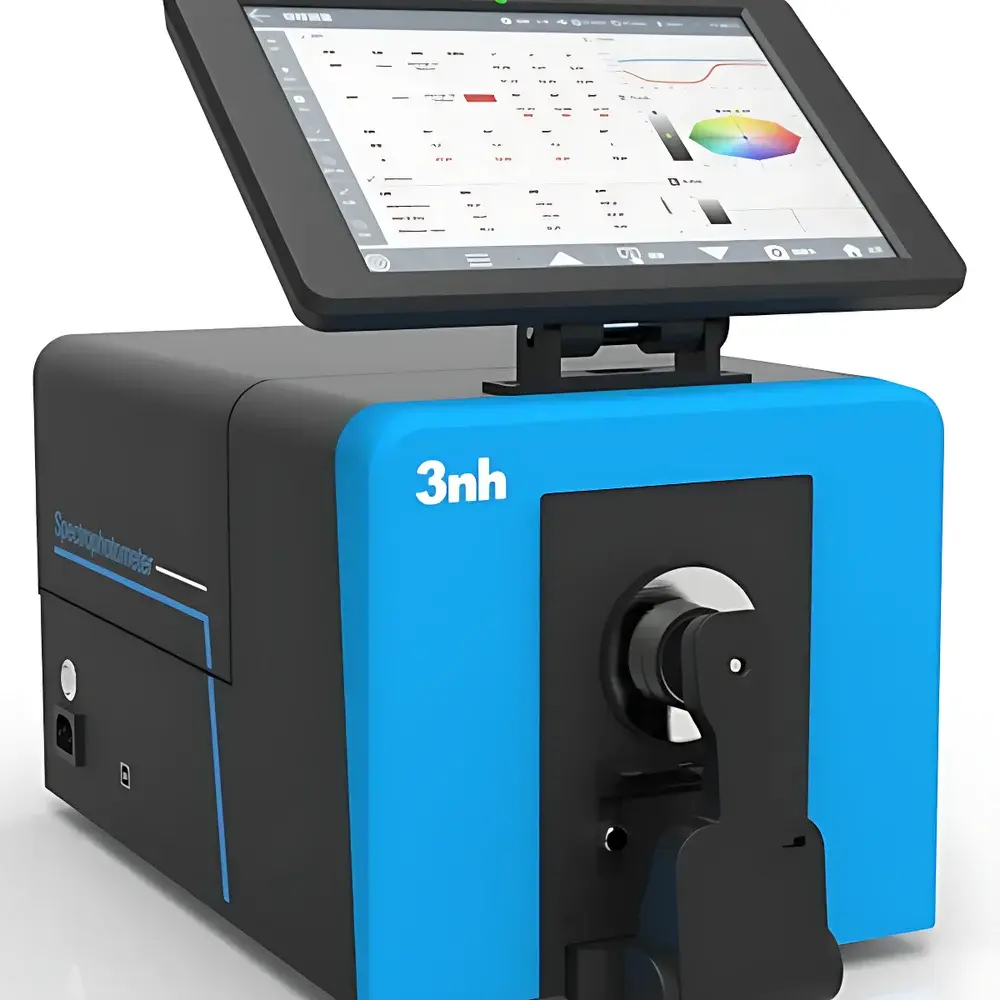
3nh TS8500 Desktop Spectrophotometer with Dual LED & Xenon Illumination
| Brand | 3nh |
|---|---|
| Origin | Guangdong, China |
| Manufacturer Type | OEM/ODM Manufacturer |
| Product Category | Domestic (China-made) |
| Model | TS8500 |
| Product Type | Spectrophotometric Colorimeter |
| Instrument Form Factor | Benchtop |
| Optical Geometry | d/8° Integrating Sphere |
| Illumination Sources | Full-spectrum LED array + Pulsed Xenon lamp |
| Spectral Range | 360–750 nm |
| Repeatability | Reflectance colorimetric values (Φ25.4 mm, SCI mode): ΔE*ab ≤ 0.015 (LED source, post-warm-up calibration, 30 measurements of white tile at 5 s intervals) |
| Spectral reflectance/transmittance stability | ≤ 0.1% |
Overview
The 3nh TS8500 is a high-precision benchtop spectrophotometer engineered for metrologically rigorous color measurement across R&D, quality control, and production environments. It operates on the CIE-compliant d/8° integrating sphere geometry—supporting both Specular Component Included (SCI) and Specular Component Excluded (SCE) modes—and delivers simultaneous dual-mode acquisition without mechanical reconfiguration. Its core optical architecture integrates a 154 mm diameter integrating sphere with dual illumination pathways: a stable, long-life full-spectrum LED array (360–780 nm, including UV) and a high-intensity pulsed xenon lamp optimized for fluorescence excitation and spectral fidelity under transient lighting conditions. The instrument employs a 256-pixel dual-array CMOS linear image sensor coupled with a concave holographic grating, enabling 10 nm wavelength resolution and 5 nm FWHM bandwidth—meeting the spectral sampling requirements defined in ISO 7724-1, ASTM E1164, and CIE Publication No. 15. Designed for traceable color data generation, the TS8500 conforms to GLP/GMP-aligned workflows through audit-ready software logging, hardware-based calibration traceability, and environmental compensation algorithms.
Key Features
- Dual-source illumination system: Independent switching between full-spectrum LED (with selectable UV cutoff filters at 400 nm and 420 nm) and pulsed xenon lamp—enabling accurate measurement of fluorescent, phosphorescent, and UV-reactive materials per ISO 11475 and ASTM D6290.
- Simultaneous SCI/SCE acquisition: Eliminates sequential measurement error and reduces cycle time to ≤4 seconds for full spectral capture in both modes.
- 10.5-inch detachable rotating tablet interface: Powered by Android OS, featuring 128 GB onboard storage, real-time camera-guided targeting, and responsive touch-driven navigation—optimized for glove-compatible operation in cleanroom or factory-floor settings.
- Auto-recognized aperture system: Four interchangeable apertures (Φ25.4 mm, Φ15 mm, Φ8 mm, Φ4 mm) with mechanical indexing and firmware-level validation—ensuring geometric consistency per CIE TC 1-74 recommendations.
- Multi-orientation sample handling: Supports top-down, side-entry, and inverted configurations via optional fixtures—compatible with solid, liquid, powder, and translucent substrates up to 54 mm thickness in transmittance mode.
- Real-time environmental compensation: Integrated temperature and humidity sensors feed adaptive correction models, minimizing drift under ambient fluctuations per ISO 13655:2017 Annex B.
Sample Compatibility & Compliance
The TS8500 accommodates diverse physical forms—including opaque solids, transparent films, gels, emulsions, and granular media—via its open transmittance chamber and modular fixture ecosystem. It complies with international standards for colorimetric performance verification: CIE No. 15:2018, ISO 7724-1:2019, ASTM E1164-22, DIN 5033-7:2018, JIS Z 8722:2012, and GB/T 3978–2008. For regulatory-grade applications, it supports 21 CFR Part 11-compliant electronic signatures and audit trails when operated with the SQCX Quality Management Software. Its ΔE*ab inter-instrument agreement of ≤0.2 (measured across BCRA Series II tiles) satisfies tier-2 repeatability requirements for cross-site color matching in automotive, packaging, and textile supply chains.
Software & Data Management
The bundled SQCX software provides a validated platform for color specification management, deviation analysis, and statistical process control (SPC). It enables creation of custom tolerances per CMC (2:1), CIEDE2000, or DIN99; generates PDF/CSV reports compliant with ISO/IEC 17025 documentation protocols; and supports multi-user role-based access control. All spectral data are stored with embedded metadata—including illumination mode, observer angle (2°/10°), illuminant selection (41 preconfigured, including LED-B1–B5, TL84, D50, F12), and environmental sensor logs. Raw .spc files adhere to the ASTM E2535-21 spectral data exchange format, ensuring interoperability with third-party LIMS and ERP systems.
Applications
The TS8500 serves as a reference-grade tool in industries requiring metrological certainty: plastics compounders validating pigment dispersion homogeneity; paint formulators assessing batch-to-batch metamerism under multiple LED spectra; textile dyehouses certifying colorfastness per AATCC TM16; pharmaceutical manufacturers verifying capsule shell hue consistency under UV-augmented D65; and food packaging suppliers monitoring ink opacity and substrate whiteness (WI ASTM E313, YI ASTM D1925). Its dual-source capability is particularly critical for measuring optically brightened papers, whitening agents in detergents, and quantum-dot enhanced displays.
FAQ
Does the TS8500 support FDA 21 CFR Part 11 compliance?
Yes—when used with the validated SQCX software suite, the system provides electronic signature enforcement, audit trail generation, and user access controls aligned with Part 11 Subpart B requirements.
Can the instrument measure haze per ASTM D1003?
Yes—transmittance mode includes dedicated haze calculation using the ASTM D1003 methodology, with automatic normalization against air and black trap references.
Is spectral data export possible in vendor-neutral formats?
Yes—raw spectra are exportable as ASCII (.spc) files conforming to ASTM E2535-21, enabling import into MATLAB, Python (NumPy/Pandas), or commercial spectroscopy platforms.
What is the expected lifetime of the xenon lamp?
The pulsed xenon source is rated for ≥3 million flashes under standard operating conditions, with intensity decay monitored via internal reference channel and compensated in real time.
How does the TS8500 handle temperature-induced drift during extended operation?
An integrated thermistor network feeds a dynamic correction algorithm that adjusts spectral baseline and photometric gain coefficients—validated to maintain ΔE*ab stability within ±0.005 over 8-hour continuous use at 25°C ±5°C.






