
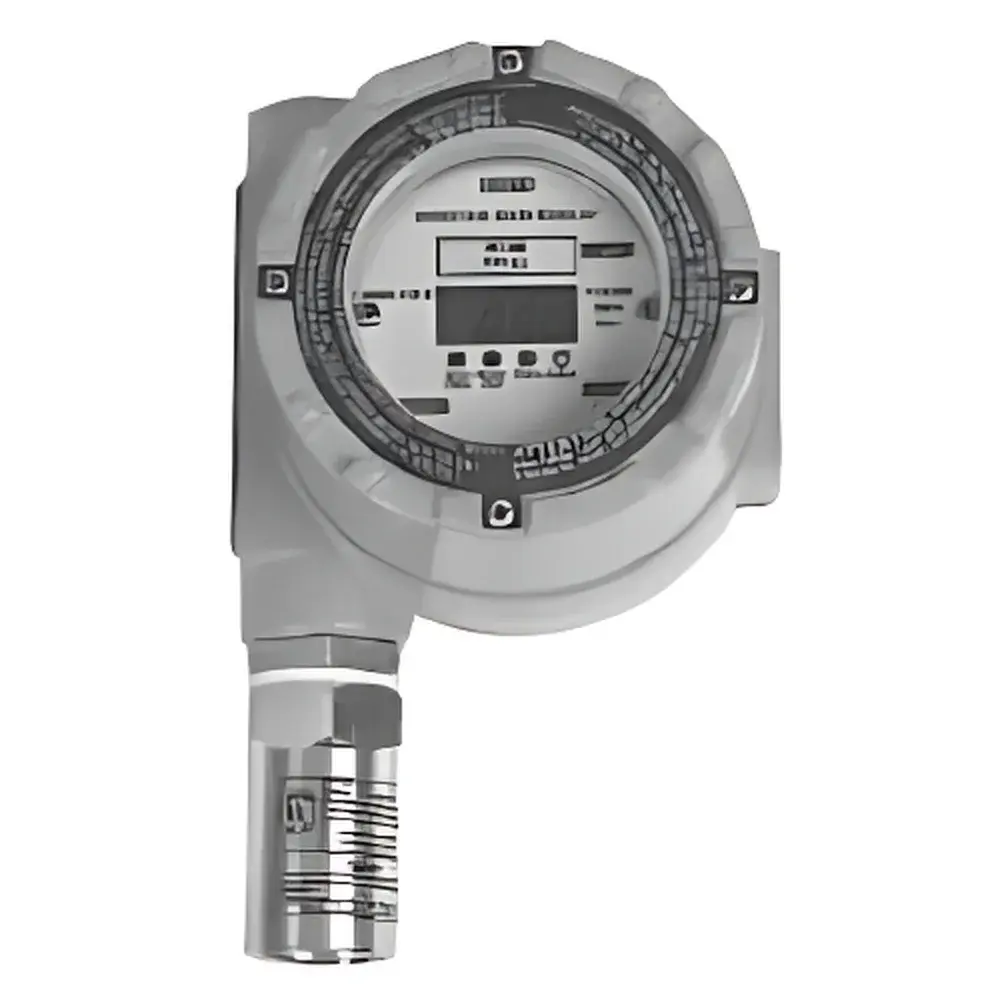
4-20IQ Online Multi-Gas Monitor
| Origin | USA |
|---|---|
| Manufacturer Type | Authorized Distributor |
| Origin Category | Imported |
| Model | 4-20IQ |
| Pricing | Available Upon Request |
| Sensor Types | Solid-State, Electrochemical, Catalytic Bead, Infrared, and Electrochemical Oxygen Sensors |
| Gas Coverage | >150 Toxic, Combustible, and Asphyxiant Gases |
| Resolution | 0.01 ppm (0–10 ppm), 0.1 ppm (10–100 ppm), 1 ppm (100–1000 ppm) |
| Accuracy | ±5% FS (all gases and ranges) |
| Output Signal | 4–20 mA (non-isolated |
| Power Supply | 14–24 VDC |
| Current Consumption | 300–500 mA |
| Operating Temperature | –20 °C to +60 °C |
| Storage Temperature | –40 °C to +85 °C |
| Humidity Range | 0–99% RH (non-condensing) |
| Enclosure Rating | Class I, Division 1, Groups B, C, D (UL/cUL Listed) |
| Dimensions | 115.32 × 198.74 × 128.27 mm |
| Weight | 1.765 kg |
| Calibration Method | Auto-calibration via magnetic wand with certified span gas |
| User Interface | Magnet-actuated membrane switches (no enclosure opening required) |
| Fault Indication | Flashing display + 0 mA output |
Overview
The 4-20IQ Online Multi-Gas Monitor is a microprocessor-based, intrinsically safe gas detection instrument engineered for continuous, real-time monitoring of toxic, combustible, and oxygen-deficient atmospheres in hazardous industrial environments. Designed for deployment in refineries, chemical processing plants, semiconductor fabrication facilities, wastewater treatment infrastructure, and confined-space entry operations, the 4-20IQ operates on proven electrochemical, catalytic bead, solid-state metal oxide, infrared (IR), and galvanic oxygen sensing principles—each selected and configured per application-specific gas and range requirements. Its architecture conforms to fundamental safety integrity requirements for continuous emission monitoring systems (CEMS) and process safety management (PSM) frameworks, delivering stable analog output for integration into distributed control systems (DCS), programmable logic controllers (PLC), or standalone alarm panels. The device supports full-scale measurement ranges spanning sub-ppm to %LEL and percent-by-volume concentrations, enabling precise quantification across regulatory thresholds defined by OSHA PELs, ACGIH TLVs, and NFPA 70E arc-flash hazard zones.
Key Features
- True multi-gas flexibility: Configurable with interchangeable sensor modules supporting over 150 gases—including H2S, CO, Cl2, NH3, SO2, HCN, CH4, C2H4, ETO, and volatile organic compounds (VOCs)—via factory or field-selectable sensor types.
- Intrinsically safe operation: UL/cUL listed for Class I, Division 1, Groups B, C, D; certified for use in Zone 0/1 hazardous locations without external barriers.
- Magnetic user interface: All configuration, zero/span calibration, and alarm setpoint adjustments performed externally using a supplied magnetic wand—eliminating exposure to hazardous atmospheres during routine maintenance.
- Auto-calibration capability: When exposed to certified calibration gas, the unit executes full-sensor diagnostics, baseline correction, and gain adjustment without manual potentiometer tuning or firmware intervention.
- Dual-stage fault reporting: Visual indication via flashing LCD and simultaneous 0 mA output signal ensures immediate recognition of sensor drift, failure, or power interruption per ISA-84.00.01 (IEC 61511) functional safety conventions.
- Robust mechanical design: IP66-rated explosion-proof aluminum housing with stainless-steel mounting hardware; optimized thermal mass for stable performance across ambient fluctuations from –20 °C to +60 °C.
Sample Compatibility & Compliance
The 4-20IQ accommodates direct sampling of ambient air or process stream gas via diffusion or active aspiration (with optional pump module). It complies with international standards governing gas detection instrumentation, including UL 2075 (Gas and Vapor Detectors), EN 45544-1 (Electrochemical sensors for toxic gases), EN 60079-29-1 (Explosive atmospheres — Gas detectors), and IEC 61000-6-2/-4 (EMC immunity and emissions). For regulated industries, its 4–20 mA output meets analog signal integrity requirements for FDA 21 CFR Part 11-compliant data acquisition when paired with audit-trail-capable SCADA systems. Sensor lifetimes are validated per manufacturer specifications: electrochemical cells typically exceed 24 months; solid-state sensors maintain stability for >10 years under typical industrial exposure profiles. All units ship with NIST-traceable calibration certificates and comply with ISO/IEC 17025 documentation practices for laboratory and field verification.
Software & Data Management
While the 4-20IQ operates as a stand-alone analog transmitter without embedded software, it integrates seamlessly into enterprise-level monitoring ecosystems via its 4–20 mA output and optional relay contacts. When connected to compatible data loggers or asset management platforms (e.g., Emerson DeltaV, Honeywell Experion, Siemens Desigo CC), the device supports time-stamped trend logging, alarm event tagging, and predictive maintenance alerts based on sensor response decay analysis. Optional isolation modules enable compliance with electromagnetic compatibility (EMC) requirements in electrically noisy environments (e.g., near VFDs or high-voltage switchgear). Configuration parameters—including gas type, full-scale range, alarm thresholds, and response delay—are stored in non-volatile memory and retained during power loss, ensuring operational continuity in critical infrastructure applications.
Applications
The 4-20IQ serves mission-critical roles across multiple sectors: continuous leak detection in hydrocarbon transfer manifolds; hydrogen sulfide monitoring in sour gas processing; chlorine and ammonia surveillance in water disinfection systems; ethylene oxide verification in sterilization chambers; and oxygen deficiency monitoring in inerted storage tanks. It is routinely deployed in semiconductor cleanrooms for silane and arsine detection (per SEMI S2 guidelines), in pharmaceutical manufacturing for solvent vapor monitoring (aligned with ICH Q5C and USP ), and in biogas upgrading facilities for methane and H2S co-monitoring per EN 16726. Its modular sensor architecture allows rapid reconfiguration for changing process chemistry—reducing lifecycle cost versus fixed-sensor analyzers.
FAQ
What sensor technologies are supported?
The 4-20IQ accepts electrochemical, catalytic bead, solid-state metal oxide, infrared (NDIR), and electrochemical oxygen sensors—all field-replaceable and pre-calibrated at the factory.
Is the 4–20 mA output isolated?
Standard output is non-isolated; isolated 4–20 mA modules are available as an option for noise-prone installations or multi-drop loop configurations.
Can the unit be calibrated without opening the enclosure?
Yes—zero and span calibration are fully executed using the magnetic wand interface, eliminating the need to breach the explosion-proof housing in classified areas.
What is the expected service life of the sensors?
Electrochemical sensors: 24–36 months depending on exposure profile; solid-state sensors: ≥10 years; catalytic bead sensors: 3–5 years under normal operating conditions.
Does the device support Modbus or other digital protocols?
No—the 4-20IQ is an analog-only transmitter. Digital communication requires integration via third-party analog-to-Modbus converters or PLC analog input cards.
Related Products







