
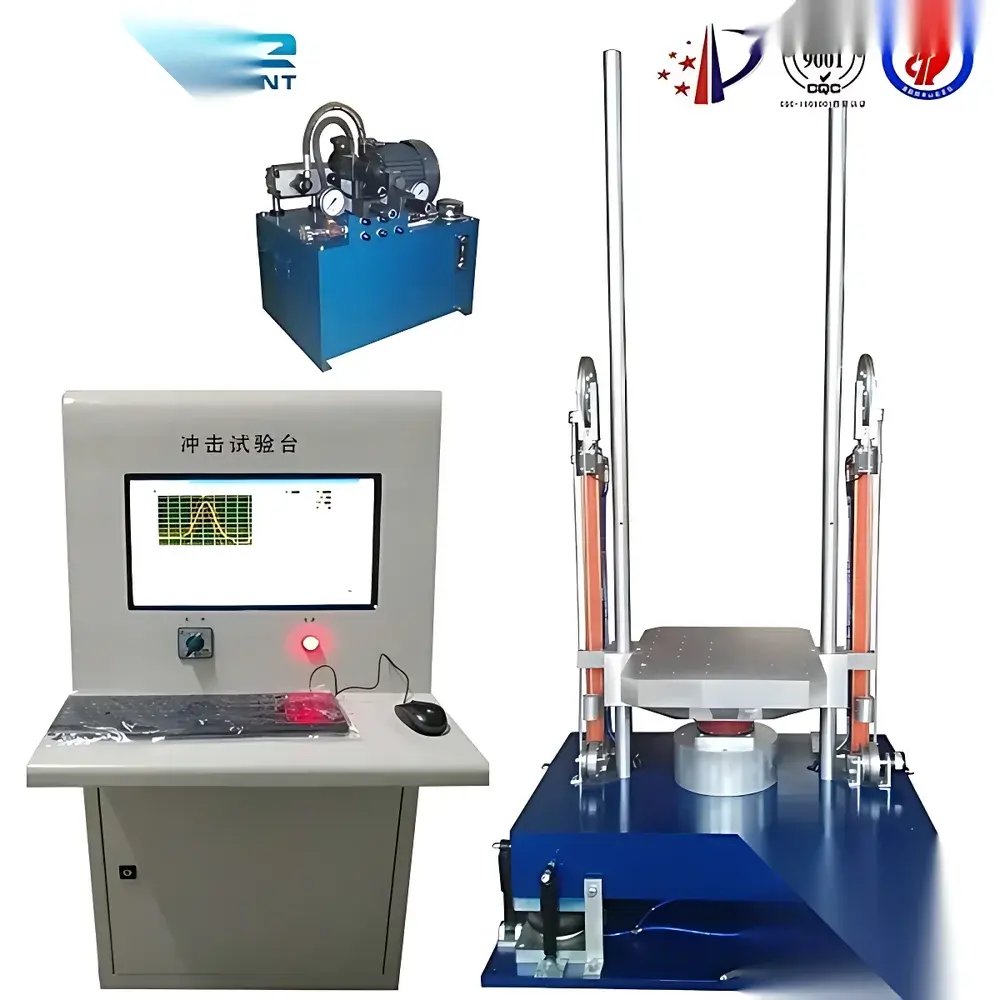
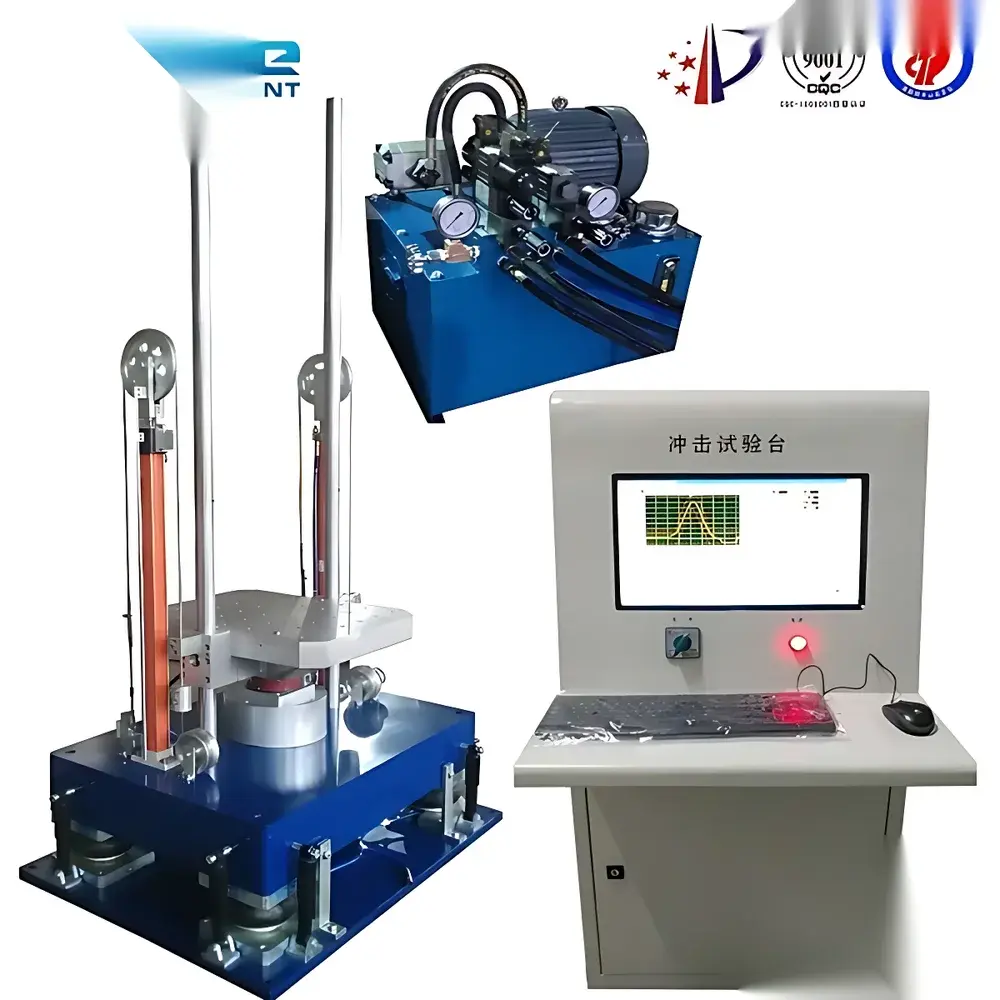
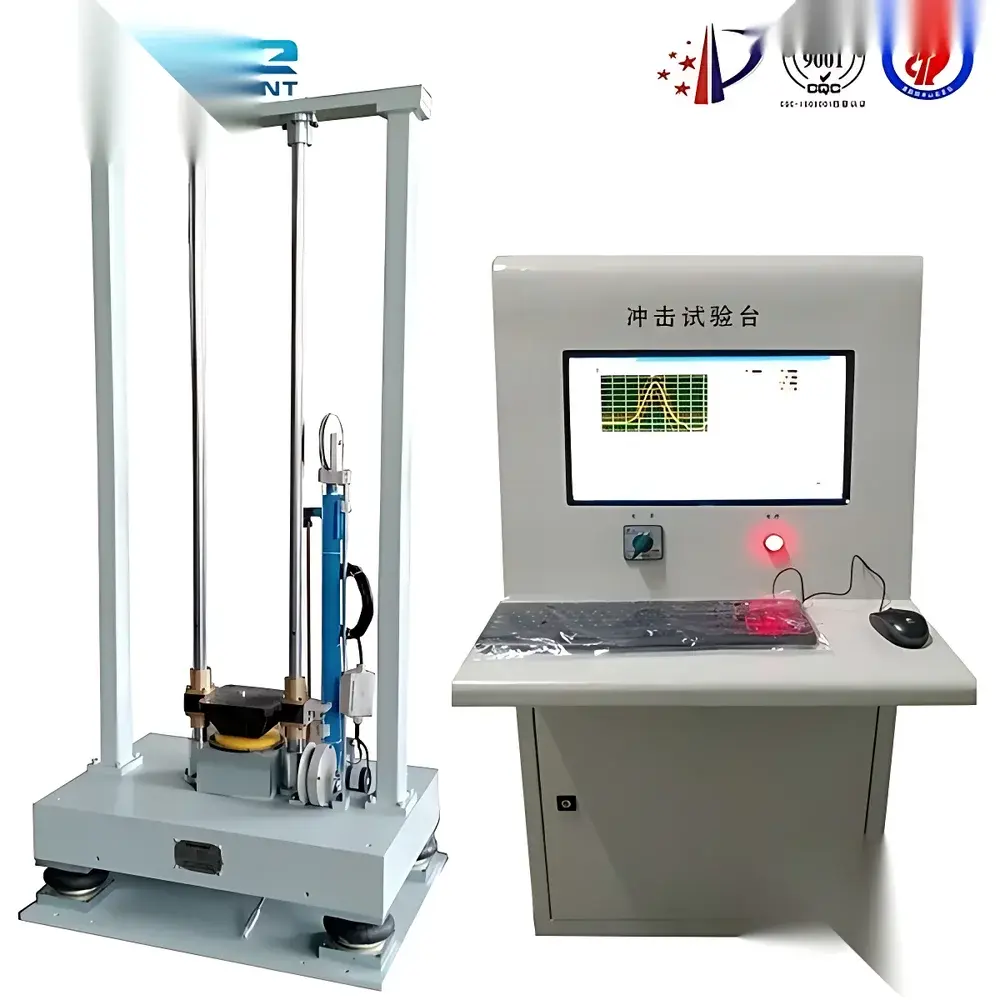
OK-S-5 Semi-Sinusoidal Impact Testing Machine
| Brand | Other Brands |
|---|---|
| Origin | Imported |
| Manufacturer Type | General Distributor |
| Price | USD 14,000 (approx.) |
| Platform Dimensions | 18 × 18 cm |
| Platform Mass | 25 kg |
| Platform Material | Aluminum Alloy |
| Maximum Acceleration | 1500 g |
| Maximum Stroke | 90 cm |
| Maximum Velocity Change Rate | 7.4 m/s (Half-Sine) |
| Minimum Shock Duration | 0.5 ms |
| Maximum Payload | 20 kg |
| Machine Weight | 1000 kg |
| Overall Dimensions | 110 × 50 × 270 cm |
| Power Supply | AC 380 V / 3-Phase / 15 A |
| Air Pressure Requirement | 6–8 kg/cm² |
Overview
The OK-S-5 Semi-Sinusoidal Impact Testing Machine is a precision-engineered electro-pneumatic impact simulator designed for controlled mechanical shock qualification in compliance with international test standards including ISO 2041, IEC 60068-2-27, MIL-STD-810H Method 516.8, and GB/T 2423.5. It generates repeatable, traceable half-sine acceleration pulses—characterized by smooth rise and decay profiles—to replicate real-world transient mechanical shocks such as free-fall impacts, transportation drop events, and sudden collision environments. Unlike pendulum or hammer-based systems, the OK-S-5 employs a vertically actuated pneumatic lift-and-drop mechanism with adjustable release height and programmable cushioning control, enabling precise waveform shaping without secondary rebound or platform displacement. Its robust aluminum alloy test platform (18 × 18 cm, 25 kg) ensures high modal rigidity and minimal resonance interference during pulse transmission—critical for accurate response measurement of sensitive electronics, automotive ECUs, aerospace components, and medical devices.
Key Features
- Electro-pneumatic dual-mode operation: Combines high-speed solenoid valve triggering with regulated air-cushion deceleration for consistent half-sine pulse generation (0.5–20 ms duration, up to 1500 g peak acceleration)
- Adjustable stroke range: 0–90 cm vertical travel enables fine-tuned velocity control (up to 4.2 m/s terminal velocity), supporting both low-g durability screening and high-g qualification testing
- Integrated vibration isolation: Dual-stage damping system comprising nitrogen-filled air springs and elastomeric anti-vibration feet absorbs residual energy and suppresses floor-borne transmission—no anchoring or foundation required
- Modular waveform capability: Configurable pulse shapes include half-sine, trapezoidal, and sawtooth via optional external shock amplifier modules; compatible with industry-standard charge-mode accelerometers and IEPE sensors
- Real-time monitoring interface: Built-in analog outputs (±10 V) for acceleration, velocity, and displacement signals; supports synchronization with external DAQ systems (e.g., NI PXI, Dewesoft X) for full waveform capture and post-processing
- Compliance-ready architecture: Designed to meet GLP/GMP documentation requirements; includes audit trail logging, user access levels, and calibration certificate traceability to NIST or PTB standards
Sample Compatibility & Compliance
The OK-S-5 accommodates specimens up to 20 kg mass and dimensions within 18 × 18 cm footprint—ideal for PCB assemblies, handheld consumer devices, battery packs, sensor housings, and small mechanical subassemblies. Its rigid aluminum platform minimizes flexural modes below 1 kHz, preserving signal fidelity for high-frequency shock analysis. The system complies with ISO/IEC 17025 calibration protocols and supports validation per ASTM D999 (vibration and shock testing of shipping containers) and USP (mechanical shock testing of pharmaceutical packaging). Optional mounting fixtures—including threaded inserts, vacuum chucks, and custom fixture plates—are available for non-standard geometries. All test reports generated through integrated software include timestamped metadata, operator ID, environmental conditions, and raw waveform data compliant with FDA 21 CFR Part 11 electronic record requirements.
Software & Data Management
The OK-S-5 operates with PC-based control software featuring intuitive pulse parameterization (peak g, duration, rise time, dwell), automated test sequencing, and real-time oscilloscope-style visualization. Data export formats include CSV, MATLAB (.mat), and universal TDMS for seamless integration into statistical process control (SPC) platforms. Software supports multi-channel acquisition (acceleration x/y/z, force, temperature), automatic pass/fail evaluation against user-defined thresholds, and batch report generation with PDF/A-1a archival compliance. Audit logs record all configuration changes, calibration events, and user interventions with digital signatures—ensuring full traceability for ISO 9001:2015 and AS9100D quality audits.
Applications
- Qualification of electronic enclosures against drop-induced PCB fracture, solder joint fatigue, and connector disengagement
- Evaluation of structural integrity in wearable medical devices subjected to accidental impact during clinical use
- Validation of adhesive bond strength in laminated displays under transient shear loading
- Shock sensitivity assessment of MEMS inertial sensors and piezoelectric transducers
- Design verification of protective packaging systems per ISTA 3A and ASTM D4169 protocols
- Material-level characterization of polymer composites and elastomeric dampers using shock-response spectrum (SRS) analysis
FAQ
What standards does the OK-S-5 support for half-sine shock testing?
It fully supports ISO 2041:2009 (vibration and shock – vocabulary), IEC 60068-2-27 (environmental testing – shock), and MIL-STD-810H Method 516.8 (shock), with configurable pulse parameters to match standard test profiles.
Can the system generate waveforms other than half-sine?
Yes—via optional external shock amplifiers and programmable pneumatic controllers, users can produce trapezoidal, sawtooth, and damped sine waveforms while maintaining traceable amplitude and timing accuracy.
Is calibration certification included with purchase?
Each unit ships with a factory calibration certificate traceable to national metrology institutes (NMI), including uncertainty budgets for acceleration, time, and velocity measurements per ISO/IEC 17025.
What safety interlocks are implemented?
The system integrates dual-channel light curtains, emergency stop circuitry meeting SIL2 per IEC 62061, and pneumatic pressure monitoring with automatic shutdown if supply pressure falls outside 6–8 kg/cm² tolerance band.
How is test repeatability ensured across multiple operators?
Role-based access control, password-protected parameter templates, and electronic signature requirements for test execution prevent unauthorized modifications and ensure procedural consistency across shifts and laboratories.



