
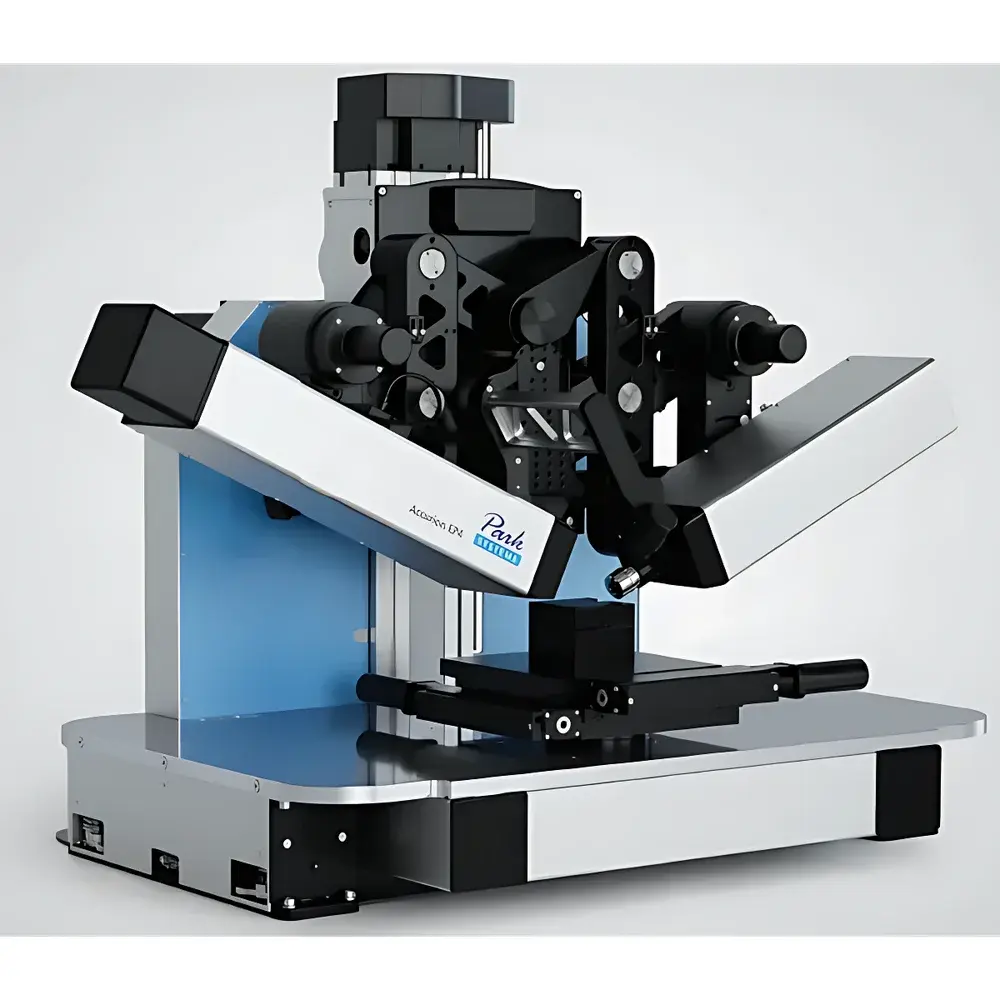
Accurion EP4 Ellipsometric Microscope
| Brand | Accurion |
|---|---|
| Origin | Germany |
| Manufacturer Type | Authorized Distributor |
| Origin Category | Imported |
| Model | EP4 |
| Pricing | Upon Request |
Overview
The Accurion EP4 Ellipsometric Microscope is a high-precision, research-grade optical metrology system engineered for nanoscale characterization of thin films and surface structures. It integrates spectroscopic ellipsometry with real-time optical microscopy to deliver spatially resolved measurements of film thickness and complex refractive index (n and k) across heterogeneous samples. Unlike conventional point-scanning ellipsometers, the EP4 employs a full-field imaging architecture based on rotating analyzer ellipsometry (RAE) combined with high-magnification microscope optics. This enables quantitative ellipsometric analysis at lateral resolutions down to 1 µm — without mechanical scanning or spot size limitations. The system operates in the visible to near-infrared spectral range (typically 400–1000 nm), supporting both single-wavelength and multi-wavelength acquisition modes. Its measurement principle relies on precise detection of polarization state changes induced by reflection from layered dielectric or semiconductor structures, allowing model-based extraction of layer thicknesses, interfacial roughness, and optical dispersion with sub-angstrom thickness resolution (≤0.1 nm repeatability under controlled conditions).
Key Features
- Microscale spatial resolution: Full-field ellipsometric mapping with ≤1 µm lateral resolution in x/y directions, enabling localized analysis of patterned substrates, microelectrodes, and nanostructured surfaces.
- Background-free measurement on transparent substrates: Proprietary beam-shaping and aperture-cutting optics eliminate parasitic substrate reflections, permitting accurate characterization of ultra-thin films (<2 nm) on glass, quartz, or sapphire without interference from backside signals.
- Integrated high-resolution optical microscope: Real-time visual correlation between sample morphology and ellipsometric data; motorized stage with precision XYZ control and optional autofocus for repeatable positioning.
- Modular platform architecture: Designed for seamless integration with complementary surface characterization tools including atomic force microscopy (AFM), surface plasmon resonance (SPR), reflectance spectroscopy (RefSpec), Raman spectroscopy (RamanSpec), quartz crystal microbalance (QCM), white-light interferometry (WLI), and Langmuir-Blodgett troughs.
- Robust environmental stability: Vibration-damped optical table mounting, temperature-stabilized light source, and active polarization calibration ensure long-term measurement reproducibility required for process monitoring and GLP-compliant studies.
Sample Compatibility & Compliance
The EP4 supports a broad range of sample types: spin-coated polymer films, ALD/CVD-deposited metal oxides, self-assembled monolayers (SAMs), 2D materials (e.g., graphene, MoS₂), biofunctionalized surfaces, and multilayer photonic stacks. It accommodates standard wafer formats (up to 8-inch diameter), custom substrates (glass, silicon, ITO, PET), and liquid-air or liquid-solid interfaces when used with environmental cells. The system complies with ISO/IEC 17025 requirements for calibration traceability and supports audit-ready documentation workflows aligned with FDA 21 CFR Part 11 and EU Annex 11 guidelines for electronic records and signatures. Measurement models are validated against NIST-traceable reference standards for thickness and optical constants.
Software & Data Management
Control and analysis are performed via Accurion’s proprietary EllipsoVision software suite, featuring a modular GUI with intuitive workflow management. The platform provides real-time image-based region-of-interest (ROI) selection, automated multi-layer optical modeling (Cauchy, Tauc-Lorentz, Cody-Lorentz parameterizations), and batch processing for time-resolved or multi-sample experiments. All raw data (psi/delta spectra, intensity images, metadata) are stored in vendor-neutral HDF5 format with embedded timestamps, instrument configuration logs, and user annotations. Export options include CSV, MATLAB (.mat), and ASCII for third-party analysis. Audit trail functionality records operator actions, parameter changes, and calibration events to support GMP/GLP validation protocols.
Applications
- Development and QC of anti-reflective, barrier, and functional coatings in display and semiconductor manufacturing.
- In situ monitoring of thin-film growth kinetics during plasma-enhanced CVD or electrochemical deposition.
- Quantitative analysis of protein adsorption, lipid bilayer formation, and biosensor surface functionalization.
- Characterization of perovskite solar cell stacks, OLED emissive layers, and flexible electronics substrates.
- Correlative metrology studies combining ellipsometric thickness maps with topographic (AFM/WLI) and chemical (Raman/SPR) data sets.
FAQ
What is the minimum measurable film thickness with the EP4?
The system achieves ≤0.1 nm repeatability for homogeneous films on reflective substrates; for ultra-thin layers (<1 nm) on transparent substrates, performance depends on optical contrast and model constraints.
Can the EP4 measure rough or patterned surfaces?
Yes — its full-field approach and ROI selection allow effective averaging over microstructures; for highly irregular topographies, coupling with WLI or AFM is recommended for deconvolution.
Is remote operation supported?
The EP4 supports secure network-based control and data access via Ethernet; remote diagnostics and software updates are available through Accurion’s authorized service portal.
Does the system require periodic recalibration?
Factory calibration is traceable to NIST standards; users perform routine verification using certified reference wafers; annual recalibration is recommended for ISO 17025 compliance.
Which optical models are included in the software?
Standard libraries include Cauchy, Sellmeier, Tauc-Lorentz, Cody-Lorentz, Drude, and effective medium approximations (EMA); custom dispersion models can be imported via scripting interface.



