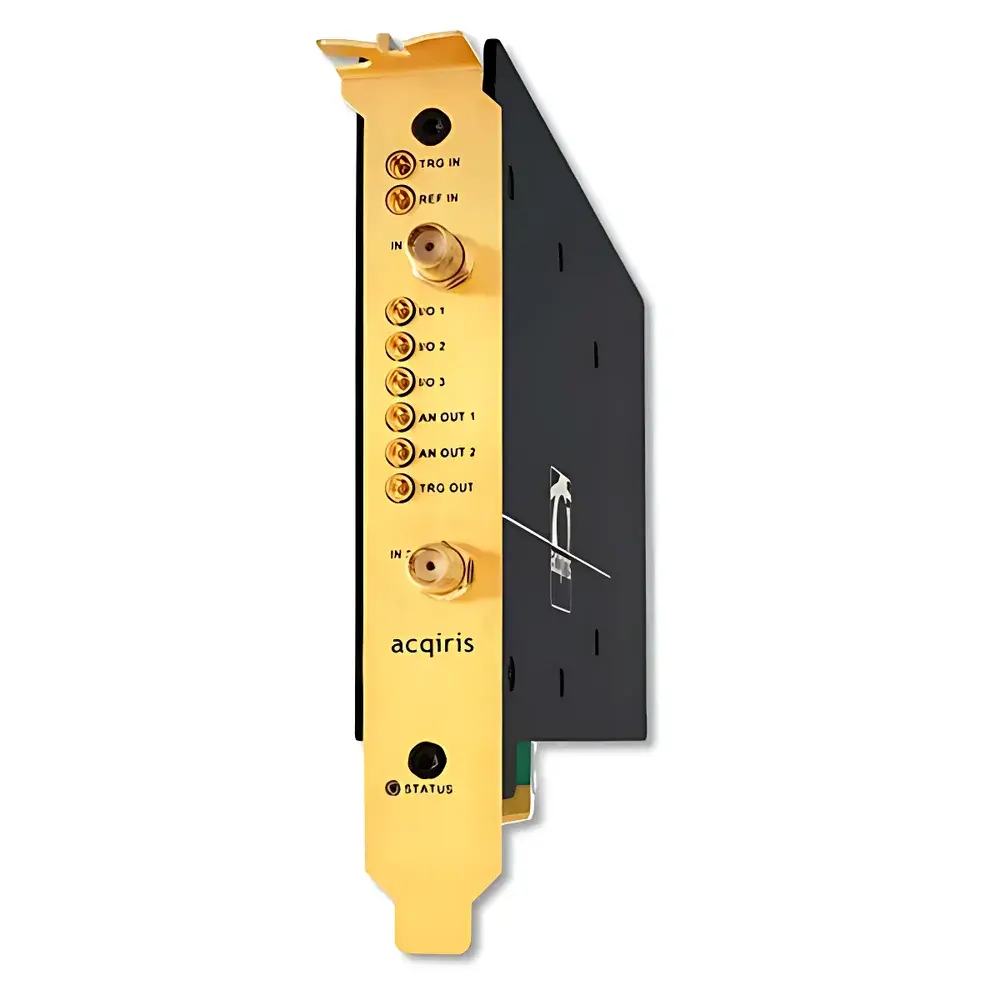
Acqiris SA220P 14-bit Dual-Channel 2 GS/s PCIe High-Speed Data Acquisition Card
| Brand | Auniontech |
|---|---|
| Origin | Shanghai, China |
| Manufacturer Type | Authorized Distributor |
| Product Origin | Domestic (China) |
| Model | SA220P |
| Sampling Resolution | 14 bit |
| Channels | 2 |
| Max Single-Channel Sampling Rate | 2 GS/s |
| Analog Bandwidth | 1.2 GHz |
| Input Impedance | 50 Ω, DC-coupled |
| Onboard Memory | 4 GB |
| Full-Scale Input Range (Selectable) | 500 mV or 2.5 V |
| Input Voltage Offset Range | ±0.5 FSR |
| Interface | PCIe x8 Gen2 |
| Real-time FPGA Processing | Yes |
| Hardware Averaging (AVG) | Yes |
| Clock Synchronization Trigger (CST) Output | Yes |
| Software Support | IVI-C, IVI.NET, C/C++, C#, VB.NET, MATLAB, LabVIEW, Linux |
Overview
The Acqiris SA220P is a high-performance, dual-channel, 14-bit PCIe data acquisition card engineered for demanding time-domain signal capture in scientific instrumentation and OEM systems. Built upon a robust FPGA-based architecture, it implements real-time signal conditioning, on-the-fly re-sampling, and hardware-accelerated FFT processing—enabling deterministic latency and sub-microsecond timing precision. Its 2 GS/s per channel sampling rate and 1.2 GHz analog bandwidth support coherent digitization of ultrafast optical and RF transients, making it especially suited for swept-source optical coherence tomography (SS-OCT), time-of-flight LiDAR, fiber-optic sensing, mass spectrometry signal digitization, and high-speed laser diagnostics. Unlike general-purpose DAQs, the SA220P integrates domain-specific firmware—including K-clock interpolation for OCT spectral calibration—eliminating post-processing bottlenecks and enabling direct generation of depth-resolved structural images from raw interferograms.
Key Features
- 14-bit vertical resolution with <0.5 LSB integral nonlinearity (INL), ensuring high dynamic range and fidelity in low-amplitude signal capture
- Dual independent ADC channels, each capable of sustained 2 GS/s sampling with interleaved or synchronized acquisition modes
- 1.2 GHz analog front-end bandwidth with 50 Ω DC-coupled inputs, optimized for broadband photodetector and RF mixer outputs
- 4 GB onboard DDR3 memory buffer supporting long-duration transient capture at full rate (e.g., >2 seconds at 1 GS/s)
- FPGA-based real-time processing pipeline including programmable digital filtering, hardware averaging (AVG), and trigger-gated acquisition
- Dedicated K-clock input and re-sampling engine compliant with SS-OCT standards (e.g., ISO 13522-3), enabling linear wavenumber interpolation without CPU intervention
- PCIe x8 Gen2 host interface delivering sustained throughput >3.2 GB/s, minimizing host-side data transfer latency
- Comprehensive synchronization I/O: CST (Clock Synchronization Trigger) output, external clock input, and multi-card phase-aligned triggering via LVDS
Sample Compatibility & Compliance
The SA220P interfaces directly with common photonic and electronic signal sources used in regulated and research-grade systems—including balanced photoreceivers (e.g., Thorlabs PDB480C), RF spectrum analyzers, pulsed laser drivers, and swept-wavelength lasers (e.g., Santec HSL-2000, Axsun 100–1300 nm modules). Its hardware design conforms to PCIe Base Specification Rev 2.0 and adheres to FCC Part 15 Class A and CE EMC Directive 2014/30/EU emission limits. For medical device integration (e.g., Class II OCT systems), the card supports audit-ready operation when deployed within IVI-compliant software frameworks; its deterministic acquisition behavior satisfies traceability requirements under ISO 13485 and FDA 21 CFR Part 11 when paired with validated host applications and proper system-level validation protocols.
Software & Data Management
The SA220P ships with a cross-platform driver suite certified for IVI-C and IVI.NET compliance, enabling seamless integration into automated test environments governed by NI TestStand or Keysight PathWave. Native APIs are provided for C/C++, C#, VB.NET, MATLAB (via MEX), and LabVIEW (supporting both Windows and Linux kernel-space drivers). The AcqirisOCT software module includes calibrated FFT bin mapping, dispersion compensation routines, and GPU-accelerated B-scan reconstruction—exporting DICOM-SR compatible metadata and supporting configurable ROI extraction. All acquisition sessions log timestamped configuration snapshots, FPGA build identifiers, and hardware calibration coefficients, facilitating GLP/GMP-compliant data integrity workflows.
Applications
- Swept-Source Optical Coherence Tomography (SS-OCT): Real-time k-space resampling, complex conjugate suppression, and volumetric rendering at up to 1 MHz A-scan rates
- Fiber Bragg Grating (FBG) and distributed acoustic sensing (DAS): Sub-nanosecond timing resolution for phase-sensitive interrogation of strain and temperature perturbations
- Time-of-Flight LiDAR: Direct digitization of return pulse waveforms for centimeter-level ranging accuracy in autonomous navigation systems
- Mass Spectrometry Signal Digitization: High-fidelity capture of transient ion current signals from TOF-MS detectors with minimal dead time
- Laser Pulse Characterization: Measurement of pulse shape, jitter, and amplitude noise in ultrafast amplifier chains and mode-locked oscillators
- Semiconductor Device Testing: Dynamic characterization of high-speed transistors, photodiodes, and integrated modulators under RF excitation
FAQ
Does the SA220P support hardware-triggered averaging across multiple acquisitions?
Yes—the FPGA implements real-time hardware averaging (AVG) with user-configurable accumulation depth (up to 65,536 triggers), preserving full 14-bit resolution without host memory bottlenecks.
Can the SA220P be synchronized with external lasers or scanners in an OCT system?
Yes—it provides LVDS-compatible CST output and accepts external clock/reference inputs, enabling sub-sample phase alignment with swept lasers and galvanometric scanners.
Is the K-clock interpolation algorithm customizable for non-standard sweep profiles?
Yes—the FPGA firmware allows user-defined interpolation kernels and lookup tables, supporting custom wavelength sweeps and nonlinear tuning trajectories.
What operating systems are officially supported?
Windows 10/11 (64-bit), RHEL/CentOS 7.9+, and Ubuntu 20.04 LTS (with kernel 5.4+); real-time extensions (e.g., Xenomai) are supported upon request.
How is calibration maintained over temperature and time?
The board includes on-board temperature sensors and factory-calibrated gain/offset coefficients stored in nonvolatile memory; periodic self-calibration routines can be initiated via API command.