
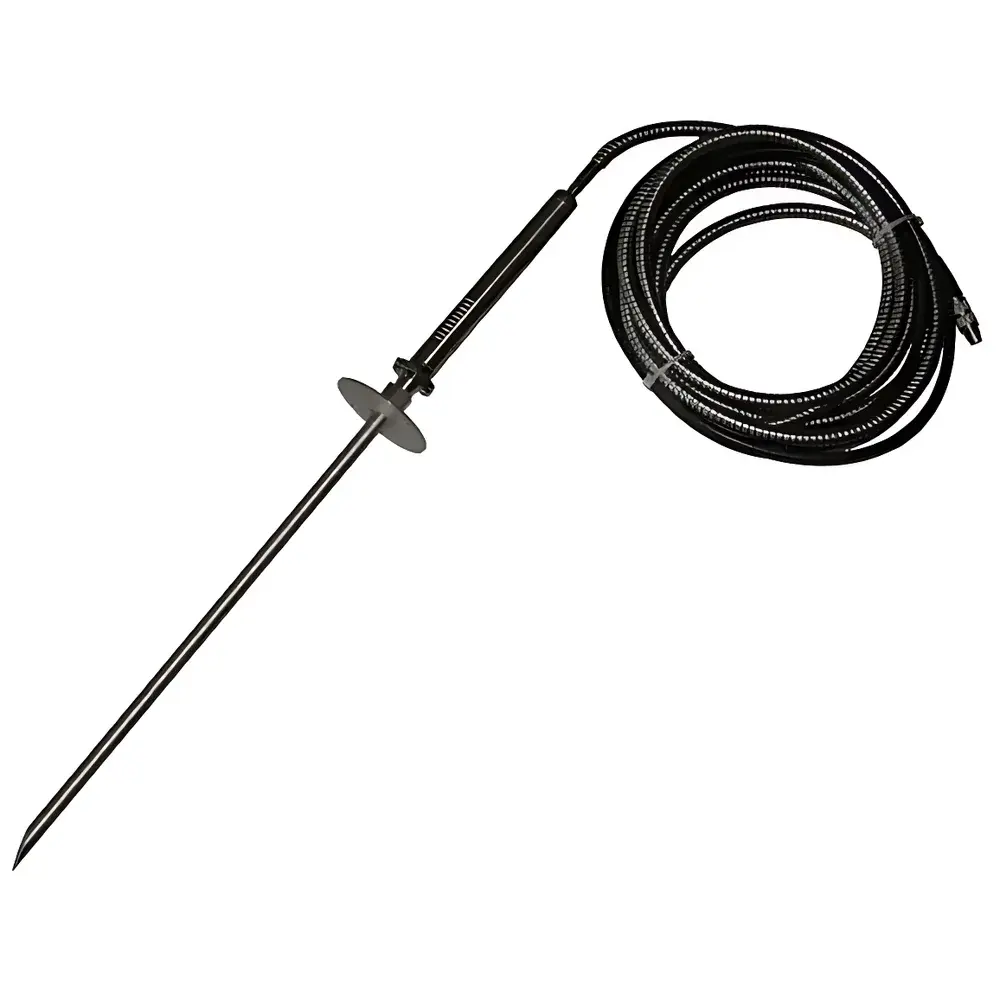
ADCON ST Stainless Steel Soil, Water & Snow Temperature Sensor
| Brand | ADCON |
|---|---|
| Origin | Imported |
| Manufacturer Type | Authorized Distributor |
| Model | ST |
| Measurement Range | -20°C to +40°C |
| Accuracy | ±0.3°C |
| Sensor Element | Pt100 Class B |
| Output Signal | 0–2.5 V |
| Supply Voltage | 5.5–8 V DC |
| Probe Length | 30 cm (12 in) |
| Total Length | 45 cm (17.7 in) |
| Cable Length | 5 m (shielded, PUR jacket |
| Enclosure Material | Stainless Steel |
| Ingress Protection | IP67 |
| Connector | 7-pin male plug |
| Max Custom Depth | 100 cm (39.4 in) |
| Ordering Code | 200.733.040 |
Overview
The ADCON ST Stainless Steel Soil, Water & Snow Temperature Sensor is a precision-engineered environmental probe designed for long-term, high-reliability temperature monitoring across heterogeneous natural media—including unsaturated and saturated soil profiles, standing or flowing water bodies, snowpack layers, and ice interfaces. Based on the platinum resistance thermometer principle (Pt100, IEC 60751 Class B), the sensor delivers traceable, stable thermal measurements under dynamic field conditions. Its fully submersible stainless steel housing enables direct burial at depths up to 30 cm as standard—and up to 100 cm with custom configurations—without compromising signal integrity or mechanical robustness. The sensor operates passively within a low-voltage DC range (5.5–8 V), generating a linear 0–2.5 V analog output proportional to temperature, facilitating seamless integration into ADCON’s telemetry platforms (e.g., ADEL, TELEMAC) as well as third-party data loggers compliant with standard voltage-input protocols.
Key Features
- Hermetically sealed 316 stainless steel probe body rated IP67—fully dust-tight and resistant to temporary immersion (up to 1 m for 30 min), validated per IEC 60529.
- Pt100 Class B sensing element offering ±0.3°C accuracy across the full operating range of –20°C to +40°C, with long-term drift <0.1°C/year under typical environmental exposure.
- Mechanically reinforced cable assembly: 5-meter total length featuring PUR outer jacket for UV, hydrolysis, and abrasion resistance; the first 3 meters armored with a flexible stainless steel braid to deter rodent gnawing and mechanical impact during installation and service life.
- Zero-maintenance probe design—no recalibration required in situ; factory-traceable calibration certificate supplied with each unit.
- 7-pin male connector (M12-compatible footprint) enabling secure, weatherproof mating with ADCON junction boxes or compatible logger interfaces; pin assignment supports power, ground, analog output, and optional diagnostics.
- Optimized insertion geometry: slender 8 mm diameter and tapered tip allow manual or hammer-driven deployment into mineral soils, organic substrates, and compacted snow without pre-drilling.
Sample Compatibility & Compliance
The ST sensor is validated for direct contact measurement in granular, clayey, and loamy soils; freshwater and brackish water columns; seasonal snowpacks (including depth hoar and melt layers); and shallow ice–water interfaces. It meets material compatibility requirements per ISO 14688-1 for geotechnical instrumentation and conforms to EN 12830 for environmental monitoring equipment used in climate and hydrological networks. While not intrinsically safe, its low-power operation and non-sparking construction support deployment in non-hazardous zones per IEC 60079-0. All materials comply with RoHS 2011/65/EU and REACH SVHC screening criteria. The Pt100 element adheres to ASTM E1137/E1137M for industrial platinum resistance thermometers.
Software & Data Management
Raw voltage outputs from the ST sensor are converted to calibrated temperature values using ADCON’s proprietary linearization algorithm—embedded in firmware of compatible data loggers (e.g., ADEL-3, TELEMAC-200) and accessible via the ADCON View software suite (v5.2+). The system supports time-stamped, audit-trail-enabled data storage aligned with GLP principles, including metadata tagging for sensor ID, installation depth, and geographic coordinates. When integrated into cloud-connected ADCON networks, data streams comply with IEC 62443-3-3 cybersecurity standards and support optional 21 CFR Part 11-compliant electronic signatures for regulated environmental reporting.
Applications
- Soil thermal regime monitoring for permafrost degradation studies, agricultural frost forecasting, and landfill cover performance assessment.
- Surface and hyporheic zone temperature profiling in stream restoration projects and groundwater–surface water exchange investigations.
- Snowpack energy balance modeling in alpine hydrology, including melt onset detection and refreezing event quantification.
- Calibration reference for distributed temperature sensing (DTS) fiber-optic systems in boreholes and embankments.
- Long-term validation of numerical heat transfer models in coupled land–atmosphere simulations (e.g., CLM, Noah-MP).
FAQ
Can the ST sensor be installed deeper than 30 cm?
Yes—standard units ship with a 30 cm active probe length, but custom configurations are available up to 100 cm total probe length upon request. Mechanical integrity and thermal response time remain unaffected within this range.
Is the sensor suitable for saline or acidic soils?
The 316 stainless steel housing provides excellent corrosion resistance in pH 4–10 environments and chloride concentrations ≤5,000 ppm. For highly aggressive media (e.g., acid mine drainage), optional passivation or PTFE-coated variants are available.
Does the 0–2.5 V output require signal conditioning?
No—this ratiometric output is optimized for direct connection to 12-bit or higher resolution analog inputs. Gain and offset correction are applied digitally by the host logger using the included calibration coefficients.
How is cable strain managed during freeze–thaw cycles?
The stainless steel braid over the first 3 meters decouples axial tension from the inner conductor bundle, while the PUR jacket maintains flexibility down to –40°C—preventing microfracture-induced signal noise in cyclic thermal environments.
Related Products







