
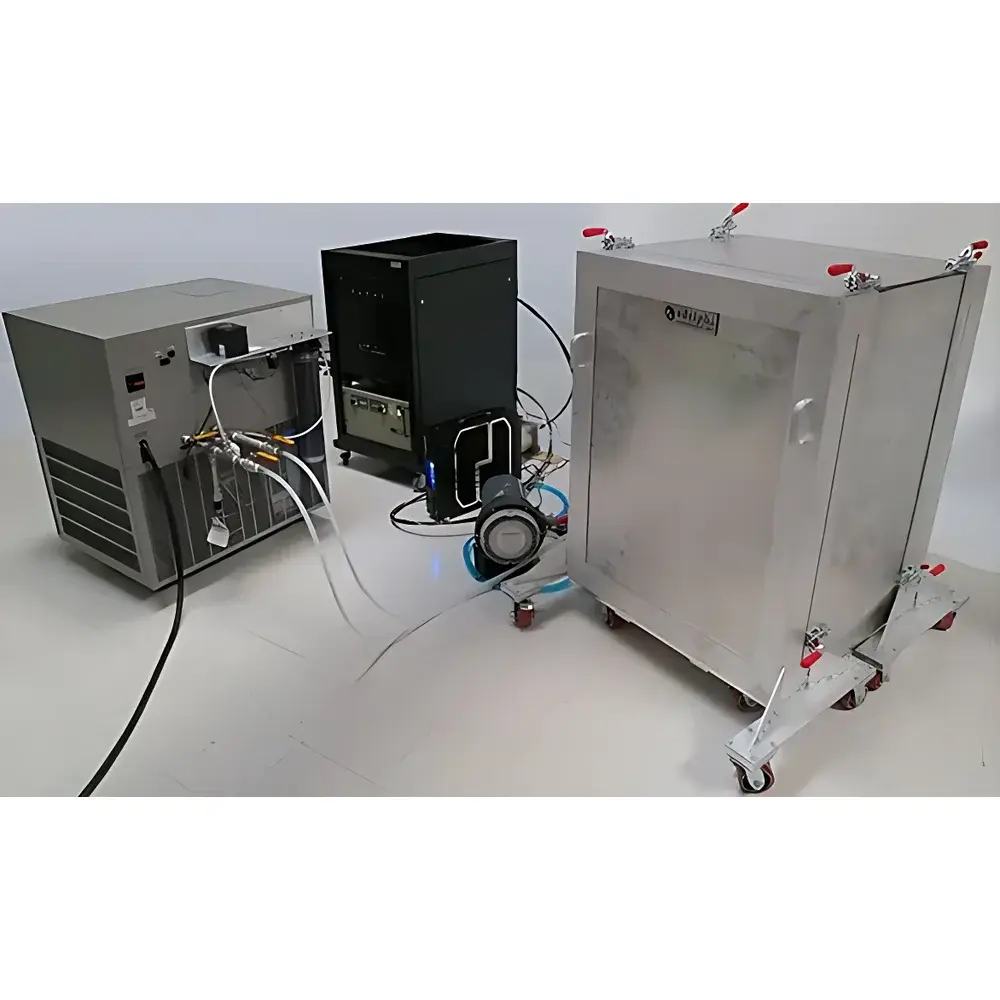
Adelphi DD110M / DD110 Compact Deuterium-Deuterium (D-D) Neutron Generator
| Origin | USA |
|---|---|
| Manufacturer Type | Authorized Distributor |
| Origin Category | Imported |
| Model | DD110M / DD110 |
| Pricing | Available Upon Technical Inquiry |
Overview
The Adelphi DD110M and DD110 are compact, sealed-tube deuterium-deuterium (D-D) neutron generators engineered for laboratory-scale neutron production in research, education, and applied nuclear science environments. Operating at 2.45 MeV, these generators produce fast neutrons via inertial electrostatic confinement (IEC) or high-voltage ion acceleration into a deuterated target, enabling reproducible, on-demand neutron emission without radioactive isotopes. Unlike isotopic sources, the DD110 series offers precise temporal control, adjustable duty cycles, and intrinsic safety—neutron output ceases immediately upon beam termination. The DD110M variant integrates an optimized polyethylene and borated polyethylene moderator assembly to enhance thermal neutron flux, making it suitable for neutron activation analysis (NAA), prompt gamma neutron activation analysis (PGNAA), boron neutron capture therapy (BNCT) feasibility studies, and neutron radiography training protocols.
Key Features
- Compact, air-cooled, benchtop-compatible design with integrated high-voltage power supply and vacuum pumping system
- D-D reaction physics yielding monoenergetic 2.45 MeV neutrons with typical fast neutron output of 1 × 10⁹ – 1 × 10¹⁰ n/s (DD110) and enhanced thermal flux up to 1 × 10⁷ n/s·cm² (DD110M)
- Modular moderator configuration (standard for DD110M; optional for DD110) using graded hydrogenous and neutron-absorbing materials for spectral tailoring
- Integrated radiation monitoring interface compatible with external neutron detectors (³He, BF₃, LiI(Eu)) and dose rate meters
- Compliance-ready interlock architecture supporting local regulatory requirements for accelerator-based neutron sources (e.g., NRC 10 CFR Part 30/35, IAEA SSG-46)
- Remote operation capability via RS-232/RS-485 or Ethernet, supporting integration into automated experimental workflows
Sample Compatibility & Compliance
The DD110M/DD110 is designed for use with solid, liquid, and powdered samples in controlled laboratory settings. Its low-energy D-D neutrons minimize induced radioactivity in most common elements (e.g., Al, Si, Fe, Cu), facilitating rapid sample turnover in teaching labs and short-cycle NAA experiments. The system meets electromagnetic compatibility (EMC) requirements per FCC Part 15 Class B and IEC 61000-6-3. Radiation shielding configurations—including custom lead-borosilicate glass viewports and movable polyethylene/boron carbide collimators—are available to satisfy ALARA principles and facility-specific shielding assessments. Documentation packages support GLP-aligned validation, including traceable calibration certificates for neutron yield measurement (via foil activation or long-counter cross-calibration), operational logs, and maintenance records compliant with ISO/IEC 17025 and ASTM E2698 standards.
Software & Data Management
Control and data acquisition are managed through Adelphi’s NeutronGen Control Suite (v4.2+), a Windows-based application offering real-time beam current monitoring, pulse-width modulation, emission timing synchronization, and integrated dosimetry logging. The software supports export of time-stamped neutron count data in CSV and HDF5 formats, with metadata fields aligned to FAIR data principles. Audit trails record all operator actions, parameter changes, and interlock events, satisfying FDA 21 CFR Part 11 requirements for electronic records and signatures when deployed in regulated R&D environments. Optional API access enables integration with LabVIEW, Python (PySerial, NumPy), or MATLAB for custom experiment automation and Monte Carlo simulation coupling (e.g., MCNP input parameter scripting).
Applications
- Undergraduate and graduate nuclear engineering pedagogy: neutron cross-section measurement, moderation efficiency studies, detector response characterization
- Non-destructive elemental analysis of geological, archaeological, and metallurgical specimens via PGNAA and delayed neutron counting
- Neutron imaging system development and resolution testing using scintillator-based or microchannel plate detectors
- Radiation hardness testing of electronics and aerospace components under controlled fast/thermal neutron spectra
- Development and benchmarking of neutron transport codes (e.g., GEANT4, Serpent) using well-characterized, monoenergetic source terms
- Preclinical BNCT dosimetry phantom studies requiring spatially resolved thermal neutron flux mapping
FAQ
What regulatory licenses are required to operate the DD110M in the United States?
U.S. users must obtain a specific license from the Nuclear Regulatory Commission (NRC) or an Agreement State authority authorizing possession and use of an accelerator-driven neutron source under 10 CFR Part 30 or Part 35. Adelphi provides technical documentation and site-specific shielding reports to support license applications.
Can the DD110M be operated continuously, or is it limited to pulsed mode?
The generator supports both continuous-wave (CW) and gated pulsed operation (down to 1 µs pulse width, 1 kHz repetition rate). Duty cycle and average power are constrained by thermal management limits of the target assembly.
Is neutron yield calibrated and traceable to national standards?
Yes—each unit ships with a NIST-traceable neutron yield calibration certificate based on activation foil analysis (e.g., indium, gold, copper) performed at an ISO/IEC 17025-accredited laboratory.
Does the system include radiation shielding, or is that specified separately?
Base configurations include minimal local shielding for operator safety during alignment. Full facility-integrated shielding (e.g., concrete vault interfaces, borated polyethylene walls, neutron beam stops) is engineered and supplied as a customized package per site survey and ANSI/ANS-6.1.1 assessment.
What maintenance intervals and consumables are required?
The sealed D-D tube has a rated lifetime of ≥1,000 hours at nominal output. Recommended preventive maintenance includes quarterly vacuum integrity checks, annual high-voltage insulation testing, and replacement of desiccant cartridges in the turbomolecular pump foreline every 12 months.




