
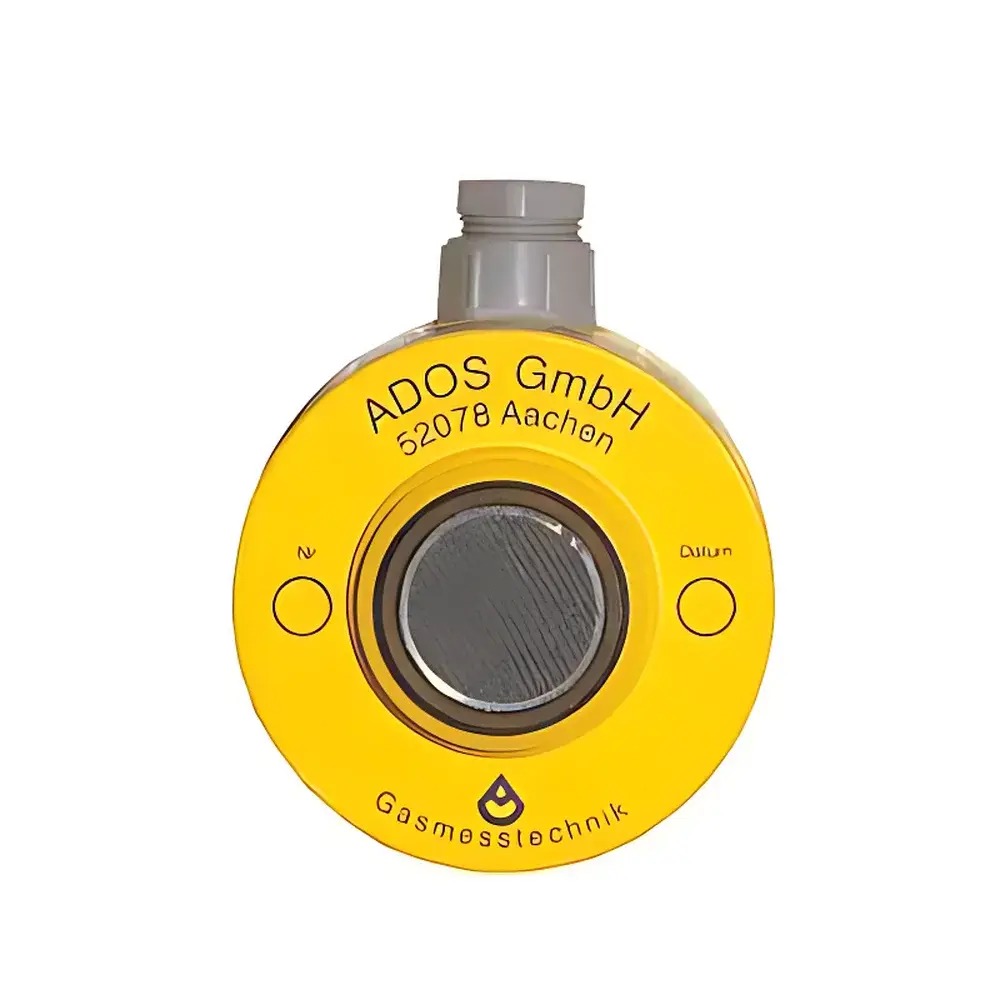
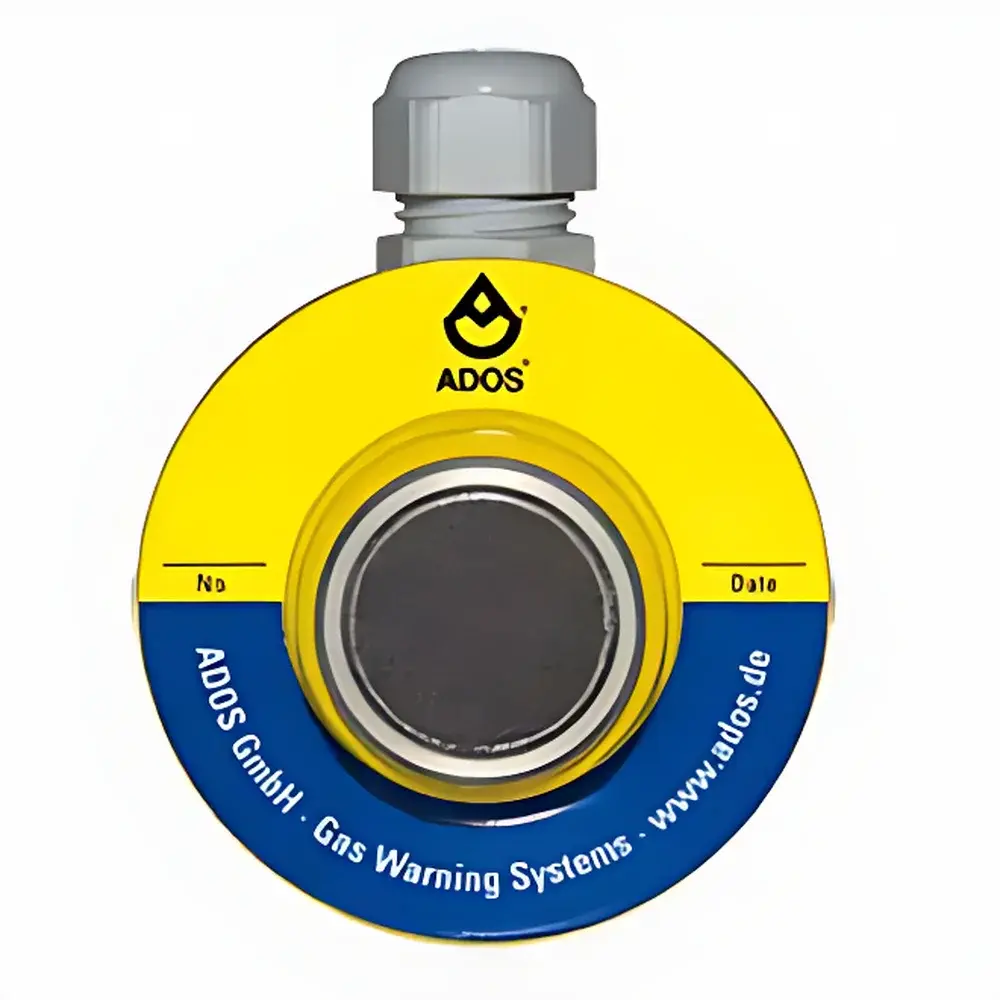
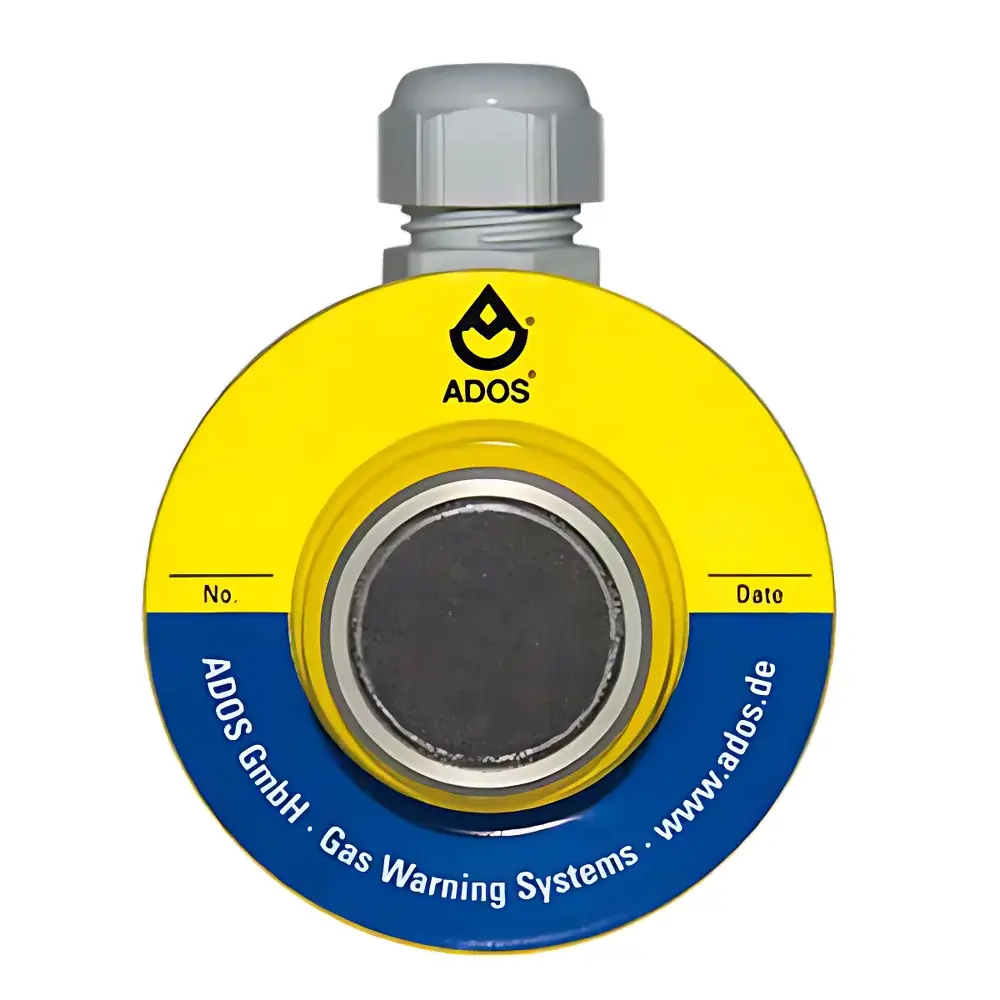
ADOS TOX592 Toxic Gas Transmitter
| Brand | ADOS |
|---|---|
| Origin | Germany |
| Model | TOX 592 |
| Instrument Type | Single-Channel Electrochemical Gas Transmitter |
| Measurement Principle | Amperometric Electrochemistry |
| Measurable Gases | CO (0–300 ppm), NH₃ (0–200 ppm), NO₂ (0–30 ppm), SO₂ (0–50 ppm), H₂S (0–20 ppm), O₃ (0–5 ppm) |
| Zero Error | <10 ppm CO |
| Baseline Drift | <2% per year |
| Accuracy | ±3% of full scale |
| Linearity | <2% of full scale |
| Response Time (t₉₀) | <60 s |
| Cross-Sensitivity | <2% with integrated filter |
| Output | 0–4–20 mA (2-wire) or LON® (4-wire, 78 kbps) |
| Supply Voltage | 15–30 V DC (max. load 100–500 Ω) |
| Operating Temperature | –10°C to +40°C (with sensor temperature compensation) |
| Humidity Range | 10–99% RH (non-condensing) |
| Sensor Lifetime | ~2 years |
| Sensor Dimensions | Ø80 mm × H80 mm |
| Weight | 600 g |
| Compliance | VDI 2053 (Germany), EN 45544-1/-2, IEC 60079-29-1 (for hazardous area variants, optional) |
Overview
The ADOS TOX 592 is a precision electrochemical toxic gas transmitter engineered for continuous, real-time monitoring of hazardous gases in ambient air. Designed and manufactured in Germany, it operates on the principle of amperometric electrochemistry—where target gas molecules diffuse through a selective membrane into an aqueous electrolyte, initiating a stoichiometric redox reaction at working and counter electrodes. The resulting current is linearly proportional to gas concentration and is converted into a standardized analog (4–20 mA) or digital (LON®) output signal. Its robust architecture supports deployment in demanding environments including vehicle test bays, laboratory workspaces, industrial control rooms, and civil defense shelters—where regulatory compliance with VDI 2053 and occupational exposure limit (OEL) enforcement is mandatory.
Key Features
- Multi-gas capability with field-selectable configurations: CO (0–300 ppm), NH₃ (0–200 ppm), NO₂ (0–30 ppm), SO₂ (0–50 ppm), H₂S (0–20 ppm), and O₃ (0–5 ppm)
- High-stability electrochemical sensors with integrated temperature compensation and hydrophobic particulate filter
- Low zero error (<10 ppm CO) and long-term baseline stability (<2% drift/year), minimizing calibration frequency
- Dual-output interface: 2-wire 4–20 mA loop-powered transmission or 4-wire LON® protocol (78 kbps) for integration into building management systems (BMS) or ADOS 914CP central controllers
- Wide operating range: –10°C to +40°C ambient temperature and 10–99% RH (non-condensing), validated under DIN EN 60068 environmental stress testing
- Compact, IP65-rated housing (Ø80 mm × 80 mm height, 600 g) suitable for wall-mounting or duct integration
- Compliant with EN 45544-1/-2 for workplace gas detection performance and IEC 60079-29-1 for optional ATEX-certified variants (Zone 1/21)
Sample Compatibility & Compliance
The TOX 592 is optimized for ambient air sampling without active aspiration—relying on passive diffusion for representative measurement of low-concentration toxicants. It meets VDI 2053 requirements for garage ventilation control systems, ensuring accurate CO tracking against statutory threshold limits (e.g., 30 ppm ceiling value over 8-hour TWA). All sensor modules are individually calibrated and traceable to NIST-equivalent reference standards. Device firmware and hardware design support GLP-aligned operational documentation, including configurable alarm thresholds, event logging, and diagnostic status reporting—enabling audit readiness for ISO 17025-accredited laboratories and EU REACH-compliant facilities.
Software & Data Management
While the TOX 592 itself is a stand-alone analog/digital transmitter, its outputs integrate natively with ADOS 914CP central monitoring units or third-party SCADA platforms via Modbus RTU (via optional gateway) or native LON® network topology. When connected to ADOS 914CP, data is timestamped, stored with 30-day circular buffer memory, and exportable as CSV for trend analysis. Alarm events—including sensor fault, signal loss, or concentration exceedance—are relayed with priority tagging and support configurable escalation protocols (e.g., email/SMS via external middleware). Firmware updates follow secure signed-package procedures compliant with IEC 62443-3-3 security levels for industrial control systems.
Applications
- Automotive test cell and underground parking ventilation control per VDI 2053
- Occupational health monitoring in chemical laboratories, paint booths, and battery manufacturing zones
- Civil protection infrastructure: air quality surveillance in bunkers, command centers, and emergency shelters
- Indoor air quality (IAQ) assurance in schools, hospitals, and public administration buildings
- Process safety interlocks for solvent storage areas where SO₂ or H₂S leakage poses acute inhalation risk
- Research-grade validation of catalytic converter efficiency via real-time tailpipe CO profiling (when paired with sampling probe)
FAQ
What gases can the TOX 592 measure, and are custom ranges available?
The standard configuration supports CO, NH₃, NO₂, SO₂, H₂S, and O₃ across defined ppm ranges. Custom sensor modules and extended ranges (e.g., CO up to 5000 ppm) are available upon request and subject to electrochemical cell compatibility assessment.
Does the TOX 592 require periodic calibration, and what is the recommended interval?
Yes—initial calibration is performed at the factory using certified gas standards. Field verification is recommended every 6 months; full recalibration is advised annually or after exposure to extreme contamination, condensation, or mechanical shock.
Can the TOX 592 be used in explosion-hazardous areas?
The base model is rated for non-hazardous locations. ATEX-certified versions (II 2G Ex ib IIC T4 Gb / II 2D Ex ib IIIC T135°C Db) are available as optional configurations—consult ADOS technical documentation for zone-specific installation guidelines.
How does temperature compensation affect measurement accuracy?
Integrated thermistor-based compensation corrects for thermal drift across the –10°C to +40°C operating envelope, maintaining linearity within ±2% of full scale without external correction algorithms.
Is the LON® interface compatible with BACnet or Modbus-based building automation systems?
Native LON® communication requires a LON-to-BACnet or LON-to-Modbus gateway (e.g., Echelon i.LON or Siemens Desigo CC). Analog 4–20 mA output provides direct compatibility with most legacy DDC controllers.
Related Products







