
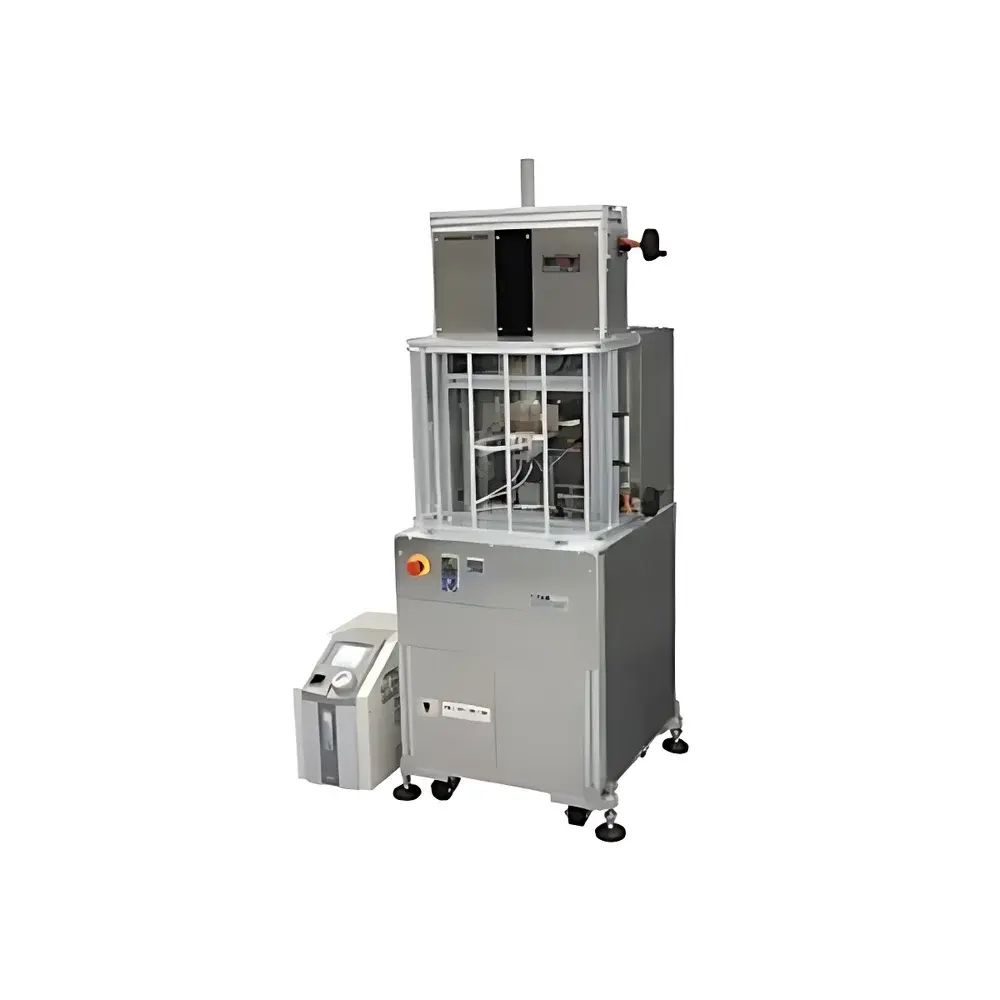
ADVANCE RIKO F-CAL Low-Thermal-Resistance Substrate Thermal Conductivity Evaluation System
| Brand | ADVANCE RIKO |
|---|---|
| Origin | Japan |
| Model | F-CAL |
| Measurement Principle | Heat Flow Method |
| Thermal Resistance Range | 1×10⁻⁵ m²·K/W |
| Repeatability | <2% fluctuation |
| Test Atmosphere | Ambient air |
| Hot-Side Temperature Setting | 50°C |
| Sample Geometry | Square, 25 mm or 40 mm edge length, thickness 1–5 mm |
| Instrument Type | Steady-State Thermal Resistance Analyzer |
Overview
The ADVANCE RIKO F-CAL Low-Thermal-Resistance Substrate Thermal Conductivity Evaluation System is a precision steady-state thermal resistance analyzer engineered for quantitative characterization of high-conductivity thin films and multilayer substrate structures—materials that fall outside the reliable measurement range of conventional laser flash analyzers (LFA) or transient plane source (TPS) instruments. Based on over six decades of ADVANCE RIKO’s expertise in thermal metrology, the F-CAL implements a guarded heat flow method: a thermally stabilized hot block makes direct, uniform contact with the sample’s upper surface, while a dual-function cold block—integrating active cooling and calibrated heat flux sensing—contacts the lower surface. Under controlled steady-state conditions, the system measures the absolute heat flow rate (W) across the sample, enabling direct calculation of thermal resistance (Rth = ΔT / Q) and, when combined with geometric parameters, effective thermal conductivity (k = d / (Rth × A)). This architecture eliminates assumptions about thermal diffusivity or optical absorption, making it especially suitable for opaque, reflective, or highly anisotropic substrates where LFA yields ambiguous or non-convergent results.
Key Features
- Steady-state heat flow measurement with traceable calibration against NIST-traceable reference standards
- Dual-zone temperature control: independently regulated hot-side setpoint (fixed at 50°C) and actively cooled cold-side block ensuring stable thermal gradient
- Integrated heat flux sensor with high linearity (<0.5% nonlinearity) and low drift (<0.1% per hour)
- Modular sample stage accommodating two standard configurations: 25 mm × 25 mm and 40 mm × 40 mm square samples, thickness 1–5 mm
- Ambient-air testing environment—no vacuum chamber or gas purging required—reducing operational complexity and cost of ownership
- Robust mechanical design with precision-machined copper blocks and low-contact-resistance interface materials to minimize parasitic thermal shunts
Sample Compatibility & Compliance
The F-CAL is validated for use with electrically and optically heterogeneous substrates commonly encountered in advanced packaging, power electronics, and thermal interface material (TIM) development. It supports evaluation of metal-coated ceramics (e.g., AlN/Al, SiC/Cu), carbon-reinforced polymer laminates, anisotropic graphite films, and semiconductor-on-metal hybrid structures. All measurements comply with ASTM E1530 (Standard Test Method for Measuring Thermal Resistance of Materials by Means of the Guarded Heat Flow Meter Technique) and align with ISO 22007-2 for steady-state thermal resistance determination. The system’s architecture satisfies GLP documentation requirements for traceability, including full audit logs of temperature setpoints, heat flux readings, ambient conditions, and operator metadata—supporting FDA 21 CFR Part 11 readiness when integrated with compliant laboratory information management systems (LIMS).
Software & Data Management
The F-CAL is operated via ADVANCE RIKO’s proprietary ThermalStudio™ software, a Windows-based platform supporting real-time monitoring of hot- and cold-block temperatures, heat flux signals, and convergence diagnostics. Software features include automated thermal equilibrium detection (based on <0.02°C/h drift threshold), batch processing for multi-sample runs, and export of raw time-series data in CSV and HDF5 formats. Calibration certificates—including uncertainty budgets per GUM (JCGM 100:2008)—are embedded in measurement reports. Data files retain full provenance: instrument ID, firmware version, calibration date, environmental timestamp, and user-defined sample identifiers. Optional API integration enables synchronization with enterprise MES or QMS platforms for automated quality gate reporting.
Applications
- Thermal resistance screening of metal-backed dielectric layers in GaN-on-SiC RF modules
- Quantification of interfacial thermal resistance (Kapitza resistance) in Cu–diamond composite heat spreaders
- Process validation of sputtered AlN thin films on silicon wafers for MEMS packaging
- Quality control of anisotropic pyrolytic graphite (APG) thermal interface sheets used in EV battery modules
- Development and benchmarking of next-generation TIMs for high-power LED substrates
FAQ
Can the F-CAL measure absolute thermal conductivity (k-value), or only thermal resistance?
The F-CAL directly measures thermal resistance (Rth). When sample thickness (d) and cross-sectional area (A) are known, k is calculated as k = d / (Rth × A). No assumption about material homogeneity is required.
Is vacuum or inert gas required for testing?
No. The system operates in ambient air and is optimized for convective stability under standard lab conditions (23 ± 2°C, 40–60% RH).
What is the minimum detectable thermal resistance?
The system achieves a resolution of 1×10⁻⁵ m²·K/W, corresponding to effective conductivities >300 W/m·K for 1-mm-thick, 25-mm-square samples.
Does the F-CAL support custom sample holders or non-standard geometries?
Yes—custom fixtures for circular or irregular shapes can be designed and validated per ISO/IEC 17025 procedures; contact ADVANCE RIKO Applications Engineering for qualification protocols.
How is calibration maintained between accredited labs?
Each unit ships with a certified reference sample (CRS) traceable to NMI-Japan (National Metrology Institute of Japan); annual recalibration follows ISO/IEC 17025-accredited procedures at ADVANCE RIKO’s Yokohama facility.



